Menu


Is Rearranging Your Furniture Putting Your Cooling System at Risk?
Did that new living room layout just put your air conditioner on a crash course for a catastrophic breakdown? You are probably asking yourself, does furniture placement over house vents really ruin compressors? The short answer is yes, and the mechanical reality behind this common household mistake is far more severe than most homeowners realize. It is incredibly common to shift couches, bookshelves, and rugs around during back-to-school room updates or late-summer rearranging. Unfortunately, when you slide a heavy piece of furniture directly over a floor register, you are not just redirecting the air to another room—you are fundamentally altering the pressure dynamics of your entire cooling system.
During periods of heavy late-summer August cooling, your system is already working at its maximum capacity. Choking off its air supply is a leading cause of sudden, catastrophic equipment failure. To keep your whole-home comfort consistent and protect your investment, you need a properly breathing system. If you want to ensure your air conditioning is operating safely, or if you need professional HVAC services to assess potential damage from restricted airflow, taking action now is critical.
What Actually Happens When You Cover a Vent?
When you ask what happens if you cover a vent, the answer comes down to a sudden, dramatic spike in static pressure within your ductwork. Air vents for house systems are not just random holes in the floor; they are precisely balanced to deliver a specific volume of air, measured in cubic feet per minute (CFM). When the system is designed, the ductwork and blower motor are calibrated to push and pull a precise amount of air through these openings.
When you block supply or return vents, that carefully calculated air gets trapped. The blower motor must suddenly work exponentially harder against this trapped air. It is like trying to breathe out forcefully while holding your hand tightly over your mouth. The immediate result is severe mechanical strain on the blower motor, which can quickly overheat and fail. We see these patterns frequently in Cornelius OR homes with floor registers, where older layouts often tempt homeowners to place heavy furniture right over the grilles.
One local homeowner recently reached out about a messy and outdated HVAC system that finally stopped working altogether. When a technician cleaned up and replaced the old HVAC system, it became clear that years of poor airflow management and blocked registers had compounded the mechanical strain on the system's components, drastically shortening its lifespan. The blower motor is usually the first component to suffer, which is exactly why blocking house vents damages your blower motor before the compressor even gets involved.
• Vents Fully Open — Static Pressure: Normal / Balanced — Blower Motor Strain: Standard Operation — Evaporator Coil Temperature: Above Freezing (Absorbing Heat)
• 1-2 Vents Blocked — Static Pressure: Elevated — Blower Motor Strain: Working Harder / Running Hot — Evaporator Coil Temperature: Dropping Toward Freezing
• Multiple Vents Blocked — Static Pressure: Dangerously High — Blower Motor Strain: Overheating / Risk of Burnout — Evaporator Coil Temperature: Below Freezing (Solid Ice Forming)
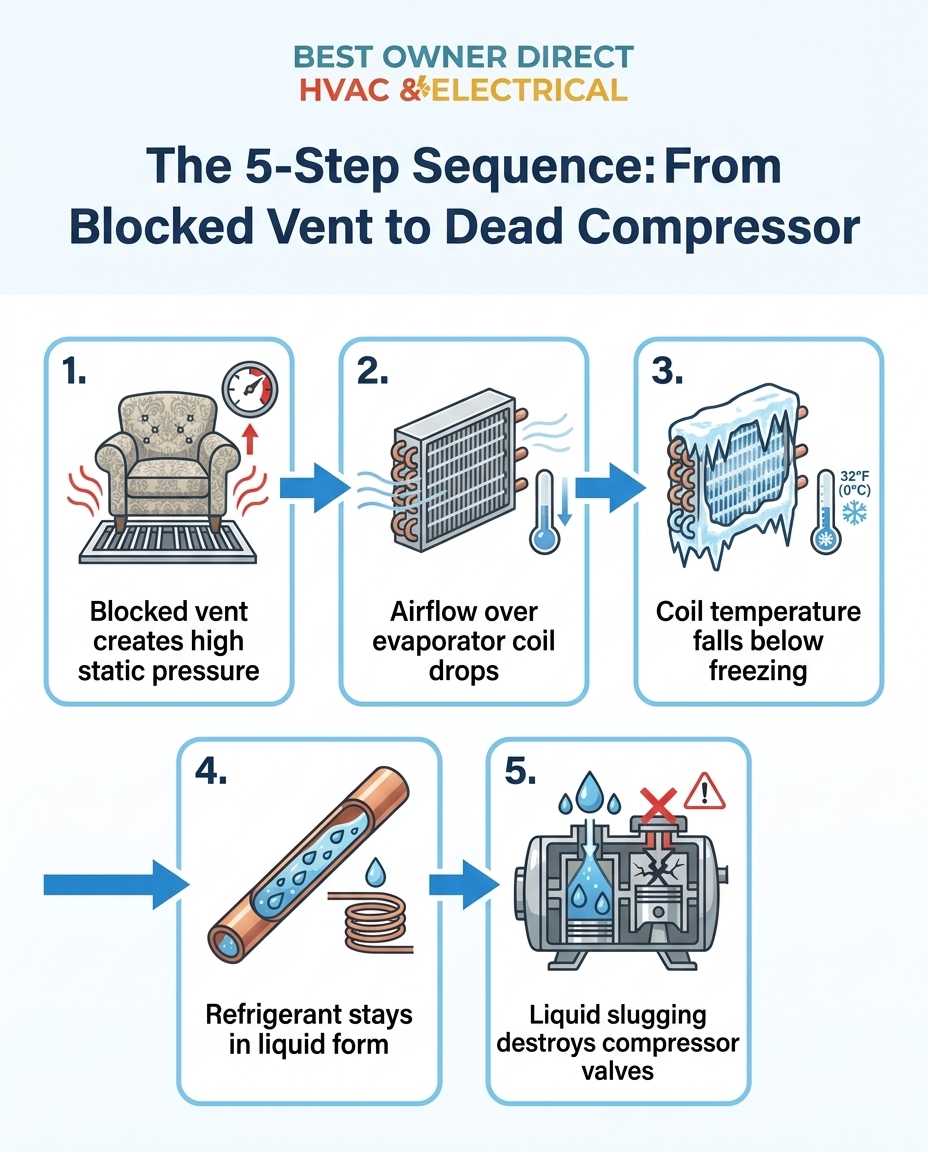
The 5-Step Sequence: How a Blocked Vent Kills a Compressor
The journey from a blocked floor register to a dead outdoor unit is a precise, predictable mechanical chain reaction. Standard residential split-system AC compressors are incredibly durable when operated correctly, but they are highly vulnerable to this specific sequence of events.
1. Step 1: Blocked Vent Increases Static Pressure. A couch or thick rug creates a physical barrier. The air that was supposed to enter the room is now trapped in the ductwork, immediately raising the internal static pressure of the system.
2. Step 2: Reduced Airflow Over the Evaporator Coil. Because the air cannot escape the supply vents, the blower motor cannot push new air across the indoor evaporator coil. The system is suddenly starved of the warm indoor air it needs to function.
3. Step 3: The Evaporator Coil Freezes. The refrigerant inside your indoor coil is freezing cold. It relies on the constant flow of warm indoor air to absorb heat. Without that warm airflow, the condensation on the outside of the coil drops below freezing and turns into a solid block of ice.
4. Step 4: Liquid Refrigerant Returns to the Outdoor Unit. Refrigerant is supposed to absorb heat inside the house, boiling from a liquid into a gas before traveling back outside. Because the coil is encased in ice, no heat is absorbed. The refrigerant remains in a liquid state as it travels down the copper line back to the outdoor unit.
5. Step 5: Liquid Slugging Destroys the Compressor. The outdoor compressor receives the returning refrigerant. Because it is expecting a gas but receives a liquid, it attempts to compress an incompressible substance. This results in immediate, catastrophic mechanical failure.
The Physics of Liquid Slugging Explained
To truly understand why a blocked vent is so dangerous, you have to look at the thermodynamics of how an air conditioner moves heat. Standard residential split-system AC compressors are specifically engineered for one job: to pump and compress vapor. They are not liquid pumps. This distinction is the core reason why restricted airflow is fatal to your outdoor unit.
The Incompressibility of Liquids
In physics, gases can be compressed into smaller volumes, but liquids are physically incompressible. When your system is operating normally, the refrigerant enters the outdoor compressor as a warm gas. The compressor squeezes this gas, raising its temperature and pressure so that the heat can be exhausted into the outdoor air. The internal pistons, valves, and connecting rods are designed strictly for the resistance provided by a gas.
The Mechanical Violence of Slugging
When an evaporator coil freezes due to blocked vents, the refrigerant never absorbs enough heat to boil into a gas. It travels back outside as a liquid. When this liquid hits the compressor cylinders, a phenomenon known as "liquid slugging" occurs. The compressor attempts to squeeze the liquid, but because the liquid cannot be compressed, the extreme hydraulic pressure has to go somewhere.
The result is immense mechanical violence. The internal valves blow out, the connecting rods shatter, and the compressor is instantly destroyed. As an owner-direct business, Best Owner Direct HVAC & Electrical focuses on honest, straightforward education to help homeowners understand the mechanics of liquid slugging and avoid these complete system replacements, rather than waiting for systems to fail. This is not a gradual wear-and-tear issue where the system slowly loses efficiency over years. It is a sudden, fatal mechanical event that requires replacing the entire compressor—or often, the whole outdoor unit.
Why Late-Summer Furniture Rearranging is Particularly Dangerous
The timing of furniture rearranging often plays a cruel role in compressor failures. As families prepare for the back-to-school season, bedrooms are reorganized, desks are moved, and living spaces are updated. During this process, it is incredibly easy to inadvertently slide a heavy bookshelf or a low-profile sofa directly over a floor register.
The problem: This rearranging frequently coincides with intense late-summer heatwaves in Cornelius OR, which drastically compounds the strain on systems. During these high-heat periods, your cooling system is likely running continuously for hours at a time to keep up with the thermostat setting.
The cause: When a system cycles on and off normally, a slightly restricted coil might have a few minutes to thaw out while the AC is resting. But during heavy late-summer August cooling, the system never gets a break. The compressor runs continuously, meaning the frozen coil gets thicker and thicker with ice.
The solution: Because there is zero thaw time between cycles, the timeline from a blocked vent to complete liquid slugging is dramatically accelerated. What might take weeks to cause a problem in mild spring weather can destroy a compressor in a matter of days during a late-summer heatwave. The only way to prevent this is to ensure every vent is fully exposed and breathing freely before the peak heat sets in.
Minimum Clearances: How to Properly Arrange Furniture Around Vents
Protecting your equipment does not mean you can never change your room layout. It simply requires following strict clearance rules to ensure your ductwork can breathe. Maintaining proper static pressure is the easiest way to extend the lifespan of your cooling equipment.
• Maintain the 18-Inch Rule: Industry standards dictate a minimum of 18 inches of unobstructed clearance above and around all floor and low-wall registers. This allows the air to form a proper "cone" of dispersion as it enters the room.
• Use Raised Legs: If you must place a couch or chair over a vent, ensure the piece of furniture has raised legs. A sofa sitting flush against the carpet will completely block the airflow. Legs that lift the frame at least 6 to 8 inches off the ground can allow air to escape, though 18 inches is still the ideal standard.
• Avoid Heavy Rugs: Never place a dense area rug over any portion of a vent grille. Even partially covering a vent forces the air backward, increasing static pressure in the duct run.
• Keep Bookshelves Clear: Solid, flat-bottomed furniture like bookshelves or dressers should never be positioned over a register. The blockage is absolute, and the backpressure is immediate.
• Schedule Professional Testing: If you live in an older home with awkward vent placements, have a professional evaluate your system's static pressure during routine HVAC maintenance. A technician can measure the exact airflow and tell you if your ductwork is breathing properly or if modifications are needed.
We see many Cornelius OR homes with floor registers where the layout makes furniture placement difficult. If you absolutely cannot avoid covering a vent, you must consult a professional about potentially capping that duct run or rebalancing the system, rather than just throwing a rug over it and hoping for the best.
Frequently Asked Questions About HVAC Airflow and Blocked Vents
Understanding how air moves through your home is the best defense against accidental mechanical failures. Here are the most common questions homeowners have about airflow, vents, and system protection.
What happens if you cover a vent?
Covering a vent immediately increases the static pressure inside your ductwork and strains your blower motor. When the air cannot escape, the blower has to push against a wall of trapped air, which can cause the motor to overheat and fail. Furthermore, it starves the indoor coil of the warm air it needs, leading to frozen coils, liquid refrigerant returning to the outdoor unit, and eventual compressor destruction.
Can you put a couch over a floor vent?
Only if the couch has tall legs that provide at least 18 inches of clearance above the vent. Couches that sit flush against the floor will completely block airflow, acting like a solid wall over your ductwork. This blockage leads directly to frozen evaporator coils and potential liquid slugging in the compressor. If your couch sits low to the ground, it must be moved away from the register entirely.
Does closing vents break the AC?
Yes, closing too many vents increases static pressure in the ductwork, which severely reduces airflow over the evaporator coil. Many homeowners close vents in unused rooms thinking it saves energy, but it actually forces the system to work harder. This restriction can cause the indoor coil to freeze solid and send liquid refrigerant back to the compressor, destroying its internal valves.
How much clearance does a floor vent need?
Industry standards dictate a minimum of 18 inches of unobstructed clearance above and around a floor vent. This clearance allows the conditioned air to properly disperse into the room without creating harmful backpressure on the blower motor. Standard residential split-system AC compressors rely on this free-flowing air to ensure the refrigerant boils into a gas before returning outside.
Will a blocked return vent ruin my compressor?
Absolutely. Blocking a return vent starves the entire system of air, leading to the exact same freezing and liquid slugging sequence as a blocked supply vent. While supply vents blow air out, return vents suck air in. If the return is blocked by a bookshelf or a heavy curtain, the system suffocates, the coil freezes, and the compressor is put in immediate danger.
How can I tell if my evaporator coil is freezing due to blocked vents?
Signs include significantly reduced airflow from your registers, warm air blowing during a cooling cycle, and visible ice forming on the copper refrigerant lines outside. You might also notice water pooling around your indoor furnace unit as the ice slowly melts. If you notice any of these signs, turn off the system immediately at the thermostat and check every room for blocked vents.
Protect Your Equipment Before the Season Ends
A simple, aesthetic furniture rearrangement is never worth the cost of a destroyed compressor. The physics of liquid slugging are unforgiving, and the damage happens in an instant. Before you finalize your back-to-school room layouts or settle into a new living room arrangement, take ten minutes to walk through your home. Verify that every single supply and return vent is completely clear of rugs, couches, boxes, and curtains.
If you have been running your system with blocked vents during heavy late-summer August cooling and you notice a drop in performance, the damage may already be starting. Do not wait for the compressor to fail entirely. Reach out to a professional to check your static pressure, evaluate your blower motor, and ensure your system is breathing exactly as it was engineered to.


Does Furniture Placement Over House Vents Really Ruin Compressors?Rearranging furniture over floor vents might seem harmless, but it severely chokes AC airflow. Understand the mechanical reality of this mistake before it triggers a catastrophic compressor failure.
Read more

The First Furnace Test of Fall: What to Listen ForThat initial September startup can bring a wave of anxiety when your heater emits strange noises. We explain which expansion pops are harmless and which grinds require an immediate shutdown.
Read more
How to Diagnose and Fix Heat Pump Ice Buildup: Simple StepsLearn how to diagnose heat pump ice buildup causes and what to do with simple DIY steps, from normal frost to heavy ice, plus when to call a pro.
Read more