Menu

Why Is Your Furnace Blowing Warm Air Instead of Hot?
Are you staring at your vents and wondering, "Why is my furnace blowing warm air but not hot?" You are certainly not alone. As September brings that familiar damp, chilly Pacific Northwest weather into the region, many homeowners are turning on their heating systems for the first time since spring. Feeling lukewarm air coming from your vents instead of a robust blast of heat can be frustrating and immediately concerning.
Noticing this subtle difference between warm and fully hot air early is actually a great catch on your part. Paying attention to these early warning signs can prevent much larger system failures down the road. The issue you are experiencing could range from completely normal multi-stage operation to a dirty internal sensor that requires professional attention. Understanding how your equipment operates is the very first step to resolving the issue before the deep winter cold sets in.
For comprehensive help with all your HVAC systems, trust our experts for professional heating repair.
Understanding Multi-Stage Heating: When Warm Air is Actually Normal
Before assuming your system is broken, it helps to understand exactly what type of equipment is installed in your home. Many modern heating systems are designed to deliver heat in stages rather than blasting at full capacity the moment they turn on. This is called multi-stage heating, and it is specifically engineered to improve your comfort and lower your energy consumption.
The First Stage: Gentle Warming
If you have a two-stage or modulating furnace, the system is designed to operate at roughly 60% to 65% capacity during its initial first stage. When the thermostat calls for heat, the system intentionally activates at this lower setting. Because the burners are not firing at maximum capacity, the air coming out of your vents will feel warm, but not piping hot.
This lower capacity conserves energy and provides a gentler, more consistent heat distribution throughout the house. It prevents the "blast of hot air followed by a sudden chill" cycle that older, single-stage units are known for.
The Second Stage: Full Heat
The staging sequence is controlled by your thermostat and the furnace's internal control board. If the first stage runs for a set period (usually 10 to 15 minutes) and the indoor temperature still has not reached the thermostat's set point, the system will automatically kick into the second, hotter stage. At this point, the burners open up to 100% capacity, and the air blowing from the vents will become noticeably hotter.
How to Test Your Staging
To determine if you are simply feeling the first stage of a normal heating cycle, observe your system for 15 minutes after it turns on.
• Turn the heat up: Set the thermostat three to four degrees higher than the current room temperature to force a heavy demand.
• Wait and feel: Stand near a supply vent and wait 10 to 15 minutes.
• Note the change: If the air temperature increases significantly after that time, your system is staging correctly. If it stays lukewarm indefinitely, you likely have a mechanical or airflow issue.
• Runs for 5 minutes, air is mild — Air Temperature at Vent: Warm (~90°F) — Diagnosis: Normal (Stage 1 operation)
• Runs for 15+ minutes, air gets hotter — Air Temperature at Vent: Hot (110°F - 120°F) — Diagnosis: Normal (Stage 2 kicked in)
• Runs continuously, air never gets hot — Air Temperature at Vent: Warm or Cool — Diagnosis: Malfunction (Requires troubleshooting)
4 Common Culprits Behind a Furnace Not Reaching Peak Heat
If you have ruled out normal multi-stage operation, it is time to look at the physical components of your heating system. Several primary mechanical and user-error reasons can cause lukewarm airflow. Understanding how each component contributes to the temperature of the air delivered to your living spaces can help you pinpoint the problem. These issues generally fall into two categories: airflow restrictions and internal sensor failures. Both are common warning signs your furnace is malfunctioning.
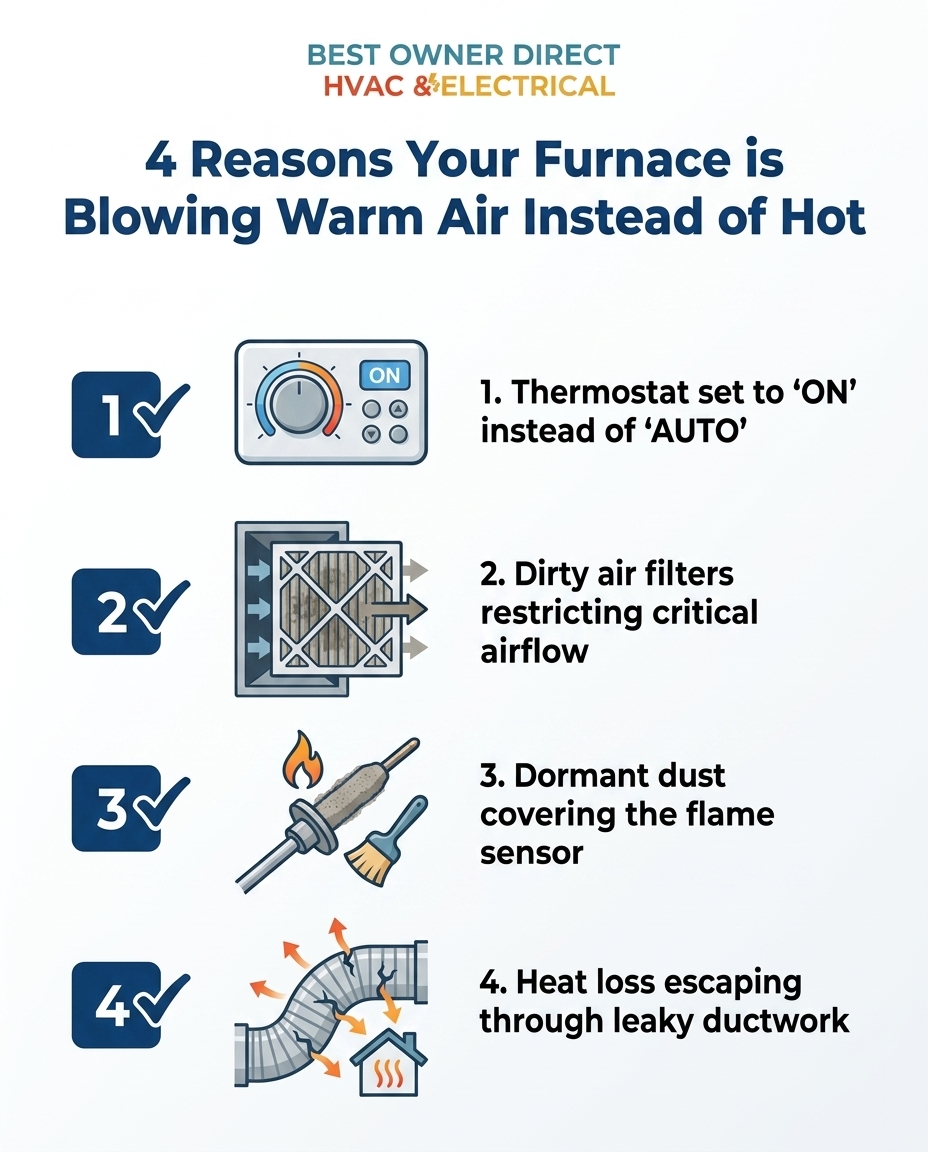
1. Thermostat Fan Settings (ON vs. AUTO)
The quick check: Look at your thermostat display right now. Is the fan setting switched to "ON" or "AUTO"?
Setting the fan switch to "ON" forces the blower motor to run continuously, 24 hours a day, regardless of whether the gas burners are actually firing. When the heating cycle finishes and the burners shut off, the fan keeps pushing air through the ductwork. Because the air is no longer being heated, you will feel room-temperature air blowing from the vents, which often feels cool or lukewarm against your skin. Switching the setting back to "AUTO" ensures the fan only runs when the system is actively heating the air.
2. Dirty Air Filters Restricting Airflow
The quick check: Pull out your air filter and hold it up to a light source. If you cannot see light shining through the media, it is clogged.
Clogged filters are a leading cause of HVAC inefficiency and poor heating performance. Your furnace requires a specific volume of air to pass over the heat exchanger to function properly. When a thick layer of dust, pet dander, and debris blocks the filter, it severely restricts this critical airflow. The system struggles to pull enough air into the cabinet, which prevents the heat exchanger from transferring heat properly to the living spaces. The limited air that does make it through often feels weak and less warm than it should.
3. Dormant Dust on Flame Sensors
The quick check: Does the furnace ignite, blow warm air for just a few seconds, and then shut the burners off while the fan keeps running?
The flame sensor is a vital safety device located inside the burner assembly. Its job is to detect whether a flame is actually present when the gas valve opens. Over the long summer months when your heating system sits idle, this small metal rod gathers a layer of dormant dust and light oxidation. When you fire up the system in the fall, that dust acts as an insulator. The dirty sensor fails to read the microamps of the flame, assumes there is no fire, and immediately shuts down the gas valve for safety. The blower fan will continue to run to clear any residual gas, resulting in a continuous flow of cool or lukewarm air.
4. Heat Loss Through Leaky Ductwork
The quick check: Walk through your home and see if some rooms receive hot air while others only receive lukewarm air.
Your ductwork is the delivery highway for your home's comfort. If those ducts have disconnected joints, cracks, or lack proper insulation, the hot air produced by the furnace will literally escape into your walls, attic, or crawlspace before it ever reaches your vents. This is especially problematic during early fall cold snaps in the Pacific Northwest. Unconditioned attics or crawlspaces can rapidly cool down the air traveling through poorly insulated ducts. By the time the air is pushed out into your living room, it has lost a significant amount of heat and feels lukewarm.
The Link Between Restrictive Filters and Tripped Limit Switches
To truly understand why a lack of airflow results in lukewarm air, we need to look at another critical safety component: the high-limit switch. The limit switch is a temperature probe located just above the heat exchanger. Its primary function is to shut off the gas burners if the internal temperature of the furnace cabinet gets dangerously high.
When you install a highly restrictive high-MERV filter, or if you let a standard filter become severely clogged with dust, you trap the heat inside the unit. The blower motor cannot push the hot air out into your ductwork fast enough. The heat exchanger rapidly overheats, and the high-limit switch trips, instantly cutting power to the gas burners to prevent a fire hazard or cracked metal.
Here is where the lukewarm air comes in: when the limit switch trips, the system's logic board forces the blower fan to continue running. The fan runs continuously to cool down the overheated heat exchanger. Because the burners are off, the fan is simply circulating unheated, room-temperature air through your vents.
Repeatedly tripping the limit switch is terrible for your equipment. A returning customer recently called us out because their system was blowing unheated air and the fan seemed faulty. We arrived the same day, checked the electrical circuits, and discovered the constant overheating from restricted airflow had damaged the blower fan motor. We replaced the fan with a stock part we had on hand, getting their system fully operational again. Addressing airflow issues early prevents this kind of cascading component failure.
Safe DIY Troubleshooting Before Calling a Technician
Before you pick up the phone to schedule a repair, there are several safe, simple steps you can take to resolve the issue without opening the furnace cabinet. Empowering yourself with these basic checks can save you time and ensure you aren't dealing with a simple user error.
1. Verify the thermostat settings: Check the thermostat screen to ensure it is explicitly set to "HEAT" and the fan switch is set to "AUTO", not "ON". It sounds simple, but accidental bumps to the thermostat happen all the time.
2. Inspect and replace the air filter: Pull the filter out and examine it. If it is visibly dirty, covered in gray dust, or hasn't been changed in over 90 days, replace it immediately with a fresh, clean filter. Ensure the arrows on the filter frame point toward the furnace unit.
3. Check the return and supply vents: Walk through every room in your home and ensure all vents are fully open. Move any rugs, heavy drapes, or furniture that might be blocking the grilles. Blocking vents increases static pressure and causes the system to overheat.
4. Check the breaker panel: Ensure the breaker switch dedicated to your heating system hasn't partially tripped. Firmly flip it completely off, then back to the "ON" position.
A strict warning regarding internal components: We strongly advise against attempting to clean flame sensors, test limit switches, or open the sealed combustion chamber without proper licensing and training. Modern heating equipment operates on high-voltage electricity and combustible gas. Tinkering with these internal safety mechanisms poses severe safety risks to your home and will almost certainly void your manufacturer warranties.
The Value of Honest Diagnostics for Staging and Sensor Issues
If you have completed the safe DIY checks and your vents are still pushing out lukewarm air, the issue likely lies with internal components like the flame sensor, limit switch, or the inducer motor. At this stage, professional intervention is required to safely test the electrical circuits, clean the sensors, and restore proper operation.
When you call a professional, the most important thing you can receive is an accurate, transparent diagnosis rather than an immediate sales pitch for a brand new system. One local homeowner reached out to us during the spring when their furnace suddenly stopped working right when they needed it. A technician arrived on time, quickly diagnosed a simple internal issue, and fixed it on the spot without trying to push an unnecessary replacement.
This is the core of our Owner Direct approach. Homeowners deserve honest diagnostics directly from experts without franchise middleman markups. A qualified technician will test the microamps on your flame sensor, check the temperature rise across the heat exchanger, and explain the findings clearly to you. You should only pay for the repairs you truly need. Many early fall heating issues are simple fixes when handled by a trustworthy team serving our local service areas.
Pre-Season Preparation: Defeating the Early Fall Chill
September is the critical window to resolve staging and temperature issues before the heavy heating season begins. Waiting until the first freezing night to discover your system can only produce lukewarm air puts your home at a severe disadvantage.
Routine system check-ups catch dormant dust accumulation, failing limit switches, and weak capacitors before they cause a complete breakdown. Preparing now means your system will be fully optimized and ready to combat the deep, damp cold of a Pacific Northwest winter without unexpected failures.
Being proactive rather than reactive with your home comfort systems ensures continuous warmth, lower energy bills, and a longer lifespan for your equipment. Scheduling routine heating maintenance in the early fall gives you peace of mind that when you turn the thermostat up, you will feel the hot air you expect.
Frequently Asked Questions About Furnace Air Temperature
Why is my heat running but blowing cool air?
This often happens if the thermostat fan is set to "ON" instead of "AUTO", causing the blower to run between heating cycles. When the burners cycle off, the fan continues to push unheated room-temperature air through the ductwork. It can also indicate a tripped limit switch or a dirty flame sensor shutting down the burners prematurely while the fan continues to run.
How do I make my furnace blow hotter air?
Ensure your air filter is clean to maximize airflow over the heat exchanger, allowing the system to transfer heat efficiently. Check that all supply and return vents in your home are completely open and unobstructed by furniture. If the air still feels weak, have a professional inspect the ductwork for heat loss, leaks, or disconnected joints in unconditioned spaces.
What happens if a flame sensor goes bad?
A faulty or dirty flame sensor will fail to detect the burner flame, causing the system to shut off the gas valve immediately as a safety precaution. Without gas, the burners cannot stay lit to heat the air. The furnace blower may continue to run to clear the cabinet, resulting in unheated air circulating continuously through the home.
Why is my gas furnace blowing warm air instead of hot?
If it is a multi-stage furnace, it may be operating normally in its lower, energy-saving first stage, which produces a gentler, warm heat. If the system never reaches full heat after 15 minutes, it could be due to severely restricted airflow, a failing limit switch, or a gas supply issue preventing the burners from reaching full capacity.
Can a high-MERV filter cause my furnace to blow cool air?
Yes, filters with a very high MERV rating can restrict airflow too much for older systems not designed to handle them. This severe restriction traps heat inside the unit, tripping the high-limit switch. Once the switch trips, the burners shut off, and the furnace blows unheated air to cool the internal components down.
Restore Your Home's Comfort with Expert Diagnostics
Ignoring lukewarm air from your vents is a gamble. What starts as a slightly chilly room in September can easily escalate into a larger, more expensive breakdown when winter weather hits its peak. Your heating system is trying to tell you that something is restricting its performance, whether that is a clogged filter, a dirty sensor, or a failing motor.
Don't wait for a complete system failure to take action. Reach out for a transparent, no-pressure evaluation of your heating equipment today. Our team is ready to provide the honest answers and efficient service you need. Schedule your professional heating repair now and ensure your home stays perfectly warm all season long.


Does Furniture Placement Over House Vents Really Ruin Compressors?Rearranging furniture over floor vents might seem harmless, but it severely chokes AC airflow. Understand the mechanical reality of this mistake before it triggers a catastrophic compressor failure.
Read more
The First Furnace Test of Fall: What to Listen ForThat initial September startup can bring a wave of anxiety when your heater emits strange noises. We explain which expansion pops are harmless and which grinds require an immediate shutdown.
Read more
How to Diagnose and Fix Heat Pump Ice Buildup: Simple StepsLearn how to diagnose heat pump ice buildup causes and what to do with simple DIY steps, from normal frost to heavy ice, plus when to call a pro.
Read more