Menu


Why Heat Pump Water Heater Energy Savings Explained Matters for Your Home Budget
Heat pump water heater energy savings explained in simple terms: these units move heat from the surrounding air into your water tank instead of generating heat from scratch — and that single difference makes them 2 to 3 times more efficient than a standard electric water heater, cutting most households' water heating bills by hundreds of dollars every year.
Quick answer for homeowners:
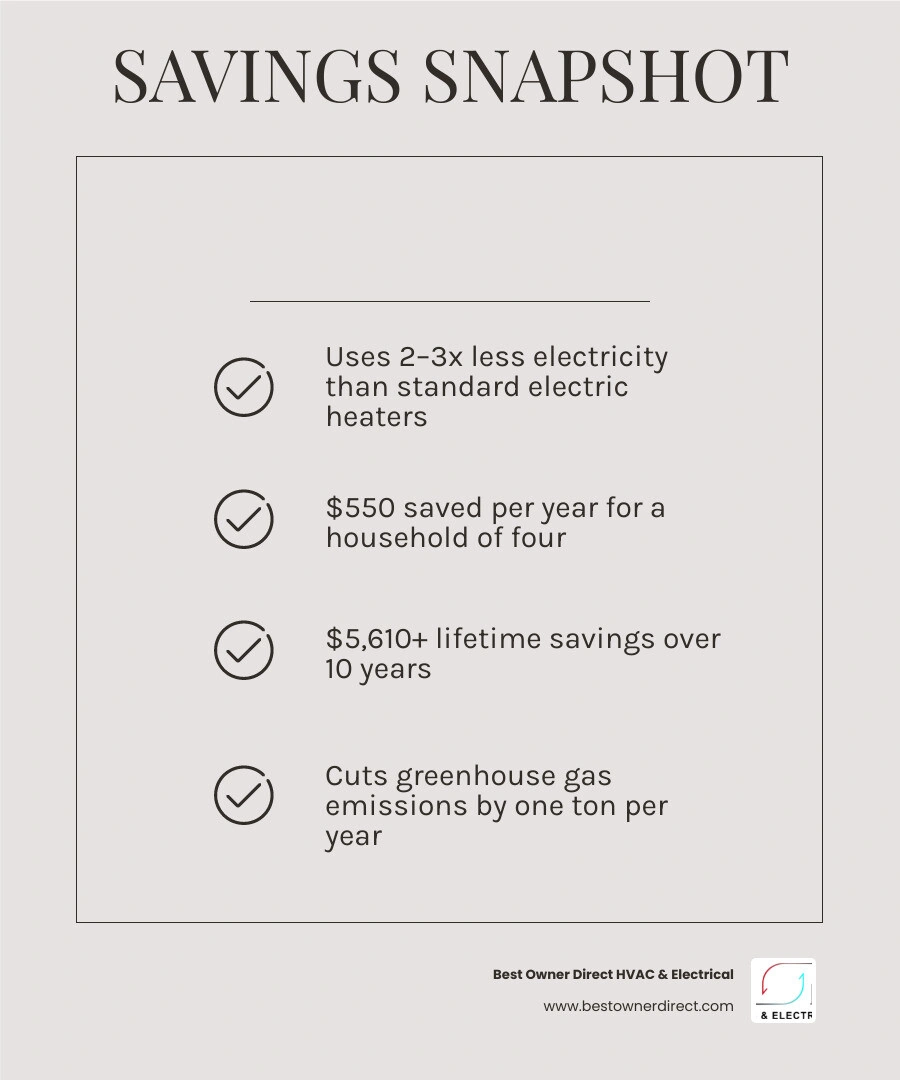
- Heat pump water heaters use up to 4 times less electricity than conventional electric models
- A typical household of four saves roughly $550 per year compared to a standard electric water heater
- Over the lifetime of the unit, that adds up to more than $5,610 in total savings
- Switching also reduces your home's greenhouse gas emissions by about one ton per year
- Federal tax credits and utility rebates can shorten the payback period to as little as one to three years
Water heating is the second-largest energy expense in most homes, accounting for roughly 18–20% of your total energy bill. Yet it's one of the easiest places to cut costs with the right equipment upgrade. If you're a homeowner in the Portland metro area trying to lower monthly utility bills without sacrificing comfort, understanding how these systems work — and what you can realistically save — is a great place to start.
Important heat pump water heater energy savings explained terms:
What is a Hybrid Water Heater and How Does It Work?
If you have ever stood behind a running refrigerator, you have probably felt the warm air blowing out from the bottom. A refrigerator works by pulling heat out from the inside of the fridge and dumping it into your kitchen.
A heat pump water heater (HPWH) — often called a hybrid water heater — does the exact same thing, just in reverse. Instead of cooling a small box, it pulls heat from the surrounding air in your basement, garage, or utility room and dumps it directly into your water tank.
This process relies on a clever refrigeration cycle that can be broken down into four main steps:
- The Evaporator: A quiet fan draws warm ambient air across an evaporator coil containing a cold, low-pressure liquid refrigerant. The refrigerant absorbs the heat from the air and turns into a gas.
- The Compressor: This gaseous refrigerant travels to a compressor. By squeezing the gas, the compressor dramatically raises its temperature and pressure.
- The Condenser: The hot gas passes through condenser coils wrapped around or submerged inside the water tank. The heat naturally transfers from the hot coils to your cold domestic water.
- The Expansion Valve: As the refrigerant loses its heat, it condenses back into a liquid and passes through an expansion valve, cooling down and returning to the start of the cycle to begin again.
Because these units combine this high-efficiency heat pump technology with standard backup electric resistance heating elements, they are known as "hybrid" systems. If there is a sudden, massive demand for hot water — like when you have houseguests taking back-to-back showers — the system can temporarily switch to standard electric elements to keep up.
To learn more about how these hybrid systems stack up against traditional models, take a look at our Heat Pump Water Heaters Complete Guide.
The Science Behind Heat Pump Water Heater Energy Savings Explained
The real magic of a hybrid water heater is found in its Coefficient of Performance (COP). In HVAC and plumbing, efficiency is all about how much energy you get out compared to how much you put in.
Traditional electric resistance water heaters have a maximum efficiency of 100%. This means that for every $1 worth of electricity they consume, they produce exactly $1 worth of heat. In reality, standby heat loss means they often deliver closer to 95 cents of hot water value per dollar spent.
A heat pump water heater, however, routinely achieves efficiencies of 300% to 400%. Because it is moving existing heat rather than creating it, it can deliver $3 to $4 of hot water value for every single dollar of electricity consumed. This massive reduction in electricity usage is the foundation of all hybrid water heater savings.
For a deeper dive into the physics of moving heat vs. creating it, you can read our Ultimate Heat Pump Water Heater Guide.
Heat Pump Water Heater Energy Savings Explained
When we talk about heat pump water heater energy savings explained, we are looking at a combination of immediate monthly utility reductions, long-term lifetime savings, and environmental benefits.
On average, switching from a standard electric tank to a hybrid model reduces the electricity used for water heating by up to 75%. For most families in our Oregon service areas — from Hillsboro and Beaverton down to Newberg and Oregon City — this translates to hundreds of dollars kept in your pocket every single year.
Over the typical 10- to 15-year lifespan of a hybrid water heater, those annual savings accumulate into thousands of dollars. But the benefits are not purely financial.
Because electricity generation in the United States still relies partially on fossil fuels, reducing your home's electricity usage directly shrinks your carbon footprint. In fact, replacing a standard electric water heater with a heat pump model prevents approximately one ton of greenhouse gas emissions from entering the atmosphere every year.
If every household in the country made the switch to an ENERGY STAR certified heat pump water heater, the collective energy cost savings would grow to about $8 billion annually, and we would prevent roughly 150 billion pounds of greenhouse gas emissions — equivalent to taking 14 million cars off the road!
To explore the full spectrum of advantages, check out our article on Heat Pump Water Heater Benefits for Homeowners.
Real-World Heat Pump Water Heater Energy Savings Explained by Household Size
Your actual savings will depend largely on how much hot water your family uses. A larger household taking more showers and running more loads of laundry will naturally see a faster return on investment than a single occupant.
Below is a breakdown of estimated annual and lifetime savings based on household size, assuming average electricity rates and hot water usage patterns:
| Household Size | Average Annual Energy Savings (kWh) | Average Annual Utility Savings ($) | Estimated Lifetime Savings ($) |
|---|---|---|---|
| 2 People | 1,880 kWh | $270 | $2,050 |
| 3 People | 2,820 kWh | $410 | $3,830 |
| 4 People | 3,760 kWh | $550 | $5,610 |
| 5+ People | 4,500+ kWh | $600+ | $6,500+ |
As the table shows, a household of four can easily save more than $5,610 over the lifetime of the unit. This makes the hybrid water heater one of the most financially rewarding home efficiency upgrades you can make.
Comparing Hybrid Systems to Gas and Tankless Options
When planning a water heater replacement, it is helpful to compare all of your options. How does a hybrid heat pump system compare to natural gas, tankless, or solar water heaters?
- Standard Natural Gas Tanks: Gas water heaters heat water quickly, but they are highly inefficient compared to heat pumps. Standard gas tanks only deliver about 60 to 70 cents of hot water value per dollar spent. While gas has historically been cheap in Oregon, a heat pump water heater is roughly five times more energy-efficient than an ENERGY STAR gas water heater and produces half the carbon emissions.
- Tankless Water Heaters: Tankless systems (either gas or electric) save energy by heating water on demand rather than keeping a large tank hot all day. However, high-efficiency tankless gas units require specialized venting, and electric tankless units demand massive amounts of electrical capacity. Furthermore, tankless systems cannot store hot water, meaning you will have no hot water during a power outage. A hybrid heat pump water heater keeps a reserve of hot water ready to go, even if the power momentarily dips.
- Solar Water Heaters: Solar systems are incredibly green, but they are highly complex, require significant roof space, and depend heavily on sunny days. In the Pacific Northwest, where winter skies can remain overcast for weeks, solar water heaters require robust backup systems. Heat pump water heaters offer a much more reliable, year-round solution for our local climate.
For a detailed side-by-side breakdown of tank styles, read our Heat Pump Water Heater vs Traditional Tank Comparison.
Key Factors That Affect Your Water Heating Efficiency
While the savings potential of a hybrid water heater is massive, these systems are not a "one-size-fits-all" appliance. Several environmental and physical factors will influence how efficiently your system runs:
- Ambient Temperature: Because heat pumps draw warmth from the surrounding air, they operate most efficiently in spaces that stay between 40°F and 90°F year-round. If the temperature drops below freezing, the system will rely more heavily on its backup electric resistance elements, reducing its efficiency.
- Air Space and Ventilation: A heat pump needs a steady supply of air to extract heat. Most standard models require at least 750 to 1,000 cubic feet of open air space around the unit (roughly the size of a small 10' x 10' room). If you must install the unit in a tight closet, you will need to use a louvered door or a dedicated duct kit to ensure proper airflow.
- Cooling and Dehumidification Effects: As the heat pump extracts warmth from the air, it exhausts cool, dry air back into the room. This cool exhaust air can slightly lower the temperature of the installation space, while also acting as a built-in dehumidifier. In a damp Oregon basement, this free dehumidification is a massive bonus! However, you wouldn't want this cool air blowing directly into a main living area or a small, frequently used bathroom.
To see if a garage installation is a smart move for your home, take a look at our guide: Do Heat Pump Water Heaters Work in Garages.
Ideal Installation Locations for Optimal Performance
To get the absolute most out of your hybrid water heater, placement is key. Here are the best locations in a typical Pacific Northwest home:
- Unfinished Basements: This is the gold standard. Basements stay cool but rarely freeze, provide plenty of open air space, and benefit greatly from the dehumidification effect of the heat pump.
- Garages: A popular choice in our milder Oregon climate. As long as your garage stays above freezing, it provides more than enough air volume for the heat pump to run efficiently.
- Utility Rooms or Large Laundry Rooms: If the room is large enough or connected to other unconditioned spaces via a louvered door, a utility room works beautifully.
Installation, Maintenance, and Financial Incentives
Upgrading to a hybrid water heater is a smart investment, and there are several ways to make the transition more affordable.
The federal government offers a 30% tax credit (up to $2,000) for qualifying ENERGY STAR certified heat pump water heaters through the Inflation Reduction Act. Additionally, local Oregon electric utilities frequently offer substantial cash-back rebates for homeowners upgrading from standard electric resistance tanks to hybrid models.
When you combine these federal tax credits with local utility incentives, the initial investment premium of a hybrid model over a standard tank can be recovered in as little as one to three years.
To learn more about how to claim these tax savings, read our guide on Federal Tax Credits for Heat Pump and Water Heater Upgrades.
Maintenance Best Practices for Long-Term Efficiency
Once your hybrid water heater is installed, keeping it running at peak efficiency requires very little effort. Here are the most important maintenance tasks:
- Clean the Air Filter: Because the unit constantly draws in air, it has an air filter to keep dust and debris off the evaporator coils. Simply slide the filter out, rinse it under a faucet, let it dry, and pop it back in every few months.
- Check the Condensate Drain: As the heat pump dehumidifies the air, it produces a small amount of condensation. Ensure the condensate line is clear of blockages and draining properly to a nearby floor drain or condensate pump.
- Flush the Tank Annually: Just like standard water heaters, hybrid tanks can accumulate sediment over time. Flushing the tank once a year keeps the backup heating elements clean and extends the overall lifespan of the unit.
For more tips on keeping your home comfort systems running perfectly for years to come, check out our Heat Pump Lifespan Complete Guide.
Frequently Asked Questions about Heat Pump Water Heaters
Do heat pump water heaters work in cold climates?
Yes! Hybrid water heaters work exceptionally well in cold climates like ours in Western Oregon. Because they are installed indoors (typically in a basement or garage), they rarely experience true freezing temperatures.
If the ambient temperature does drop below the unit’s operating threshold (usually around 37°F to 40°F), the smart onboard controls will automatically cycle on the backup electric resistance elements. Once the surrounding air warms up again, the system seamlessly transitions back to high-efficiency heat pump mode.
How noisy are heat pump water heaters?
A hybrid water heater does make some noise because it contains a compressor and a fan. However, modern units are designed to operate quietly, typically producing around 50 to 60 decibels of sound.
To put that in perspective, it is roughly the same volume as a modern dishwasher or a gentle window air conditioner. If installed in a basement, garage, or utility closet, you will likely never notice it running from your main living areas.
When should I replace my current water heater?
The average lifespan of a standard water heater is 8 to 12 years. If your water heater is approaching or has passed its tenth birthday, it is wise to plan a proactive replacement.
Waiting for your water heater to burst and flood your home often forces you into an emergency replacement. In a rush to get hot water back on, homeowners often default to whatever standard tank is readily available on a service truck, missing out on the massive long-term savings of a hybrid model.
Keep an eye out for these warning signs that your water heater is nearing the end of its life:
- Rusty or discolored water coming from your hot taps
- Unusual rumbling, popping, or banging noises from the tank
- Visible moisture, slow leaks, or pooling water around the base of the unit
- Having to wait longer for hot water or running out of hot water faster than usual
If you are experiencing any of these issues, visit our Water Heater service page to explore your options.
Conclusion
Understanding heat pump water heater energy savings explained makes it clear that upgrading to a hybrid system is one of the smartest, most impactful investments you can make for your home. By moving heat instead of creating it, these advanced systems keep your showers hot, your energy bills low, and your carbon footprint small.
At Best Owner Direct HVAC & Electrical, we are proud to be a family-owned company based right here in Cornelius, OR. We serve homeowners and businesses throughout the entire Portland metro area — including Banks, Beaverton, Hillsboro, Lake Oswego, Oregon City, Tigard, Tualatin, and beyond. Our highly trained, licensed technicians are dedicated to providing the quality workmanship, transparent pricing, and friendly customer care you deserve.
If you are ready to stop overpaying to heat your water and want to start enjoying the comfort and savings of a hybrid system, we are here to help.
Schedule your heat pump water heater replacement in Cornelius, OR with Best Owner Direct HVAC & Electrical today, and let our family take care of yours!


The Anatomy of a Wall Vent: Directing Heat Downward in WinterIf your furnace is running but your floors are freezing, the solution might be a simple 10-second vent adjustment. Pointing your wall vent louvers downward forces warm air into your living space.
Read more

Can Mini Split Installation Efficiently Cool an Older Oregon Home That Never Had Central AC?Learn about mini split benefits for homes that never had central cooling
Read more

DIY Furnace Filter Replacement vs. Professional Fall Tune-UpsSwapping a furnace filter is a great start for fall heating prep, but it only addresses airflow. We define where safe DIY maintenance ends and when combustion safety requires professional tools.
Read more