Menu


What Homeowners in the Portland Metro Need to Know About R410A vs R454B Refrigerant
Here is a quick summary of R410A vs R454B refrigerant what you need to know before reading further:
| Topic | R-410A | R-454B |
|---|---|---|
| Global Warming Potential (GWP) | 2,088 | 466 (78% lower) |
| ASHRAE Safety Class | A1 (non-flammable) | A2L (mildly flammable) |
| Operating Pressure (high side) | ~400 psig | ~370 psig |
| Energy Efficiency (COP) | Baseline | 3–5% higher |
| Drop-in Replacement? | - | No |
| New Equipment Manufacturing | Banned after Jan 1, 2025 | Required for new systems |
| Service Refrigerant Availability | Still legal, prices rising | Available for new systems |
| Atmospheric Lifetime | ~17 years | ~3 years |
The HVAC industry is in the middle of its biggest refrigerant shift in decades. If you own a home in the Portland metro area and your air conditioner or heat pump uses R-410A, this transition directly affects you — whether you are planning a new system, facing a refrigerant leak repair, or simply trying to understand what the news about phase-outs actually means for your wallet and comfort.
R-410A has been the standard refrigerant in residential HVAC systems since it replaced R-22 in the early 2000s. But under the EPA's AIM Act, the manufacture of new R-410A residential equipment came to an end on January 1, 2025. Its replacement, R-454B (marketed as Opteon XL41 by Chemours), cuts the global warming impact of your home's refrigerant by roughly 78% while delivering modest efficiency gains. The catch? R-454B is not a simple swap — it requires entirely new equipment, different tools, and specially trained technicians.
I'm Chandrine Stepisnik, and in this guide I'll walk you through everything you need to make a confident, informed decision about your home's HVAC system during this transition.
Common r410a vs r454b refrigerant what you need to know vocab:
- How AC Refrigerant Changes Affect Homeowners
- How the Refrigerant Transition Affects Your Next AC Purchase
Why the Shift to R-454B is Happening
The transition away from R-410A is not an arbitrary choice by equipment manufacturers. It is a direct result of federal environmental regulations designed to phase down the use of high-Global Warming Potential (GWP) hydrofluorocarbons (HFCs).
The primary driver is the American Innovation and Manufacturing (AIM) Act of 2020. This legislation authorized the Environmental Protection Agency (EPA) to implement an 85% phase-down of high-GWP HFC substances by 2036. As part of this plan, the EPA established a critical regulatory deadline: starting January 1, 2025, the manufacture and import of residential air conditioning and heat pump systems utilizing refrigerants with a GWP of 700 or higher was officially banned.
Because R-410A has an exceptionally high GWP of 2,088, it fell far above the new 700 GWP limit. Manufacturers had to find a sustainable, highly efficient alternative. R-454B emerged as the leading choice for most major residential HVAC brands.
To understand the environmental benefits of this shift, we can look at the physical and chemical differences between these two refrigerants:
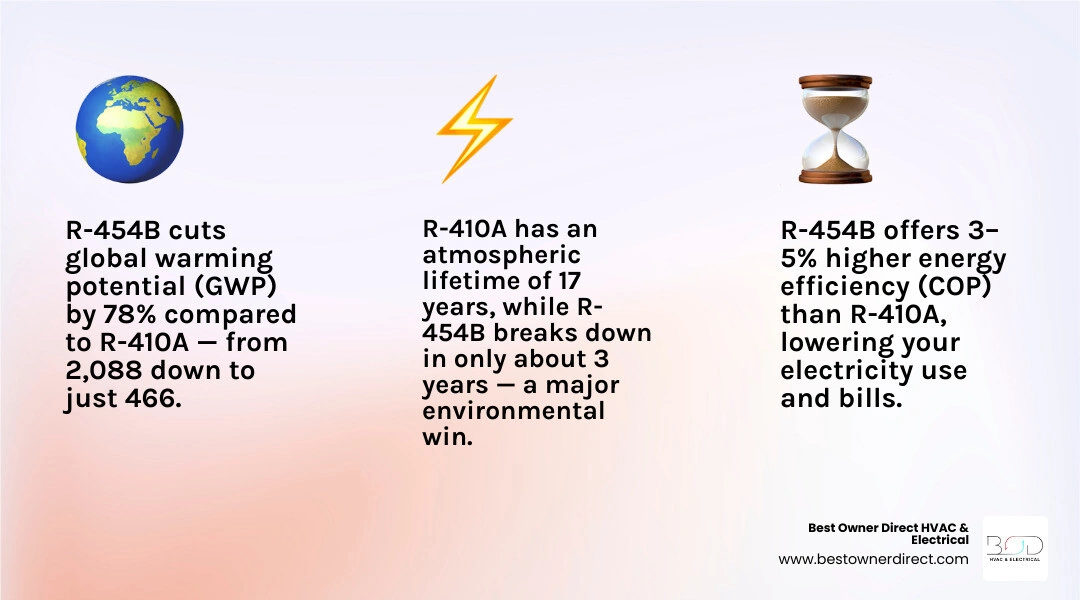
- Global Warming Potential (GWP) Reduction: R-410A has a GWP of 2,088, while R-454B has a GWP of 466. This represents an immediate 78% reduction in direct greenhouse gas impact.
- Atmospheric Lifetime: Once released into the atmosphere, R-410A remains for approximately 17 years (with some estimates up to 16.95 years). In contrast, R-454B breaks down much faster, with an atmospheric lifetime of only about 3 years (or up to 5.5 years depending on the specific environmental model).
- Chemical Composition: R-410A is a near-azeotropic blend consisting of 50% R-32 and 50% R-125. R-454B is a zeotropic blend composed of 68.9% R-32 and 31.1% R-1234yf (a hydrofluoroolefin, or HFO, which carries an extremely low GWP).
By transitioning to R-454B, we are dramatically reducing the potential environmental footprint of residential heating and cooling. This regulatory phase-down ensures that the systems installed in our Portland metro communities are aligned with modern sustainability goals. For a deeper look at how this regulatory environment affects you directly, read our detailed article on How AC Refrigerant Changes Affect Homeowners.
R410A vs R454B Refrigerant What You Need to Know
When comparing r410a vs r454b refrigerant what you need to know about their physical behavior, we find that while they perform similar jobs, they do so with slightly different thermodynamic properties.
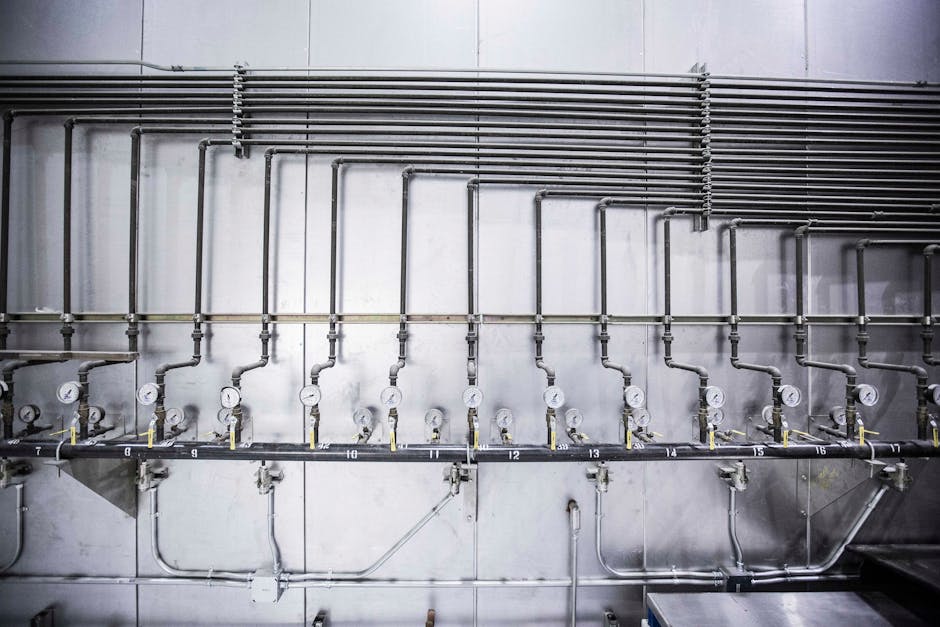
One of the most notable differences lies in their operating pressures and temperature glide. R-454B is a zeotropic blend, meaning its individual chemical components boil and condense at slightly different temperatures. This creates a "temperature glide" of roughly 1.5°F. While R-410A is a near-azeotropic blend with virtually no temperature glide, R-454B requires technicians to calculate system superheat and subcooling with extra care, charging the system strictly as a liquid to prevent the blend from separating (a process known as fractionation).
Despite this glide, R-454B operates at slightly lower pressures than R-410A under typical high-side operating conditions. For example, under standard summer conditions, R-454B runs at approximately 370 psig on the high side, compared to R-410A’s 400 psig. This slightly lower operating pressure reduces mechanical stress on the compressor, which can contribute to a longer system lifespan.
Thermodynamically, R-454B also boasts a higher latent heat capacity of 273 kJ/kg compared to R-410A’s 256 kJ/kg. This means R-454B can transfer more heat per pound of refrigerant, allowing systems to achieve a 3% to 5% higher Coefficient of Performance (COP). In practical terms, this translates directly to better energy efficiency for your home.
| Specification | R-410A | R-454B |
|---|---|---|
| Chemical Type | HFC Blend | HFC/HFO Blend |
| Composition | 50% R-32 / 50% R-125 | 68.9% R-32 / 31.1% R-1234yf |
| Temperature Glide | Negligible (~0.2°F) | ~1.5°F |
| Latent Heat Capacity | 256 kJ/kg | 273 kJ/kg |
| Typical High-Side Pressure | ~400 psig | ~370 psig |
| Discharge Temperature | Baseline | 3–5°F Lower |
These efficiency improvements are closely tied to your system's overall performance. If you are wondering how these efficiency gains translate to standard industry metrics, you can learn more by reading What Is a SEER Rating? What Does It Mean?.
Safety and Flammability: Understanding A2L Refrigerants
The most talked-about change with next-generation refrigerants is their flammability classification. Under the ASHRAE Standard 34 safety group, R-410A is classified as an A1 refrigerant, which means it is non-toxic and non-flammable. R-454B, however, is classified as an A2L refrigerant.
The "A" indicates low toxicity, the "2" indicates flammability, and the "L" stands for "low" or mild flammability. This means that while R-454B can ignite under very specific laboratory conditions, it is incredibly difficult to ignite in a real-world residential setting.
To help put this in perspective, let's look at the flammability characteristics of R-454B:
- Lower Flammability Limit (LFL): R-454B has an LFL of approximately 11.3% to 12.4% by volume. This means a massive amount of refrigerant would have to leak rapidly into a highly confined space to even reach a concentration capable of burning.
- Minimum Ignition Energy (MIE): The ignition energy required to light R-454B is exceptionally high (greater than 1,000 mJ). Standard household ignition sources, like static electricity or a light switch spark, do not carry enough energy to ignite it. It generally requires an open flame or a high-energy electrical arc.
- Burning Velocity: Even if ignited, R-454B has a very slow burning velocity of 5.2 cm/s (well under the 10 cm/s threshold). Rather than a rapid explosion, any flame would propagate slowly, behaving more like a lazy, self-extinguishing candle.
Because of this A2L classification, safety is built directly into the design of new R-454B equipment. Modern systems are certified to strict safety standards (such as UL 60335-2-40). They include factory-installed leak detection sensors and integrated mitigation boards. If a leak is detected inside the indoor evaporator coil cabinet, the system automatically shuts down the compressor, closes safety valves, and activates the indoor fan to safely disperse and dilute the refrigerant long before it can reach its flammability limit.
These built-in safety features ensure that R-454B is entirely safe for residential use. To see how these safety designs affect your purchasing decisions, check out our guide on How the Refrigerant Transition Affects Your Next AC Purchase.
Equipment Compatibility and Retrofitting Realities
A common question we hear from homeowners in the Portland metro area is whether they can simply swap R-454B into their existing R-410A system. The short and definitive answer is no.
R-454B is not a drop-in replacement for R-410A. Attempting to mix these refrigerants or put R-454B into an older system is illegal under EPA SNAP rules, violates UL safety ratings, voids manufacturer warranties, and can cause catastrophic equipment failure.
The physical and mechanical differences between the two systems make retrofitting impossible:
- Compressor Displacement: R-454B and R-410A scroll compressors have different volumetric displacements. Running R-454B in an R-410A compressor will cause a significant loss in system capacity and place improper mechanical stress on the motor.
- Coil Surface Area: Because of its thermodynamic properties, R-454B coils require 10% to 20% additional heat transfer surface area to meet the same capacity as an equivalent R-410A design.
- Expansion Valves (TXVs): Thermal expansion valves must be precisely calibrated to the specific pressure-temperature characteristics of the refrigerant. R-410A TXVs are not compatible with the temperature glide and flow rates of R-454B.
- Safety Controls: Older R-410A systems do not have the integrated leak detection sensors, mitigation boards, or spark-proof electrical contactors required by safety codes for A2L refrigerants.
- Lubricant Compatibility: While both systems use synthetic Polyolester (POE) oil, the specific additives and viscosity requirements differ to prevent copper plating and ensure proper oil return to the compressor.
Because of these factors, transitioning to R-454B requires replacing the entire system — including the outdoor condenser, the indoor evaporator coil, and the safety controls.
R410A vs R454B Refrigerant What You Need to Know About System Upgrades
If your current air conditioner or heat pump is nearing the end of its lifespan, upgrading to a modern R-454B system is the most reliable, future-proof choice.
New systems designed around R-454B are engineered from the ground up to maximize the thermodynamic advantages of this refrigerant. Because R-454B has a higher latent heat capacity, these systems are highly efficient, often achieving a 3% to 10% improvement in SEER2 ratings.
For homeowners in Oregon, this transition is particularly beneficial when it comes to heat pump performance. In our damp, chilly winters, R-454B heat pumps maintain their heating capacity exceptionally well. R-454B systems can maintain roughly 82% of their heating capacity at -15°C (5°F), whereas older R-410A systems typically drop to about 78%. This means less reliance on expensive auxiliary electric heat strips during cold snaps.
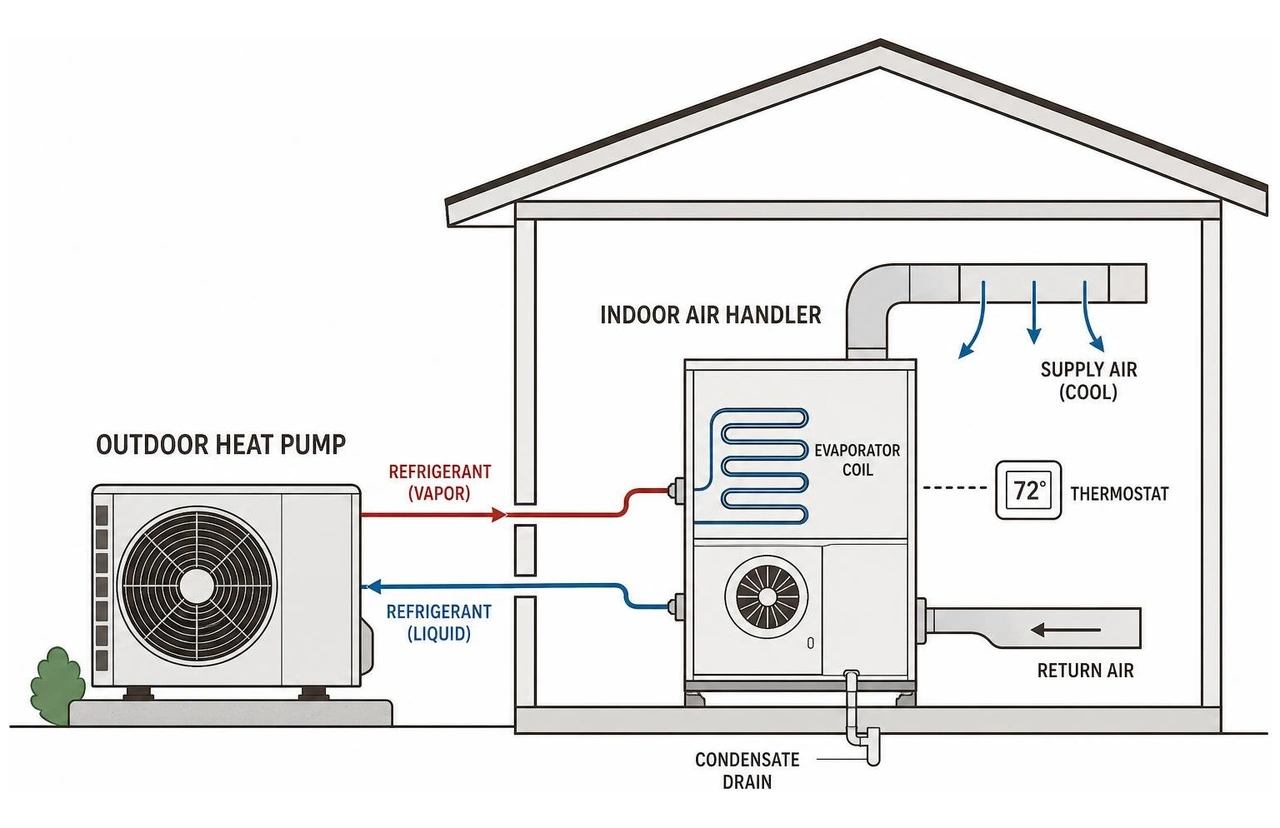
When upgrading, it is essential to work with a licensed professional who understands A2L safety standards and proper installation practices. If you are ready to explore your options for a new, highly efficient cooling or heating system, you can learn more about our professional AC Installation Replacement and Heat Pump Installation Replacement services.
R410A vs R454B Refrigerant What You Need to Know for Existing Systems
If you currently own a functioning R-410A system, there is no need to panic. The EPA mandate only bans the manufacture of new R-410A equipment; it does not ban the use of your existing system. You can legally run, maintain, and repair your R-410A air conditioner or heat pump for the remainder of its natural lifespan.
However, as the phase-down of HFC production progresses, the supply of virgin R-410A will tighten. The industry is already transitioning to reclaimed and recycled R-410A to service existing units. Over the next decade, this shrinking supply means that the cost of R-410A refrigerant will continue to rise.
To protect your investment and avoid expensive repairs:
- Schedule Regular Maintenance: Annual professional tune-ups are critical. Keeping your coils clean and your system running smoothly reduces operating pressures and minimizes stress on components.
- Address Leaks Early: If your system has a minor refrigerant leak, do not simply "top it off" year after year. Finding and repairing the leak immediately preserves your expensive refrigerant and prevents compressor damage.
- Plan Ahead: If your R-410A system is more than 10 to 12 years old and faces a major repair, we can help you evaluate whether a repair is practical or if transitioning to a modern, energy-efficient system is the smarter long-term decision.
Frequently Asked Questions About the Refrigerant Transition
Navigating a major industry transition can bring up many questions. Here are some of the most common concerns we hear from homeowners:
Can I use R-454B in my existing R-410A air conditioner?
No. You cannot use R-454B in a system designed for R-410A. R-454B requires A2L-compatible compressors, larger heat exchanger coils, specific expansion valves, and integrated safety sensors. Attempting to charge R-454B into an R-410A system is highly unsafe, violates federal regulations, and will ruin your equipment.
How does R-454B compare to other alternatives like R-32?
R-454B and R-32 are both excellent, low-GWP A2L refrigerants, but they have different strengths. R-32 is a single-component refrigerant with a GWP of 675, while R-454B is a blend with a lower GWP of 466.
In the US market, the choice has largely split by equipment type: major American brands have adopted R-454B as their primary choice for traditional ducted split systems and heat pumps, while many ductless mini-split manufacturers use R-32. Both offer excellent efficiency, but R-454B is the more future-proof option regarding long-term environmental regulations due to its lower GWP.
Will R-410A still be available for servicing my current AC?
Yes, R-410A will remain available for servicing existing systems for many years to come. The HVAC industry relies on a robust network of reclaimed and recycled refrigerant to meet service demands. However, because virgin production is winding down under the AIM Act, the cost of R-410A refrigerant is expected to rise steadily over the next decade.
Conclusion
The transition from R-410A to R-454B is a significant milestone for home comfort and environmental responsibility. While it changes how systems are designed and serviced, the result is a safer, more efficient, and more environmentally friendly heating and cooling experience for your home.
At Best Owner Direct HVAC & Electrical, we are fully prepared for this transition. Based in Cornelius, OR, we proudly serve homeowners across the Portland metro area, including Banks, Beaverton, Canby, Carlton, Dayton, Dundee, Forest Grove, Gaston, Gladstone, Hillsboro, King City, Lafayette, Lake Oswego, Milwaukie, Newberg, North Plains, Oregon City, Portland, Sherwood, Tigard, Tualatin, West Linn, Wilsonville, and Yamhill.
Our licensed, professional technicians are fully trained in A2L safety standards, proper system design, and precise installation techniques. Whether you need to maintain your existing R-410A system, repair a leak, or upgrade to a modern, energy-efficient R-454B heat pump, we are here to provide reliable, customer-focused service.
If you live in Beaverton or the surrounding areas and are considering a system upgrade, explore our HVAC Installation Beaverton OR services. Ready to schedule a tune-up or discuss your home's heating and cooling needs? Schedule your next service with Best Owner Direct HVAC & Electrical today!


Repairing vs. Replacing a Frozen AC Unit During Peak Oregon HeatA frozen AC compressor during a July heatwave forces a tough choice. Use this objective framework to evaluate your system's health and make the right call for your home.
Read more
Everything You Need to Know About How Oregon Energy Rates Affect Your Water Heater ChoiceLearn how Oregon energy rates affect your water heater choice and find the most efficient, cost-saving option for your home.
Read more
Diagnosing Weak Airflow from Your House Air Vents in Mid-JulyA sudden drop in AC airflow during peak summer usually points to cumulative mechanical strain. Learn whether it's a basic maintenance issue you can fix or a mechanical failure requiring a pro.
Read more