Menu


What the 2026 Refrigerant Transition Means Before You Buy a New AC
How the refrigerant transition affects your next AC purchase comes down to a few concrete changes that are already in effect — and every homeowner in the Portland metro area and surrounding Oregon communities needs to understand them before signing off on a new system.
Here is what you need to know right now:
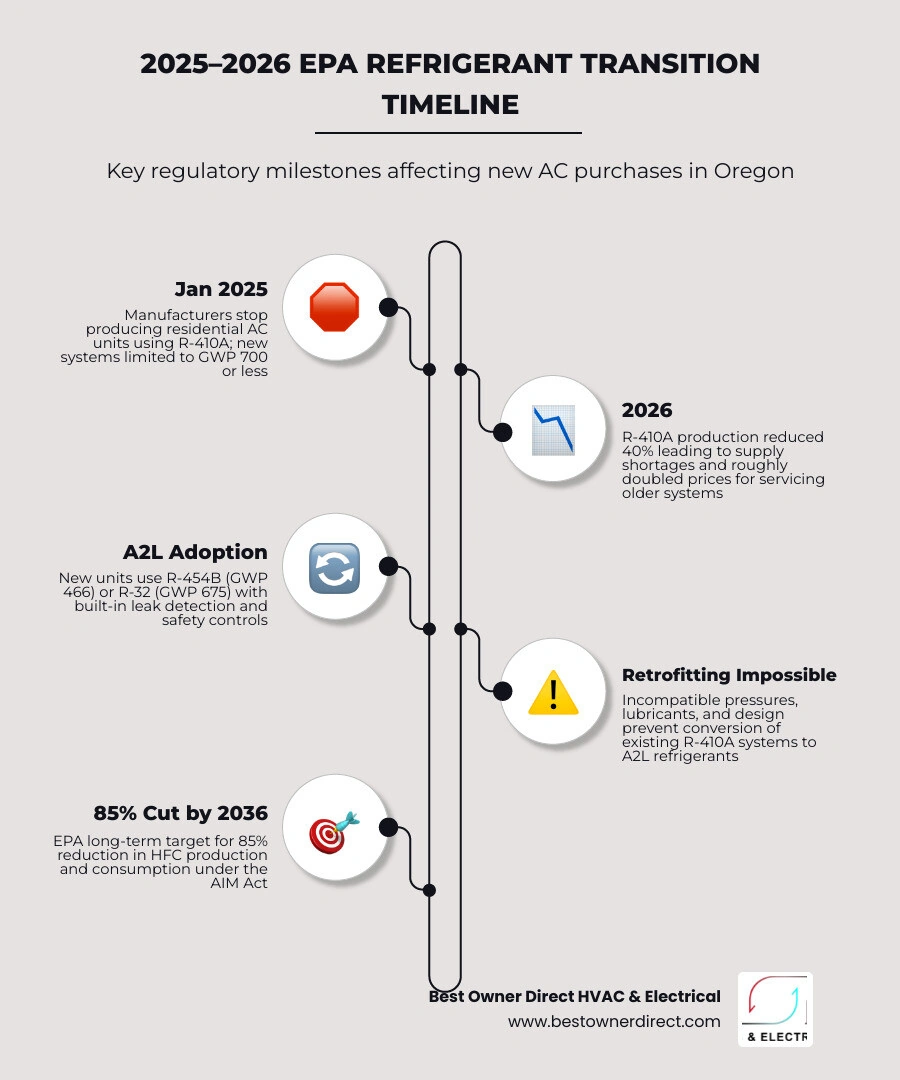
- New systems use different refrigerants. As of January 1, 2025, manufacturers stopped producing residential AC equipment using R-410A. All new units must use refrigerants with a Global Warming Potential (GWP) of 700 or less, such as R-454B (GWP: 466) or R-32 (GWP: 675).
- Your existing R-410A system is still legal to operate. There is no requirement to replace a working system. However, servicing it will become more expensive as R-410A supply shrinks — production was cut by 40% in 2026, and prices have roughly doubled compared to a couple of years ago.
- Retrofitting is not possible. Older R-410A systems cannot be converted to use the new refrigerants due to incompatible pressures, lubricants, and missing safety components.
- New A2L systems are meaningfully more efficient. Systems using the new refrigerants are designed to run 10–15% more efficiently than the R-410A units they replace.
- New safety features are required by law. All new A2L systems must include integrated leak detection sensors and automatic mitigation controls.
The driving force behind all of this is the American Innovation and Manufacturing (AIM) Act of 2020, which authorized the EPA to phase down hydrofluorocarbons (HFCs) — a category of potent greenhouse gases. R-410A, with a GWP of 2,088, has been one of the primary targets. The EPA's long-term goal is an 85% reduction in HFC production and consumption by 2036.
For homeowners in Cornelius, Hillsboro, Beaverton, Portland, and throughout the region, this transition is no longer on the horizon — it is already here. Whether your current system is aging, you are facing a repair decision, or you are simply planning ahead, understanding what changed and why puts you in a much stronger position to make a smart, long-term investment in your home's comfort.
Understanding the 2025–2026 EPA Refrigerant Mandates
To understand why the heating, ventilation, and air conditioning (HVAC) industry is undergoing its most significant shift in decades, we have to look at the concept of Global Warming Potential (GWP). GWP is a relative measure of how much heat a greenhouse gas traps in the atmosphere compared to carbon dioxide (which has a baseline GWP of 1).
For many years, R-410A was the standard refrigerant used in residential air conditioners and heat pumps across Oregon. While it was a major improvement over the older, ozone-depleting R-22 refrigerant (which was phased out years ago), R-410A has an exceptionally high GWP of 2,088. This means that a single pound of R-410A released into the atmosphere has the same warming impact as more than two thousand pounds of carbon dioxide.
Under the AIM Act of 2020, the EPA established a strict phase-down schedule for HFCs to limit these emissions. The core rule for residential cooling systems mandates that any new central air conditioner or heat pump manufactured after January 1, 2025, must utilize a refrigerant with a GWP of 700 or less.
For a deeper look at how these federal environmental guidelines impact your household equipment, you can read our detailed guide on How AC Refrigerant Changes Affect Homeowners.
How the Refrigerant Transition Affects Your Next AC Purchase
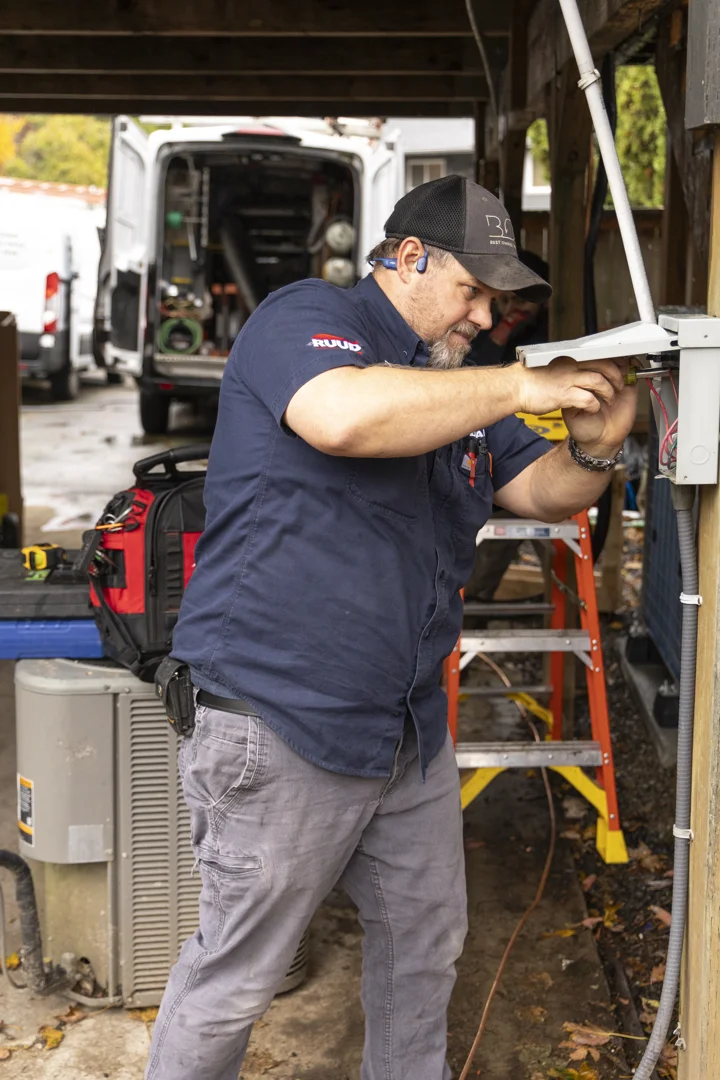
When the time comes to invest in home comfort, how the refrigerant transition affects your next AC purchase will be visible in the technology, efficiency ratings, and safety systems of the equipment available on the market. If you are shopping for a new air conditioner or heat pump in the Willamette Valley, you will no longer be buying a standard R-410A system. Instead, you will be selecting from a new generation of systems engineered specifically for low-GWP alternatives.
To learn more about the complete process of upgrading your home's cooling setup, check out our comprehensive resource on Air Conditioning Installation and Replacement.
Comparing R-410A to New A2L Alternatives (R-454B and R-32)
The primary replacements for R-410A are R-454B and R-32. Both belong to a safety classification known as A2L.
To put this in perspective, the American Society of Heating, Refrigerating and Air-Conditioning Engineers (ASHRAE) classifies refrigerants based on toxicity and flammability:
- Class A1 refrigerants (like R-410A) have low toxicity and show no flame propagation during testing.
- Class A2L refrigerants have low toxicity but are classified as "mildly flammable."
While "mildly flammable" might sound intimidating at first, A2L refrigerants are incredibly difficult to ignite. They require a highly concentrated, sustained direct flame or high-energy ignition source to burn. If they do ignite, their flame propagation speed is exceptionally slow — slower than a gentle walking pace — and they are typically self-extinguishing. In fact, many everyday household items, such as hairspray, cooking sprays, and aerosol deodorants, are significantly more flammable than A2L refrigerants.
The environmental benefits of these new alternatives are substantial. R-454B (which is a blend of R-32 and R-1234yf) offers a 78% reduction in GWP compared to R-410A, while R-32 (a single-component refrigerant) offers a 68% reduction. Furthermore, these new options break down in the atmosphere much faster. R-410A has an atmospheric lifetime of roughly 17 years, whereas R-454B breaks down in about 3 years, and R-32 takes about 5 years.
| Refrigerant Type | ASHRAE Safety Class | Global Warming Potential (GWP) | GWP Reduction vs. R-410A | Atmospheric Lifetime |
|---|---|---|---|---|
| R-410A | A1 (Non-flammable) | 2,088 | Baseline | ~17 Years |
| R-32 | A2L (Mildly Flammable) | 675 | 68% Reduction | ~5 Years |
| R-454B | A2L (Mildly Flammable) | 466 | 78% Reduction | ~3 Years |
System Compatibility and Why Retrofitting is Not an Option
We are frequently asked by homeowners if they can simply swap out the old R-410A refrigerant in their existing system for the new, eco-friendly A2L options. Unfortunately, retrofitting is physically impossible and highly illegal.
A2L refrigerants operate at different physical pressures and have different thermodynamic properties than R-410A. Additionally, they require entirely different synthetic polyolester (POE) compressor lubricants. Running an A2L refrigerant in an older system would ruin the compressor, damage the expansion valves, and void any remaining manufacturer warranties.
More importantly, older R-410A indoor evaporator coils and outdoor condensers lack the mandatory safety controls, leak detection sensors, and mitigation boards required by modern building codes for A2L systems.
To ensure safety, performance, and warranty protection, you must replace the entire matched system. This means replacing both the outdoor condenser unit and the indoor evaporator coil (or air handler) at the same time. If you live in Hillsboro or the surrounding areas, you can learn more about how a matched system replacement works by reading our local guide on AC Replacement in Hillsboro.
Safety and Efficiency Upgrades in Modern A2L Cooling Systems
The transition to A2L refrigerants has driven manufacturers to completely redesign residential cooling systems. These changes are not just about compliance; they represent a major technological leap forward that benefits the homeowner.
For a detailed look at how modern equipment reduces energy consumption, check out our guide on Energy Efficient Air Conditioning.
Advanced Leak Detection and Mitigation Technology
Because A2L refrigerants are mildly flammable, safety is engineered directly into the equipment. New A2L air conditioners and heat pumps are equipped with an integrated Refrigerant Detection System (RDS).
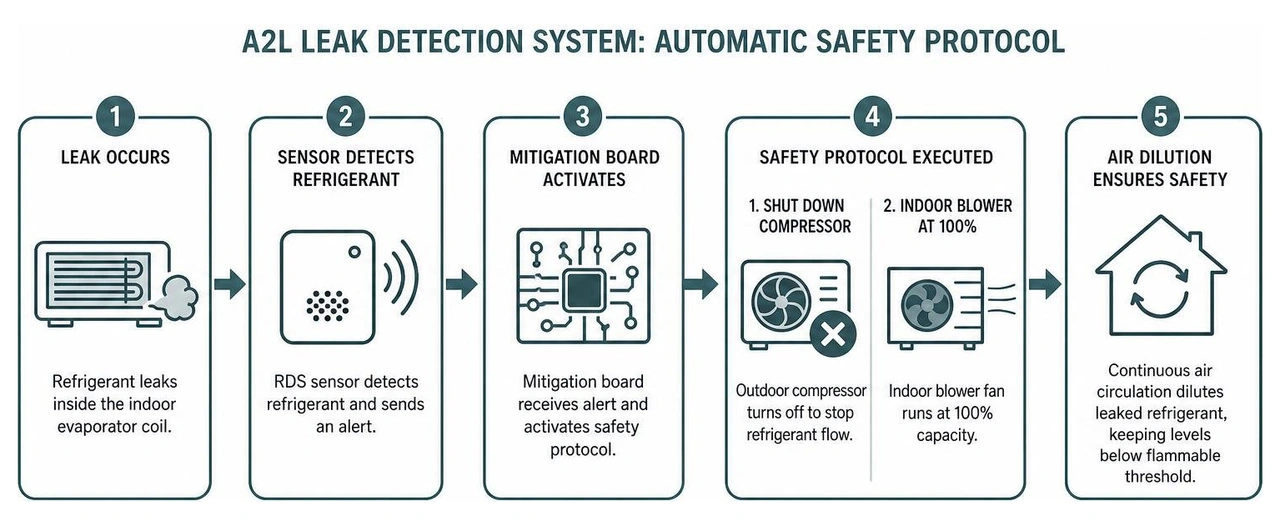
If a leak occurs within the indoor evaporator coil, the RDS sensor detects the presence of the refrigerant and immediately communicates with the system’s mitigation board. The mitigation board instantly executes a safety protocol:
- It shuts down the outdoor compressor to stop the flow of refrigerant.
- It turns on the indoor blower fan to run at 100% capacity.
- By circulating air continuously, the system safely dilutes the leaking refrigerant, preventing it from ever reaching a concentration level that could pose a flammability risk.
Additionally, manufacturers use spark-resistant electrical components, sealed contactors, and robust solid-state controls to eliminate potential ignition points within the air handler and condenser cabinet.
How the Refrigerant Transition Affects Your Next AC Purchase Efficiency Ratings
One of the most exciting aspects of how the refrigerant transition affects your next AC purchase is the boost in performance. A2L refrigerants have superior heat transfer capabilities compared to R-410A. For example, R-32 has about a 10% higher thermal capacity than R-410A, meaning it can carry more heat per pound.
Because of these thermal properties, new A2L systems are designed to be 10% to 15% more energy-efficient than the older systems they replace. When paired with modern SEER2 (Seasonal Energy Efficiency Ratio 2) standards, variable-speed compressors, and multi-stage blower motors, these systems provide incredibly precise temperature control and superior humidity removal.
For local context on upgrading to a high-efficiency system in our area, take a look at our specialized resource on AC Installation in Beaverton.
Repair vs. Replace Decisions for Oregon Homeowners in 2026
As we navigate 2026, many homeowners with R-410A systems are finding themselves at a crossroads. When an older air conditioner experiences a component failure, deciding whether to invest in repairs or upgrade to a new system requires careful consideration of the changing market landscape.
To help you evaluate your current equipment's condition and expected service life, read our article on When to Replace Your Air Conditioner.
Managing an Existing R-410A System and Rising Service Expenses
It is completely legal to keep running and repairing your existing R-410A system. However, the financial reality of doing so has changed dramatically.
Under the EPA phase-down timeline, the production of virgin R-410A was cut by 40% of its historical baseline. This sharp reduction in supply, combined with steady demand from the millions of R-410A systems still installed across the country, has caused the market cost of R-410A to double over the last couple of years.
If your older system develops a refrigerant leak, simply "topping it off" is no longer a sensible or cost-effective strategy. A full system recharge, combined with the labor-intensive process of locating and permanently sealing the leak, can quickly add up to a significant portion of what a modern, reliable system replacement would cost.
To extend the lifespan of your current unit and prevent expensive refrigerant leaks, proactive maintenance is absolutely essential. You can find practical maintenance tips and schedules in our AC Tune-Up Guide for Oregon Homeowners.
How the Refrigerant Transition Affects Your Next AC Purchase Timeline
The timeline for the transition has moved quickly:
- January 1, 2025: Manufacturers ceased production of all residential R-410A central air conditioning and heat pump units.
- January 1, 2026: The official installation grace period for remaining R-410A inventory expired in most jurisdictions, making A2L systems the standard choice for new installations.
As remaining distributor stocks of R-410A equipment disappear, future-proofing your home comfort becomes a primary goal. Investing in a new A2L-compliant system now ensures that you will have ready access to compatible replacement parts, manufacturer warranty support, and affordable refrigerant for the next 15 to 20 years.
Frequently Asked Questions About the Refrigerant Transition
Navigating regulatory changes can bring up plenty of questions. Here are the answers to the most common concerns we hear from local homeowners. If you are experiencing issues with your current setup, you can learn more about our diagnostic and repair options on our AC Repair Service page.
Do I need to replace my working R-410A air conditioner immediately?
No, you do not need to replace a working R-410A air conditioner. The EPA regulations only apply to the manufacturing and installation of new equipment. Your existing system can continue to operate safely and legally for the remainder of its natural lifespan.
However, you should focus on regular professional maintenance to prevent leaks, as the cost of R-410A refrigerant will continue to rise as production allocations shrink further toward the 2036 target of an 85% total reduction.
Are there federal tax credits or local rebates for new A2L systems?
Yes! Because the refrigerant transition has coincided with significant efficiency upgrades, many new A2L-compliant air conditioners and heat pumps qualify for substantial financial incentives.
Under the Energy Efficient Home Improvement Credit (Section 25C), homeowners can claim federal tax credits for qualifying high-efficiency central air conditioners and heat pumps. Additionally, local Oregon electric utilities frequently offer rebates for upgrading to Energy Star-certified cooling and heating systems. Paired together, these incentives can make upgrading to an environmentally friendly heat pump or AC system highly rewarding.
What should I ask an HVAC contractor before buying a new AC?
When interviewing contractors for a system replacement in 2026, we recommend asking the following targeted questions:
- Are your technicians specifically certified to handle A2L refrigerants, and do they use spark-resistant tools?
- Do your installation protocols include nitrogen-purge brazing and deep vacuum testing below 250 microns?
- Will you perform a proper Manual J load calculation to ensure the new system is sized correctly for my home's specific layout and ductwork capacity?
- Are you pulling all the necessary municipal permits and handling the electrical connections with licensed professionals?
Conclusion
How the refrigerant transition affects your next AC purchase is ultimately a positive change for your home, your wallet, and the environment. While the regulations have introduced new technology and safety standards, they also bring incredible opportunities for enhanced home comfort, 10% to 15% better energy efficiency, and long-term peace of mind.
At Best Owner Direct HVAC & Electrical, we are dedicated to providing our neighbors in Banks, Beaverton, Hillsboro, Oregon City, Portland, and across the surrounding communities with reliable, affordable, and energy-efficient home comfort solutions. Our highly trained, licensed technicians understand the ins and outs of the new A2L systems, ensuring your installation is completed safely, professionally, and in full compliance with all local codes.
If you are ready to explore your options for a modern, high-efficiency cooling system, or if you want to make sure your current system is operating at its absolute best, we are here to help. Schedule an air conditioning consultation with our local experts today and let us guide you to the perfect cooling solution for your home.


Why August Is the Best Time to Plan a Furnace ReplacementAvoid the September supply chain bottleneck by upgrading your aging heating system now. Booking early secures the best equipment and an installation date that fits your busy schedule.
Read more
A Practical Guide to Ductless Mini Split Value in OregonIs a ductless mini split worth the investment in Oregon? Discover zoned comfort, energy savings, and incentives for older homes.
Read more
Direct-to-Owner HVAC Services vs. Large Franchises for AccountabilityWhen an AC breaks down in late summer, the technician's accountability is critical. See how an owner-operated business compares to a massive corporate dispatch fleet.
Read more