Menu


Why a Tune-Up Is One of the Smartest Ways to Lower Your Energy Bills
Understanding how a tune up improves efficiency and lowers bills starts with one simple idea: your HVAC system works harder than it needs to when it hasn't been serviced — and that extra effort shows up directly on your monthly utility statement.
Heating and cooling can account for nearly half of your home's total energy use. When your system is dirty, poorly calibrated, or running low on refrigerant, it burns more electricity or fuel to do the same job. The result is a bill that quietly climbs month after month, even if your usage habits haven't changed at all.
Here is how a professional tune-up directly addresses that problem:
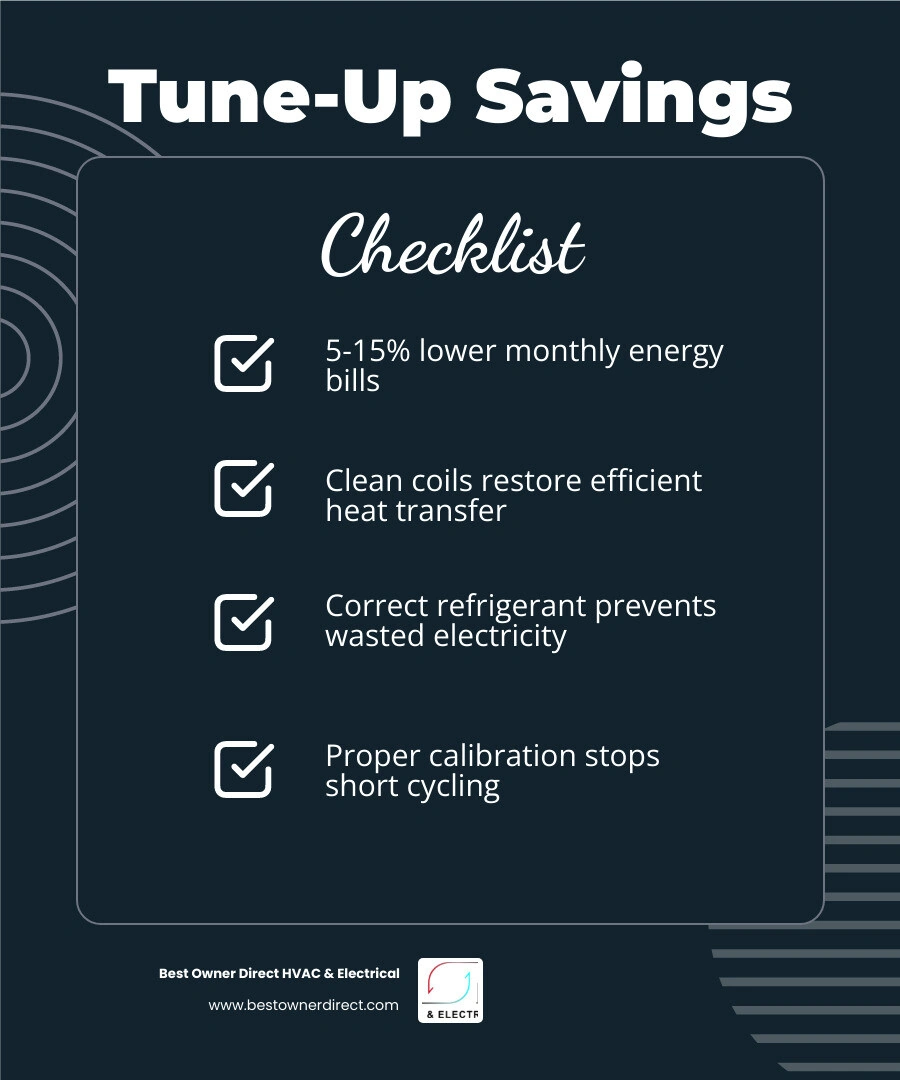
- Cleans coils and filters so heat transfers more easily and airflow isn't restricted
- Corrects refrigerant levels so the system doesn't overwork to reach your set temperature
- Calibrates the thermostat to prevent short cycling and wasted startup energy
- Lubricates moving parts to reduce friction and lower the electrical draw on motors
- Tightens electrical connections to prevent energy-wasting resistance in the system
- Inspects safety controls to catch small issues before they become expensive failures
On average, homeowners see a 5% to 15% reduction in monthly energy costs after a professional tune-up. If your system has gone several years without service, that improvement can reach as high as 30% — often paying for the tune-up itself within a single season.
Best Owner Direct HVAC & Electrical serves homeowners across Cornelius, OR and throughout the Portland metro area, helping families get more out of the systems they already own.
How a tune up improves efficiency and lowers bills vocab to learn:
- ac tune up checklist what your technician should check
- ac tune up guide for oregon homeowners
- best time of year to schedule your ac tune up
What is an HVAC Tune-Up and What Does It Include?
Think of an HVAC tune-up as a comprehensive wellness check for your home comfort system. Just like you wouldn't drive a car for years without changing the oil, rotating the tires, or checking the brakes, you shouldn't expect your heating and cooling equipment to run flawlessly without regular professional attention.
A professional tune-up is a proactive, multi-point preventative maintenance service designed to restore your system to its original factory performance specifications. It is highly technical and goes far beyond basic cleaning. A certified technician will systematically inspect, clean, calibrate, and test every critical component within your system to ensure it operates safely and at peak thermodynamic efficiency.
During a typical visit, we focus on identifying and correcting minor operational faults before they can escalate into major mechanical failures. This process involves testing safety controls, tightening loose electrical connections, measuring electrical draw on motors, and verifying that the system's control board communicates perfectly with your thermostat. By addressing these hidden issues, we reduce the overall strain on your system, which directly impacts your monthly energy consumption.
For a detailed look at everything a technician reviews during a service call, check out our AC Tune-Up Checklist: What Your Technician Should Check to understand the level of detail involved in keeping your system running smoothly.
Essential Tasks for Cooling and Heating Systems
While the overall goal of any tune-up is to optimize performance, the specific tasks differ depending on whether we are servicing your air conditioner, furnace, or heat pump. Each system has unique mechanical and electrical demands that must be addressed to maximize efficiency.
For cooling systems, the primary focus is on restoring optimal heat transfer. This includes:
- Cleaning the condenser coils: Outdoor coils accumulate dirt, grass clippings, and pollen, which act like an insulating blanket and prevent the system from releasing heat.
- Verifying the refrigerant charge: Using precision manifold gauges, we measure subcooling and superheat to ensure the refrigerant level is exactly where the manufacturer intended. Even a slight deviation in refrigerant charge can increase energy usage by 5% to 15%.
- Inspecting the condensate drain line: We clear any algae or debris buildup to prevent water damage and high-humidity issues inside your home.
For heating systems, the focus shifts to combustion efficiency and safety:
- Inspecting the heat exchanger: We perform a meticulous visual inspection to check for cracks or corrosion. A cracked heat exchanger can leak deadly carbon monoxide into your home's airflow.
- Cleaning and adjusting the gas burners: Dirty burners prevent complete combustion, wasting fuel and producing excess soot.
- Testing the ignitor and flame sensor: We clean the flame sensor to prevent unexpected system shutdowns on freezing winter nights.
To learn more about how these tasks protect your home and wallet, read our comprehensive AC Tune-Up Guide for Oregon Homeowners.
When to Schedule Your Professional Tune-Up
Timing is everything when it comes to HVAC maintenance. The absolute best time to schedule a tune-up is during the "shoulder seasons"—specifically spring (March to May) for your air conditioner and fall (September to November) for your furnace.
Scheduling during these moderate weather periods offers several key advantages:
- Technician Availability: Because emergency breakdowns are less common during the spring and fall, our schedule is much more flexible, making it easier to book an appointment at a time that works best for you.
- Pre-Season Preparation: Getting your system serviced before the first summer heatwave or winter freeze ensures that it is ready to handle the extreme weather load without failing when you need it most.
- Immediate Savings: A system tuned up in the spring will run efficiently from the very first hot day, preventing those shocking mid-summer utility bill spikes.
If you have a heat pump that provides both heating and cooling year-round, we highly recommend scheduling professional maintenance twice a year to account for the continuous wear and tear. For more advice on timing your service, read about the Best Time of Year to Schedule Your AC Tune-Up.
The Science Behind How a Tune Up Improves Efficiency and Lowers Bills
To truly appreciate how a tune up improves efficiency and lowers bills, it helps to understand a bit of the physics going on behind your drywall. Your HVAC system doesn't actually "create" cold; instead, it is a heat-transfer machine. It absorbs heat from inside your home and dumps it outside (during summer), or extracts heat from the outside air or fuel combustion and brings it indoors (during winter).
Anything that gets in the way of this heat-transfer process forces your system to run longer and consume more energy. The two primary physical barriers to efficiency are airflow restriction and thermal resistance.
When dust, dirt, and mechanical wear build up inside your system, they act as physical resistance. The system must run longer cycles and draw more electrical current to achieve the temperature set on your thermostat. By systematically removing these barriers, a professional tune-up restores the physics of your system back to its original design, allowing it to cool or heat your home in much shorter cycles.
To discover more practical ways to keep your system running optimally, read our guide on How Can I Make My HVAC Run More Efficiently This Summer.
How a Tune Up Improves Efficiency and Lowers Bills Through Airflow Optimization
Airflow is the lifeblood of your HVAC system. If the air cannot move freely through your ductwork, your system will struggle to maintain comfortable temperatures.
When an air filter becomes clogged, or when dust accumulates on the blades of your blower motor, it creates a condition known as high static pressure. Think of static pressure like trying to breathe through a tiny straw while running a marathon. The blower motor has to work twice as hard to push air through the restricted passages, which dramatically increases its electrical consumption.
A dirty blower wheel can reduce system airflow by up to 20%, leading to uneven temperatures across different rooms in your home. During a tune-up, we clean the blower assembly, inspect the duct connections for leaks, and ensure your system can breathe freely. This optimization reduces the motor's workload, balances the air pressure in your home, and lowers your monthly power bill.
For additional tips on maintaining balanced temperatures, explore our article on How Can My HVAC Maintain a Cooler Temperature This Summer.
How a Tune Up Improves Efficiency and Lowers Bills by Restoring Heat Transfer
The second major barrier to efficiency is poor thermal exchange. In an air conditioner or heat pump, this exchange happens across the evaporator coils (indoors) and the condenser coils (outdoors).
Even a microscopically thin layer of dust on these copper coils acts as an insulator, blocking the transfer of heat between the refrigerant and the air. When this happens, the compressor has to run significantly longer to cool your home, increasing its runtime by up to 15%.
Furthermore, if your system's refrigerant level is off by even a small margin, the thermal exchange process breaks down. Low refrigerant forces the system to run continuously without ever reaching your desired temperature, which can lead to frozen evaporator coils and eventual compressor failure.
By deep-cleaning the coils and precisely calibrating the refrigerant charge, a tune-up restores the rapid thermal exchange your system needs to operate at its rated SEER (Seasonal Energy Efficiency Ratio). To understand why SEER ratings matter and how maintenance protects them, read What Is SEER and Why Is It Essential for Your Summer HVAC System.
Long-Term Financial and Equipment Lifespan Benefits
While the immediate reduction in your monthly energy bills is fantastic, the long-term financial benefits of regular maintenance are even more significant. An HVAC system is one of the most expensive investments you will make in your home. Protecting that investment through regular tune-ups is a highly effective way to delay costly replacement expenses.
A neglected system typically lasts only 8 to 12 years and operates at a degraded efficiency of 70% to 85% of its original rating. In contrast, a well-maintained system can easily last 15 to 20 years while maintaining 95% to 100% of its original efficiency. By extending your system's lifespan by just 5 years, you save thousands of dollars in premature replacement costs.
To learn more about maximizing the life of your equipment, check out our guide on How to Extend the Life of Your AC Unit.
Here is a direct comparison of what you can expect from a maintained system versus a neglected one:
| Performance Metric | Well-Maintained HVAC System | Neglected HVAC System (3+ Years) |
|---|---|---|
| Average Lifespan | 15 to 20 Years | 8 to 12 Years |
| Operating Efficiency | 95% to 100% of original SEER/AFUE | 70% to 85% of original SEER/AFUE |
| Annual Breakdown Risk | Less than 5% | Up to 95% preventable failures |
| Monthly Energy Costs | Optimized (5% to 30% savings) | Elevated (10% to 30% higher bills) |
| Warranty Status | Fully Protected & Compliant | Voided due to lack of maintenance |
| Indoor Air Quality | Clean, filtered, low dust | High dust, allergen accumulation |
Preventing Costly Breakdowns and Emergency Repairs
There is nothing worse than your air conditioner breaking down on a scorching July afternoon in Hillsboro, or your furnace failing during a freezing January night in Oregon City. Emergency repairs are not only stressful, but they also tend to happen during peak usage periods when technician schedules are packed.
The vast majority of emergency service calls are completely preventable. During a routine tune-up, we inspect high-wear components like capacitors, contactors, and fan belts.
For example, a capacitor is a small, inexpensive electrical component that helps start your system's motors. If a capacitor begins to degrade, it causes the motor to overheat, which can quickly destroy a compressor. Catching a failing capacitor during a routine tune-up is a quick and simple fix, whereas replacing a burned-out compressor is an incredibly expensive mechanical failure.
To see how preventative maintenance keeps your home safe during extreme weather, read How An AC Tune-Up Prevents Breakdowns During Heat Events.
Preserving Manufacturer Warranties and System Value
If your heating or cooling system was installed within the last ten years, it is highly likely covered by a manufacturer's parts warranty. However, many homeowners are surprised to learn that nearly every major HVAC manufacturer requires documented annual professional maintenance to keep that warranty valid.
If a major component like the compressor or heat exchanger fails, the manufacturer will often require you to provide proof of regular professional service before they will honor the warranty claim. Without documented service records, your claim could be denied, leaving you to pay for the replacement parts out of pocket.
Regular professional tune-ups provide you with a paper trail of professional care, keeping your warranty fully intact and protecting your financial investment. For more insights on how proper care and professional installation impact your system over time, read How Proper AC Installation Affects Long-Term Performance.
Frequently Asked Questions About HVAC Efficiency
Can I perform a full HVAC tune-up myself?
While we always encourage homeowners to handle basic tasks like replacing air filters every 30 to 90 days and keeping the outdoor unit clear of leaves, weeds, and debris, a full tune-up must be left to a licensed professional.
Working with HVAC equipment involves high-voltage electricity, combustible natural gas, and highly pressurized chemical refrigerants. Properly checking refrigerant charges requires specialized tools like manifold gauges and EPA certification to handle the chemicals safely and legally. Attempting a DIY tune-up can lead to severe safety hazards, accidental system damage, and will void your manufacturer's warranty.
How much can I actually save on my energy bills after a tune-up?
Most homeowners see an immediate 5% to 15% reduction in their monthly energy costs after a professional tune-up. If your system has been neglected for several years, the accumulation of dust and minor mechanical faults can cause a massive drop in efficiency; in these cases, a thorough professional cleaning and calibration can reduce your energy consumption by up to 30%.
Over the course of a single heating or cooling season, these monthly savings often completely offset the cost of the tune-up. To read more about the value of annual maintenance, check out 5 Reasons You Need an AC Tune-Up Every Year.
What happens if I skip my annual maintenance?
Skipping your annual maintenance is a gamble where the house always wins. Without regular care, your system will lose approximately 5% of its operating efficiency every single year, causing your utility bills to rise steadily.
Additionally, the risk of a sudden, catastrophic mechanical failure increases dramatically. Dust buildup will restrict airflow, causing components to overheat and fail prematurely. Finally, skipping maintenance introduces serious safety risks, such as undetected carbon monoxide leaks from a cracked heat exchanger or electrical fire hazards from loose, corroded wiring connections.
Conclusion
Understanding how a tune up improves efficiency and lowers bills is the key to enjoying a more comfortable, affordable, and safe home. By restoring airflow, optimizing heat transfer, and catching minor mechanical issues early, a professional tune-up keeps your utility costs low while adding years of reliable service to your heating and cooling equipment.
At Best Owner Direct HVAC & Electrical, we are proud to be a family-owned company based in Cornelius, OR. We serve our neighbors throughout the entire Portland metro area—including Beaverton, Hillsboro, Lake Oswego, Oregon City, Tigard, Tualatin, West Linn, and beyond—with reliable, energy-efficient comfort solutions.
Don't wait for the next extreme weather event to find out if your system is running efficiently. Schedule your professional AC Tune-Up in Milwaukie, OR today and experience the difference that expert, customer-focused care makes for your home comfort and your wallet!


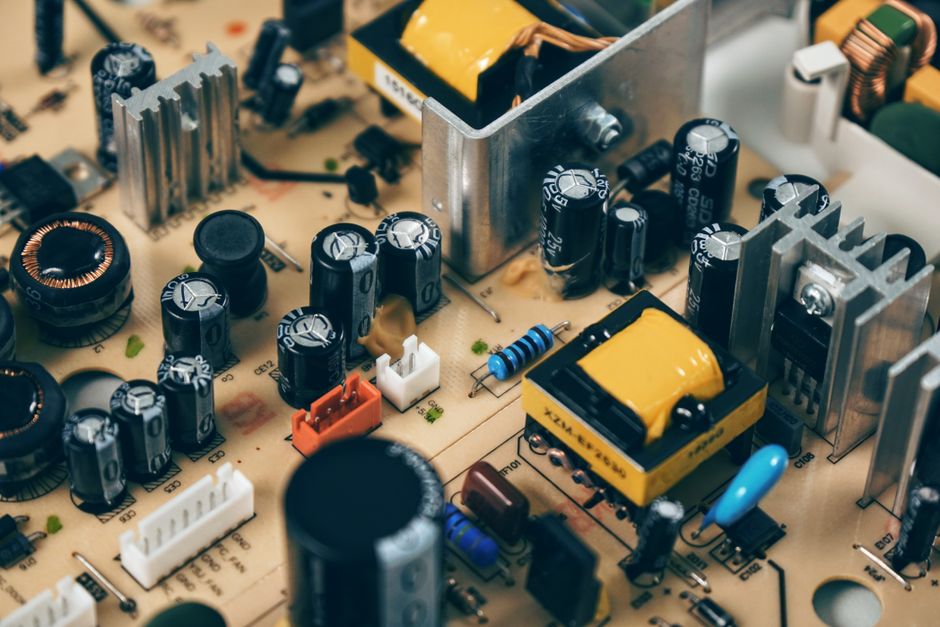
Why Capacitor Failure Is the Most Common AC Repair: Terms DemystifiedLearn why capacitor failure is the most common AC repair, how it happens, and how to prevent costly damage to your HVAC system.
Read more
Evaluating HVAC Companies Near Me: What Cornelius Residents Should AskA late-summer AC breakdown often forces rushed decisions. Asking the right questions over the phone ensures you hire an accountable, licensed professional instead of a sales-driven corporation.
Read more
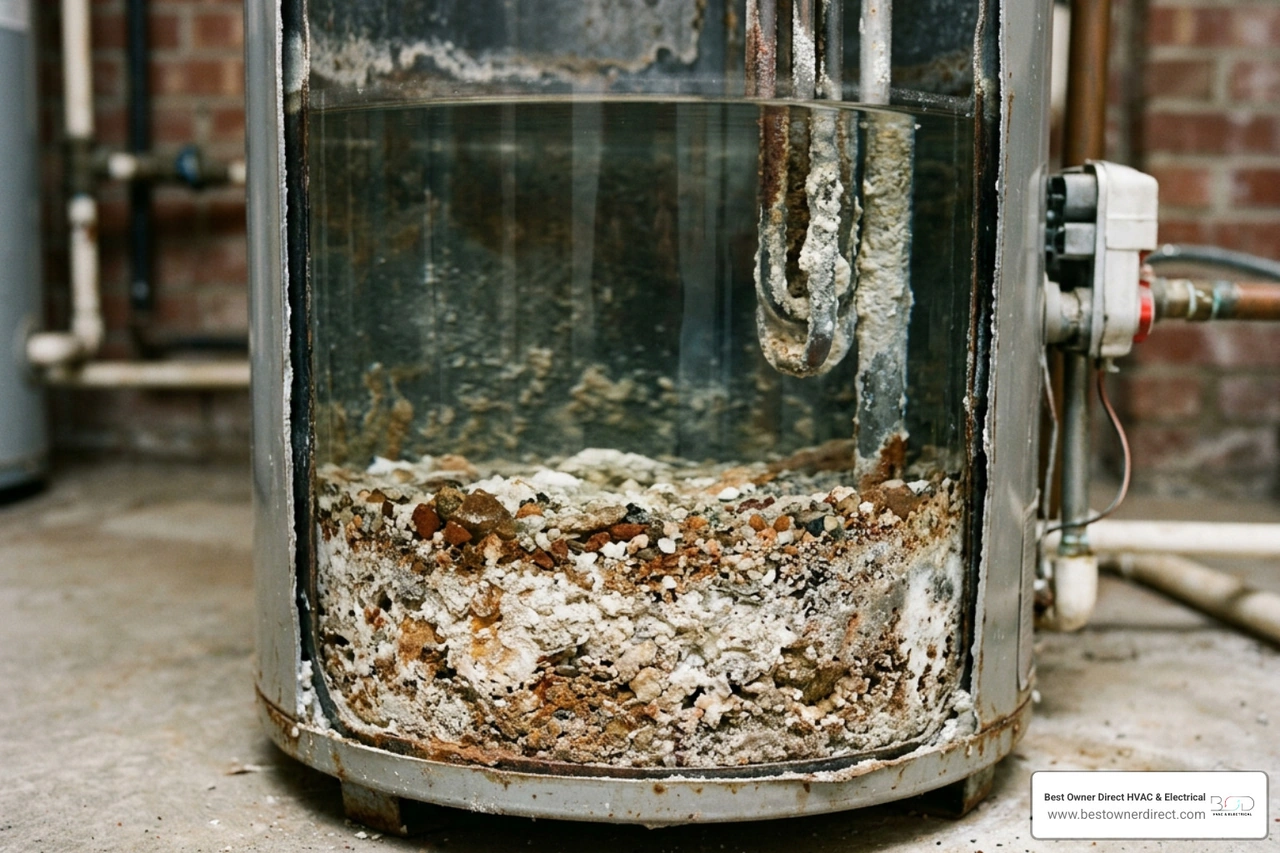
How to Understand Sediment Damage and Extend Your Water Heater Life in the Right WayLearn how sediment buildup shortens your water heater life and discover essential maintenance tips to prevent damage and extend your system's lifespan.
Read more