Menu


Why Heat Pump Water Heaters Are the Most Efficient Way to Heat Water at Home
Understanding how heat pump water heaters are the most efficient option for home hot water starts with one key fact: they don't generate heat — they move it. Instead of burning fuel or running electric resistance coils to create heat from scratch, a heat pump water heater pulls warmth from the surrounding air and transfers it into the water tank. That simple difference in physics is why these units deliver 2 to 3 times more efficiency than a conventional electric water heater, and up to 4 times more in optimal conditions.
Here's a quick breakdown of why heat pump water heaters lead the pack on efficiency:
- They move heat instead of creating it, achieving 300–420% thermal efficiency (compared to 100% maximum for electric resistance heaters)
- UEF ratings of 3.0–4.0+ vs. roughly 0.93 for a conventional electric tank and 0.6–0.8 for natural gas
- Up to 70% less electricity used compared to a standard electric water heater
- Annual savings of $200–$550 for most households, depending on the water heater being replaced
- ENERGY STAR certified models can save a family of four approximately $550 per year and more than $5,600 over the unit's lifetime
Water heating accounts for around 18% of a typical home's energy use — making it the second largest energy expense after space heating and cooling. For homeowners in the Portland metro area and surrounding Oregon communities, that's a significant line item on the monthly utility bill. The good news is that switching to a heat pump water heater is one of the most straightforward upgrades available to cut that cost, reduce your carbon footprint, and take advantage of strong federal and state incentives still available in 2026.
This guide walks you through exactly how these systems work, what to expect from installation, how they compare to other water heater types, and what rebates are available to Oregon homeowners right now.

Learn more about how heat pump water heaters are the most efficient option:
What is a Hybrid Water Heater and How Does It Work?
To truly appreciate the engineering behind these systems, it helps to understand why they are often called "hybrid" water heaters. A hybrid electric heat pump water heater combines standard electric resistance elements with an air-source heat pump. On a typical day, the system relies entirely on the highly efficient heat pump. If demand spikes suddenly—such as when you have back-to-back showers or run the washing machine and dishwasher at the same time—the system can temporarily switch on its backup resistance elements to make sure you do not run out of hot water.
To dive deeper into the core design of these systems, you can read our Heat Pump Water Heater Complete Guide.
Understanding the Refrigeration Cycle
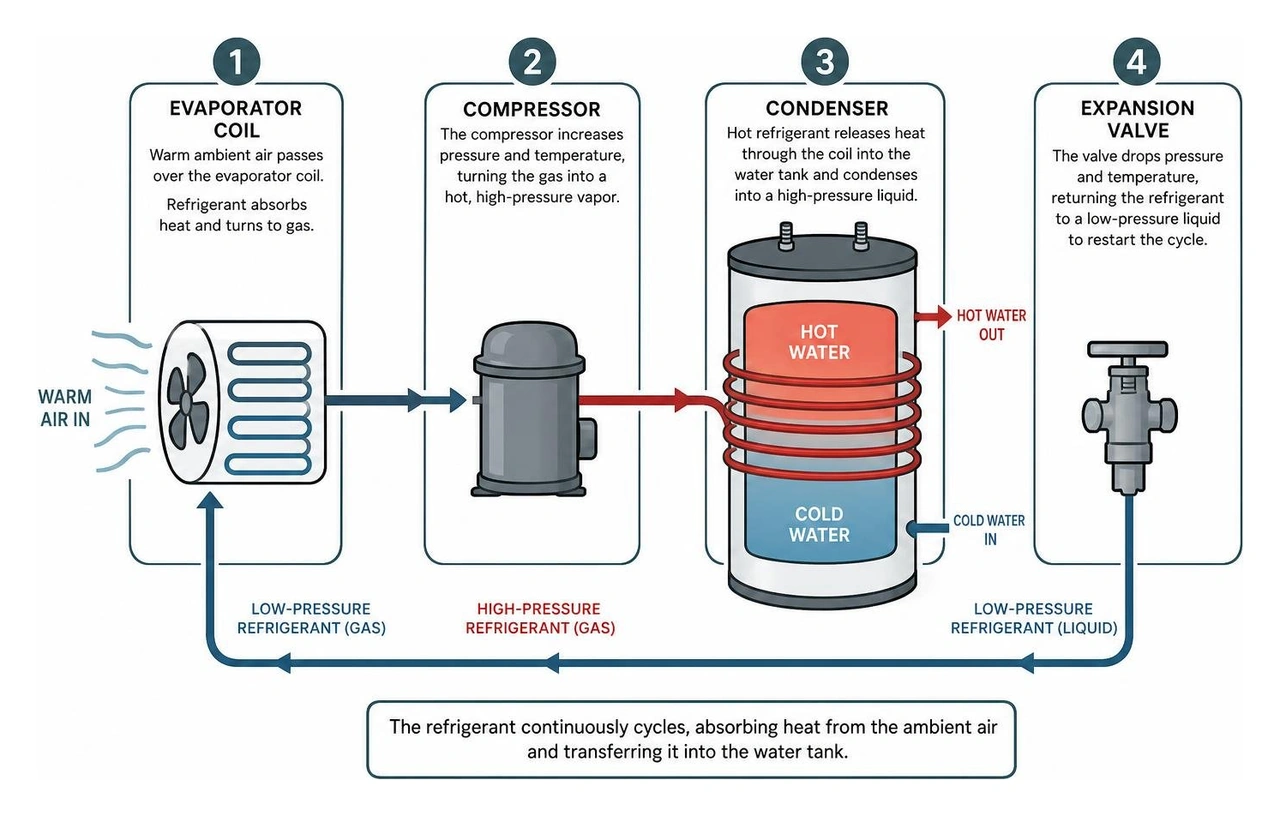
The heat pump operates on a vapor compression cycle, which is essentially a refrigerator running in reverse. While a refrigerator extracts heat from inside its cabinet and expels it into your kitchen, a heat pump water heater pulls heat from the surrounding room air and dumps it into your water tank.
This process occurs in four main steps:
- Evaporator Coil: A fan at the top of the unit draws in warm ambient air and passes it across an evaporator coil. This coil contains a low-pressure liquid refrigerant. Because the refrigerant has an extremely low boiling point, the warmth from the surrounding air is enough to heat the liquid until it vaporizes into a gas.
- Compressor: The gaseous refrigerant travels to an electric compressor. By compressing the gas, the system rapidly increases its pressure and temperature, turning it into a superheated vapor.
- Condenser: This hot, pressurized gas then flows through a condenser coil wrapped around the water tank (or inside a heat exchanger). The heat from the refrigerant naturally transfers through the tank walls and into the water. As the refrigerant loses its heat to the cooler water, it condenses back into a high-pressure liquid.
- Expansion Valve: Finally, the liquid refrigerant passes through an expansion valve, which drops its pressure and temperature, resetting the cycle so it can absorb heat all over again.
Why Hybrid Systems Use Backup Heating Elements
While the heat pump cycle is incredibly efficient, it relies on the heat present in the surrounding air. If the ambient air temperature drops below approximately 37°F to 40°F, or if the household's hot water demand temporarily exceeds the heat pump’s recovery rate, the system needs help.
This is where the "hybrid" feature comes in. Built-in electric resistance elements act as a reliable backup. Most modern units allow homeowners to choose between several operating modes:
- Heat Pump Only Mode: The most efficient setting, relying 100% on the refrigeration cycle. This is perfect for daily use when demand is steady and ambient temperatures are mild.
- Hybrid/Eco Mode: The default setting. The unit primarily uses the heat pump but will automatically engage the resistance elements if hot water demand spikes or if the room gets too cold.
- High Demand/Boost Mode: Temporarily prioritizes recovery speed over efficiency by running both the heat pump and the electric elements simultaneously.
- Electric Only Mode: Bypasses the heat pump entirely and runs like a conventional electric tank. This is useful as a temporary fallback option.
- Vacation Mode: Drops the tank temperature to a low, energy-saving level (typically around 50°F) while you are away, preventing freezing while minimizing standby energy use.
How Heat Pump Water Heaters Are the Most Efficient Option
When we talk about energy efficiency in water heaters, the primary metric used by the industry is the Uniform Energy Factor (UEF). Established as the standard efficiency metric, UEF measures how much usable hot water is produced per unit of fuel or electricity consumed over a typical day. The higher the UEF, the more efficient the water heater.
To see how these numbers stack up against other household energy decisions, take a look at our guide on Which Water Heater Saves the Most Energy?.
Comparing UEF Ratings Across Water Heater Technologies
Conventional water heaters are fundamentally limited by the laws of thermodynamics. Because they must generate heat directly, they can never be more than 100% efficient. In fact, due to standby heat loss through the tank walls and flue gases escaping up the chimney, standard gas and electric models fall well below that mark.
Heat pump water heaters break through this barrier because they are merely transferring existing thermal energy. For every single unit of electricity consumed to run the compressor and fan, they deliver three to four units of heat energy to the water.
| Water Heater Type | Fuel Source | Typical UEF Range | Average Thermal Efficiency |
|---|---|---|---|
| Standard Storage Tank | Electric Resistance | 0.90 – 0.95 | 90% – 95% |
| Standard Storage Tank | Natural Gas | 0.60 – 0.80 | 60% – 80% |
| Tankless (On-Demand) | Natural Gas | 0.80 – 0.97 | 80% – 97% |
| Hybrid Heat Pump (HPWH) | Electricity | 3.00 – 4.20+ | 300% – 420%+ |
As the table shows, a high-efficiency heat pump water heater operates at roughly three to four times the efficiency of a standard electric resistance tank. Even when compared to highly efficient gas tankless models, a heat pump water heater is still the clear winner in terms of pure energy conservation.
Real-World Energy Savings and Environmental Impact
What do these efficiency metrics mean for your household budget and the environment? Because heat pump water heaters use up to 70% less electricity than traditional electric models, they drastically lower your monthly utility costs.
For a typical family of four, switching from a standard electric resistance tank to an ENERGY STAR certified heat pump water heater can save hundreds of dollars annually on electricity bills. Over the course of the system's lifespan—which typically ranges from 13 to 15 years—those savings accumulate to thousands of dollars, easily offsetting the initial installation costs.
From an environmental perspective, the impact is equally dramatic. Because water heating accounts for nearly a fifth of home energy consumption, upgrading to a heat pump water heater is one of the most effective single-appliance carbon reduction strategies available. For homes in the Pacific Northwest, where our electric grid is increasingly powered by clean, renewable hydro, wind, and solar energy, transitioning to an ultra-efficient electric heat pump water heater can reduce your home's annual greenhouse gas emissions by up to one ton.
If you want a deeper look at the math behind these numbers, check out our resource on Heat Pump Water Heater Energy Savings Explained.
Key Advantages and Disadvantages for Homeowners
Like any home comfort technology, hybrid water heaters come with their own set of unique tradeoffs. While the efficiency benefits are unmatched, it is important to weigh the pros and cons to ensure a heat pump model is the right fit for your home's layout and your family's hot water habits.
To help you make an informed decision, we have compiled a detailed breakdown of Heat Pump Water Heater Benefits for Homeowners.
The Pros: Lifespan, Dehumidification, and Safety
- Extended Lifespan: Traditional electric and gas water heaters typically last between 8 and 12 years. Because heat pump water heaters are built with advanced diagnostic controls and premium components, they often last 13 to 15 years—and can even reach up to 20 years with proper maintenance, such as regular tank flushing and anode rod inspections.
- Built-In Dehumidification: Because the evaporator coil condenses moisture out of the air as it extracts heat, a heat pump water heater acts as a natural dehumidifier. If your unit is installed in a damp basement or garage, it will help keep the space dry, preventing mold, mildew, and musty odors.
- Enhanced Safety: Unlike gas or propane water heaters, heat pump water heaters do not burn fossil fuels. This completely eliminates the risk of carbon monoxide leaks, gas line issues, or combustion-related fire hazards in your home.
- Advanced Smart Controls: Most modern hybrid models feature Wi-Fi connectivity, allowing you to monitor hot water levels, adjust operating modes, track energy usage, and receive leak detection alerts right on your smartphone.
The Cons: Space, Noise, and Cold-Climate Performance
- Airflow and Space Requirements: Because the heat pump relies on ambient air to heat the water, it needs a continuous supply of air. Most manufacturers require the unit to be installed in a space with at least 450 to 1,000 cubic feet of unconfined air volume (roughly the size of a 10' x 10' room). If installed in a tight utility closet, you will need to use louvered doors or install a ducting kit to bring in air from adjoining rooms.
- Operational Noise: Unlike silent electric resistance tanks, a heat pump water heater contains a compressor and a fan. When running, it produces a steady hum of about 45 to 55 decibels—comparable to a modern dishwasher. While easily ignored in a garage, basement, or utility room, it may be noticeable if placed directly next to a bedroom or quiet living space.
- Slight Cooling Effect: As the unit extracts heat from the surrounding air, it expels cool air back into the room. This can drop the immediate room temperature by 1 to 3 degrees. While this cooling effect is a welcome bonus during hot Oregon summers, it can make an unheated indoor utility room feel slightly chilly in the dead of winter.
For a side-by-side comparison of how these units match up against older, traditional designs, see our article on Heat Pump Water Heater vs Traditional Tank Comparison.
Sizing, Installation, and Rebates for Oregon Homes in 2026
If you live in the Portland metro area—whether in Cornelius, Hillsboro, Beaverton, Tigard, or Portland itself—proper planning is essential to ensure your new heat pump water heater performs flawlessly in our unique Pacific Northwest climate.
Before moving forward, it is highly recommended to read our localized analysis: Is a Heat Pump Water Heater Worth It in Oregon?.
Sizing Your Tank with First-Hour Rating
When sizing a traditional gas or electric water heater, homeowners often look solely at the physical tank capacity (e.g., a 50-gallon tank). However, with heat pump water heaters, the First-Hour Rating (FHR) is a much more critical metric. The FHR is the number of gallons of hot water the unit can deliver in a single hour starting with a fully heated tank.
Because the heat pump recovery rate is slower than that of a gas burner, we often recommend sizing up by one category when transitioning to a hybrid system. For example, if your household currently uses a 50-gallon gas water heater, upgrading to a 65-gallon or 80-gallon hybrid model ensures you have an ample buffer of hot water during peak morning hours without forcing the system to rely on its less-efficient backup electric elements.
Physical and Electrical Installation Requirements
Installing a hybrid water heater requires a bit more technical expertise than swapping out a standard electric tank. Here are the key requirements we look for during an in-home assessment:
- Electrical Supply: Most high-capacity hybrid models require a dedicated 240-volt, 30-amp circuit. However, for homes where upgrading the electrical panel is difficult or expensive, new 120-volt "plug-in" retrofit models are available in 2026. These units can plug directly into a standard household outlet, making them an excellent option for quick, cost-effective swaps.
- Condensate Drainage: Because the dehumidification process pulls moisture out of the air, a hybrid water heater produces 5 to 10 gallons of condensate daily. We must route this water to a nearby floor drain, laundry standpipe, or install a small, quiet condensate pump to direct it outside.
- Clearance and Air Volume: The unit needs plenty of breathing room. If we are installing it in a tight space, we will need to plan for louvered closet doors or dedicated ducting to maintain proper airflow.
Oregon State and Utility Rebate Programs
Because Oregon is highly focused on clean energy and home electrification, homeowners in our service areas have access to some of the strongest rebate programs in the country in 2026. By stacking these incentives, you can dramatically lower the net cost of your upgrade.
- Federal Tax Credits (Section 25C): Under the Inflation Reduction Act, homeowners can claim a non-refundable federal tax credit of 30% of the total equipment and installation cost, capped at up to $2,000.
- Energy Trust of Oregon: Working with local utilities like Portland General Electric (PGE) and Pacific Power, the Energy Trust offers substantial cash-back rebates for customers who transition from standard electric water heaters to qualified high-efficiency hybrid models.
- Local Utility Promotions: Depending on your specific ZIP code in Washington, Clackamas, or Multnomah County, additional instant rebates or demand-response program credits may be available.
To navigate these savings and ensure you do not leave any money on the table, read our comprehensive Heat Pump Water Heater Rebates Oregon Guide and check out our general overview of Heat Pump Water Heater Rebates and Incentives.
Frequently Asked Questions About Heat Pump Water Heaters
Do heat pump water heaters work in unheated garages?
Yes, they do! Modern hybrid water heaters are designed to operate efficiently in ambient temperatures down to approximately 37°F to 40°F. In our mild Pacific Northwest climate, an unheated garage in Beaverton or Sherwood rarely stays below freezing for extended periods.
Even during our coldest winter days, the system's smart controls will automatically switch to hybrid or electric-resistance mode to keep your water hot. Once the garage warms back up, the system seamlessly transitions back to ultra-efficient heat pump operation.
For a complete breakdown of garage installations, check out Do Heat Pump Water Heaters Work in Garages?.
How heat pump water heaters are the most efficient option for solar-powered homes?
If your home has a solar photovoltaic (PV) array, a hybrid water heater can act as a highly effective "thermal battery." Instead of storing excess daytime solar generation in an expensive chemical battery system, you can program your smart hybrid water heater to "overheat" the water tank during peak solar hours (for example, raising the tank temperature to 135°F or 140°F using clean, free solar electricity).
A mixing valve then safely tempers the water down to a comfortable 120°F before it reaches your taps. This smart load-shifting strategy allows you to store solar energy as heat, ensuring you have plenty of hot water for evening showers without drawing expensive power from the grid.
How heat pump water heaters are the most efficient option compared to tankless systems?
While gas tankless water heaters are highly efficient because they eliminate standby heat loss, they are still limited by the energy content of the fuel they burn. A gas tankless unit can never exceed 100% thermal efficiency (most top-tier models hover around 95% to 97%).
A hybrid heat pump water heater, on the other hand, regularly achieves efficiencies of 300% to 400%+ by moving existing environmental heat. Furthermore, tankless systems can struggle to maintain consistent temperatures if multiple high-demand appliances are running simultaneously. A hybrid tank provides a large reservoir of hot water ready to go, delivering the perfect balance of peak flow performance and unmatched energy savings.
For a detailed head-to-head comparison, read our Tankless vs Tank vs Heat Pump Water Heater Comparison.
Conclusion
Upgrading to a hybrid heat pump water heater is one of the smartest investments you can make for your home. By shifting from heat generation to heat transfer, these advanced systems deliver unmatched efficiency, lower your monthly operating costs, and reduce your home's environmental impact—all while keeping your family comfortable.
Because these systems have unique installation requirements—including dedicated electrical circuits, condensate drainage, and specific airflow needs—a professional installation is the key to maximizing your energy savings and ensuring your system qualifies for all available federal, state, and utility rebates.
At Best Owner Direct HVAC & Electrical, we are proud to serve our neighbors throughout Cornelius, Hillsboro, Beaverton, Portland, and the surrounding communities with reliable, high-quality home comfort solutions. Our family-owned business focuses on expert workmanship, transparent communication, and helping you find the most energy-efficient upgrades for your home.
Ready to see how much you can save by making the switch? Schedule a professional water heater consultation with Best Owner Direct HVAC & Electrical today, and let our licensed technicians help you select and install the perfect hybrid system for your household.


A Practical Guide to Ductless Mini Split Value in OregonIs a ductless mini split worth the investment in Oregon? Discover zoned comfort, energy savings, and incentives for older homes.
Read more

Direct-to-Owner HVAC Services vs. Large Franchises for AccountabilityWhen an AC breaks down in late summer, the technician's accountability is critical. See how an owner-operated business compares to a massive corporate dispatch fleet.
Read more

Why Capacitor Failure Is the Most Common AC Repair: Terms DemystifiedLearn why capacitor failure is the most common AC repair, how it happens, and how to prevent costly damage to your HVAC system.
Read more