Menu


How the Right Filter Improves Your AC Efficiency
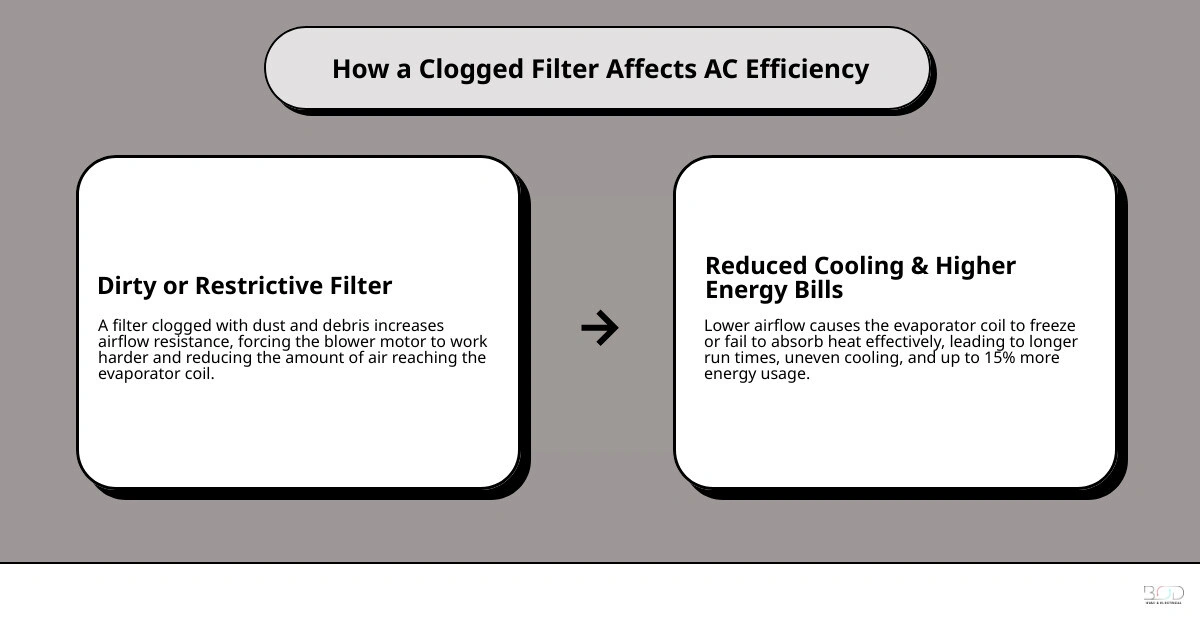
How the right filter improves your AC efficiency comes down to clean, steady airflow. A properly sized filter with a suitable MERV rating catches dust and allergens without making your system struggle to pull air through it. When a filter is dirty, too restrictive, or installed incorrectly, airflow drops. Your AC may run longer, cool less evenly, and use more energy. For homeowners seeking AC maintenance in Portland, OR, checking the filter is one of the simplest ways to support comfort, indoor air quality, and dependable cooling. A clean filter can improve air conditioner efficiency by up to 15%.
Explore AC services | Schedule AC maintenance in Portland, OR
The best filter is not always the one with the highest rating. It is the one that fits your system, household needs, and airflow capacity.
I’m Chandrine Stepisnik, and I’ll help you understand the filter choices and warning signs that can affect your AC’s performance.
Get professional AC maintenance support.
Know your how the right filter improves your ac efficiency terms:
- dirty evaporator coil air conditioner
- how a clogged filter makes your ac work harder
- how dirty air filters affect your ac and air quality
The Mechanics: How the Right Filter Improves Your AC Efficiency
To understand how the right filter improves your ac efficiency, we first need to look at how central air conditioning actually cools your home. An air conditioner does not generate cold air out of thin air. Instead, it extracts heat from your indoor living spaces. Your system’s blower motor pulls warm indoor air through return grilles, passes it through the air filter, and pushes it across the cold evaporator coil. The refrigerant inside the evaporator coil absorbs heat and moisture from the air before returning chilled, dehumidified air back through your supply ducts.
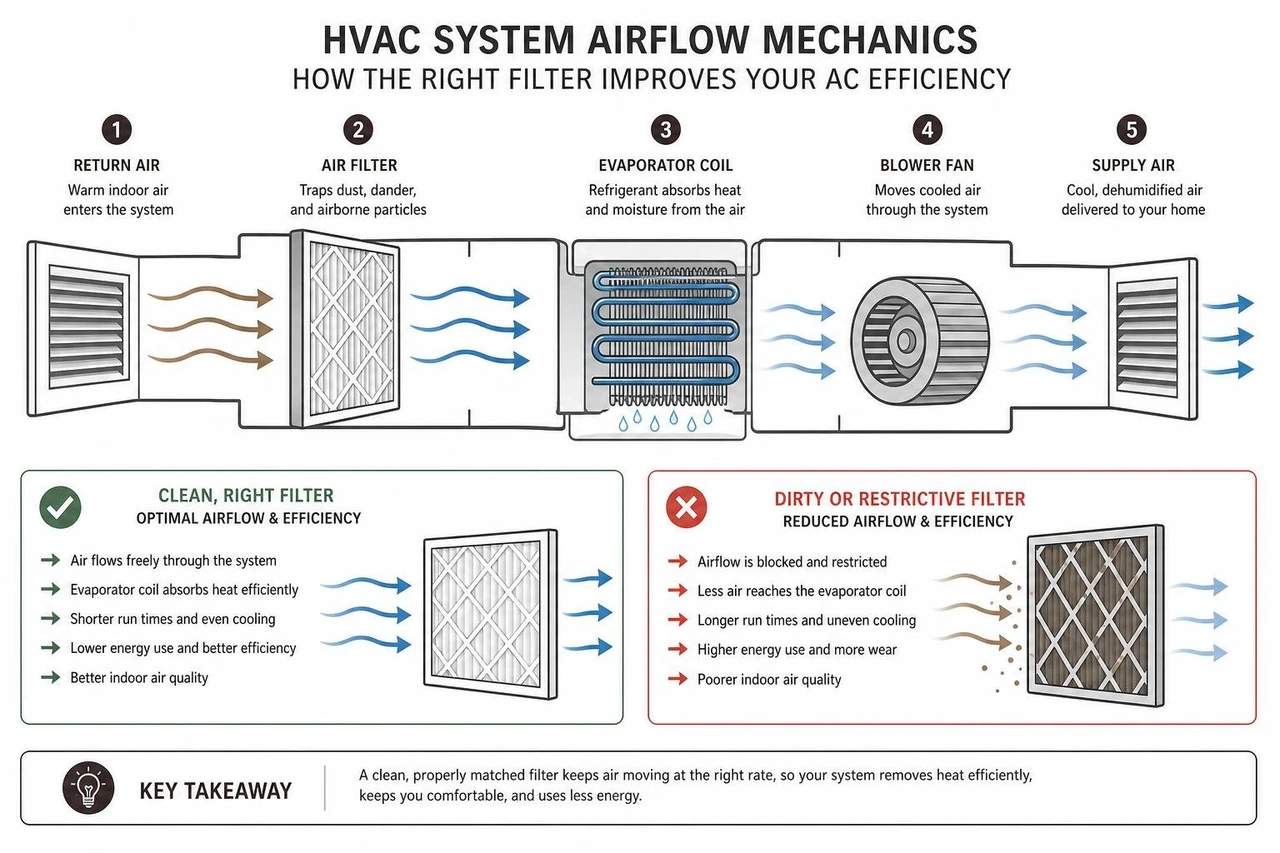
When your filter is clean and properly matched to your equipment, air flows smoothly at the velocity designed by the manufacturer (typically around 400 cubic feet per minute per ton of cooling capacity). However, when a filter is clogged with dust, dander, or lint—or if the filter medium is too dense for the system—airflow slows dramatically.
When airflow drops, your cooling system faces immediate efficiency problems:
- Reduced Heat Absorption: Without enough air passing across the evaporator coil, the refrigerant cannot absorb heat efficiently. The system has to run for significantly longer cooling cycles to meet the set temperature on your thermostat.
- Increased System Strain: The blower motor must work against restriction, drawing more power while delivering less chilled air to your rooms.
- Energy Waste: Heating and cooling account for approximately 48% of all energy used in a standard home. Operating an air conditioner with restricted airflow wastes substantial electricity, driving up summer utility bills unnecessarily.
By learning how a clogged filter makes your ac work harder, homeowners across Cornelius, Hillsboro, and the greater Portland area can prevent unnecessary strain on their cooling equipment.
Understanding Static Pressure and Blower Motor Resistance
In the HVAC industry, static pressure refers to the resistance against airflow within your ductwork and equipment, measured in inches of water column (in. w.c.). Every HVAC system is designed to operate within a specific total external static pressure limit—usually around 0.50 to 0.80 in. w.c. An air filter is an intentional point of resistance in the system, but when that resistance becomes excessive, your blower motor responds in ways that degrade efficiency.
How your system reacts to high static pressure depends largely on the type of blower motor inside your air handler:
- Permanent Split Capacitor (PSC) Motors: Older or entry-level systems frequently use single-speed PSC motors. When a dirty filter or overly restrictive media increases static pressure, PSC motors cannot adjust their speed. As resistance rises, airflow drops by up to 22%. This sharp drop in air volume causes the evaporator coil to freeze and drastically reduces cooling capacity.
- Brushless Permanent Magnet (BPM / Variable-Speed) Motors: Modern, high-efficiency systems feature ECM or BPM motors designed to maintain constant airflow. When a filter becomes dirty or overly dense, a BPM motor automatically speeds up to force air through the barrier. While this preserves airflow, it forces the motor to draw significantly more electrical power—increasing blower motor energy consumption by up to 20%.
Understanding static pressure helps explain why choosing an overly restrictive filter can backfire. Balancing particle filtration with low airflow resistance is essential to protecting motor longevity and maintaining high efficiency.
Signs That Airflow Restriction Is Lowering System Efficiency
Catching airflow restriction early helps prevent permanent component damage and high monthly bills. If your air conditioning system is suffering from air filter restriction, you will typically notice several distinct warning signs around your home.
- Iced Evaporator Coil or Refrigerant Lines: When restricted airflow prevents warm air from reaching the evaporator coil, the coil surface drops below freezing (32°F). Condensate freezes into ice, insulating the coil and completely blocking air passage.
- Warm or Weak Supply Airflow: If air coming out of your floor or ceiling vents feels lukewarm or unusually weak, restricted airflow is often the primary cause.
- Short-Cycling: High static pressure can trigger internal limit switches or cause quick system overheating, leading your air conditioner to turn on and off rapidly in short 3- to 5-minute bursts.
- Whistling Return Grilles: High suction caused by a clogged filter creates a pressure differential that pulls air around filter edges or through tiny cabinet gaps, producing high-pitched whistling sounds.
- Sudden Utility Bill Spikes: If your electricity usage jumps during summer cooling months without changes in outdoor weather or thermostat settings, your system is likely running extended cycles due to air restriction.
Deciphering MERV Ratings, Filter Types, and Thickness
Choosing the right filter requires understanding the Minimum Efficiency Reporting Value (MERV) scale. Developed by the American Society of Heating, Refrigerating and Air-Conditioning Engineers (ASHRAE) under Standard 52.2, the MERV scale measures a filter's ability to capture airborne particles ranging in size from 0.3 to 10.0 microns. MERV ratings range from 1 to 20, with higher numbers indicating smaller particle capture capabilities.
However, higher MERV ratings also naturally create more airflow resistance. Selecting the optimal filter requires evaluating cheap vs expensive air filters to strike the right balance between filtration performance and low static pressure.
How the Right Filter Improves Your AC Efficiency Without Restricting Airflow
For most residential central HVAC systems in Oregon communities like Beaverton, Tigard, and Lake Oswego, filters rated between MERV 8 and MERV 11 provide the optimal balance between high air quality and low airflow resistance.
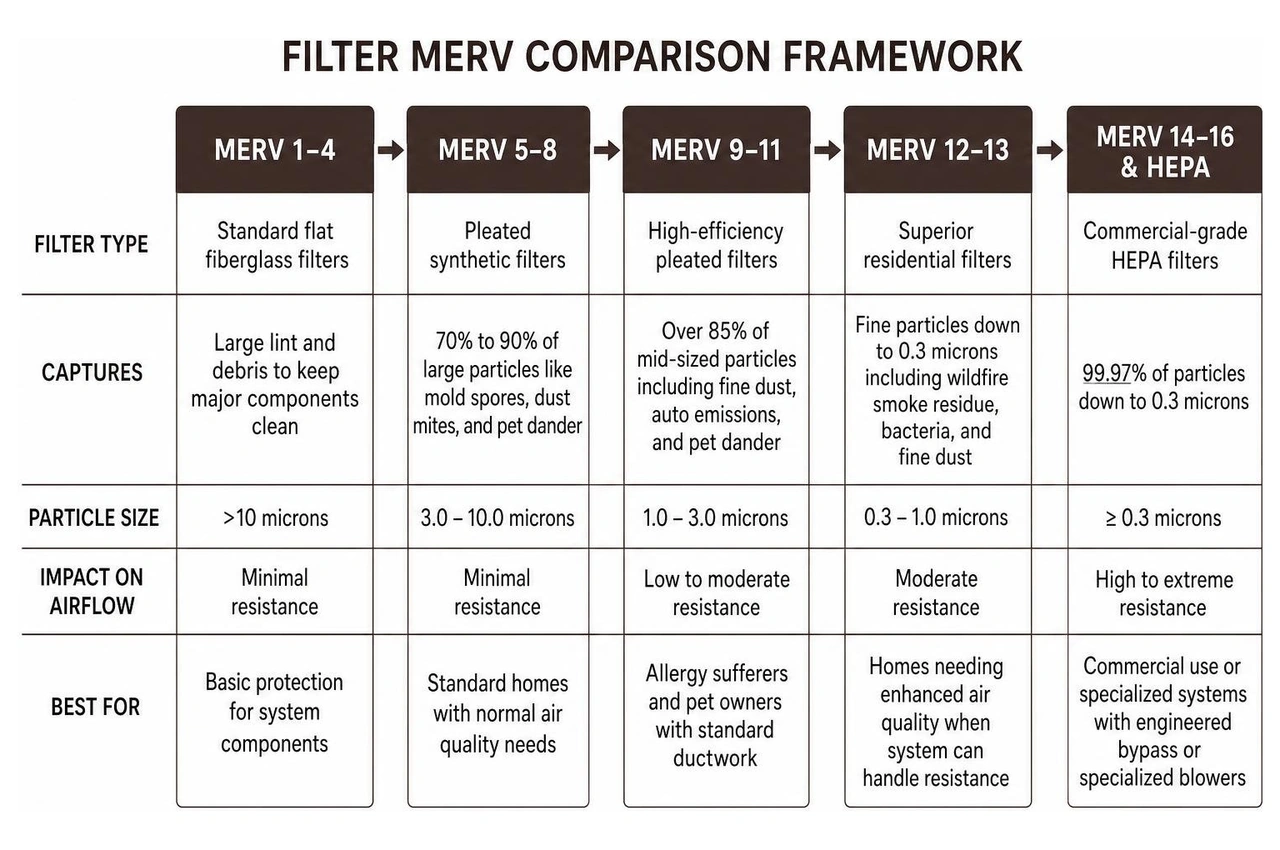
- MERV 1–4: Standard flat fiberglass filters. These capture large lint and debris (particles >10 microns) to keep major components clean, but offer zero protection against small allergens or fine dust while providing minimal air cleaning.
- MERV 5–8: Pleated synthetic filters. Captures 70% to 90% of large particles (3.0–10.0 microns) like mold spores, dust mites, and pet dander with minimal static pressure impact. Ideal for standard homes without severe allergy concerns.
- MERV 9–11: High-efficiency pleated filters. Captures over 85% of mid-sized particles (1.0–3.0 microns), including fine dust, auto emissions, and pet dander. Excellent choice for allergy sufferers or pet owners when paired with standard ductwork.
- MERV 12–13: Superior residential filters. Captures fine particles down to 0.3 microns, including wildfire smoke residue, bacteria, and fine dust. Requires verification that your HVAC system can handle the added static resistance.
- MERV 14–16 & HEPA: Commercial-grade filtration. True HEPA filters capture 99.97% of particles down to 0.3 microns but create extreme static pressure drop. They should never be installed directly into standard central residential return air slots without engineered bypass ductwork or specialized blowers.
Choosing a MERV 8 to MERV 11 filter gives homeowners an efficient solution that protects cooling components while maintaining airflow velocity. To protect indoor air quality during wildfire seasons, review best AC filter options for homes dealing with smoke and pollen.
Comparing Filter Types: Disposable, Washable, and Electronic
Not all air filters are constructed from the same materials. The three primary filter categories available for central air conditioners each affect efficiency, airflow, and routine care differently.
| Filter Category | Material Construction | Typical MERV Rating | Airflow Resistance | Efficiency & Maintenance Impact |
|---|---|---|---|---|
| Disposable Pleated | Polyester or synthetic pleated media | MERV 8 – 13 | Low to Moderate | High filtration consistency; replaced every 30–90 days; maintains low pressure drop when clean. |
| Washable / Reusable | Woven aluminum mesh or electrostatic polypropylene | MERV 4 – 6 | Moderate to High | Efficiency degrades with washing cycles; prone to mold growth if reinstalled damp; restricts airflow easily. |
| Electronic Air Cleaners | Charged ionization cells / electrostatic collectors | MERV 10 – 14 equivalent | Very Low | Minimal static pressure drop; captures tiny particles; requires regular cleaning of collection plates. |
While washable filters seem appealing for long-term convenience, they are generally not recommended for central air conditioners. Reusable aluminum mesh filters provide relatively low filtration efficiency (MERV 4–6) and accumulate stubborn debris over time. If reinstalled while still damp after cleaning, washable filters can foster mold growth inside the return ductwork and severely restrict cooling airflow.
Can High-MERV Filters Void Your Warranty or Damage New Units?
A common misconception among homeowners installing a new cooling system is that buying the thickest or highest-rated filter available will automatically improve performance. In reality, installing an overly restrictive filter (such as a MERV 13 to 16 filter on a system rated only for MERV 8) can cause serious equipment damage.
When excess static pressure starves an air conditioner of air:
- The evaporator coil freezes into a solid block of ice.
- Liquid refrigerant fails to boil off into gas and flows back down the suction line into the compressor.
- Liquid slugging damages compressor valves, resulting in total compressor failure—one of the most expensive single repairs in residential HVAC.
Furthermore, major HVAC equipment manufacturers require documentation that equipment was operated within specified static pressure limits and subjected to routine maintenance. If a technician determines that a compressor or motor failure was caused by operating against excessive static pressure from an incompatible filter, manufacturer warranty coverage for replacement parts may be denied.
Optimal Filter Replacement Schedules and Environmental Factors
Even the highest quality, perfectly matched air filter will turn into an efficiency-robbing barrier if left in place too long. As a filter traps dust, pollen, and pet hair, open passages in the media become filled. This process—known as dust loading—steadily increases static pressure drop across the filter slot.
Understanding proper replacement frequencies allows you to maximize system lifespan while enjoying lower monthly energy usage. To explore the full advantages of routine replacement, read about 5 benefits of changing your HVAC filters.
How Environmental Factors in Oregon Impact Filter Lifespan
There is no universal calendar schedule for air filter replacement. The ideal replacement timeline depends on filter depth, total equipment runtime hours, and localized environmental factors across the Pacific Northwest.
- 1-Inch Standard Pleated Filters: Inspect every 30 days during peak summer cooling months; replace every 30 to 60 days.
- 4-Inch to 5-Inch Deep Media Filters: Feature significantly more surface area due to deeper pleats. They allow greater airflow volume with lower pressure drop, typically lasting 6 to 12 months between replacements.
Localized factors that accelerate filter dust loading in Oregon homes include:
- Pets and Fur: Homes with dogs or cats accumulate dander and floating fur quickly, plugging 1-inch filters within 30 to 45 days.
- Seasonal Pollen Spikes: Spring and summer grass, tree, and weed pollen in the Willamette Valley load filters rapidly during heavy cooling periods.
- Wildfire Smoke and Airborne Particulates: Late summer smoke events carry micro-fine carbon particles that coat filter media, requiring immediate filter checks once outdoor air quality clears.
- Home Renovation and Construction Dust: Drywall dust, saw dust, and floor sanding particulates instantly clog filter fibers. Filters should always be inspected and replaced immediately following any home improvement project.
To understand how fine particulates impact indoor living spaces, read about how dirty air filters affect your ac and air quality.
How the Right Filter Improves Your AC Efficiency with Routine Maintenance
Routine filter replacement is the most effective DIY maintenance task available to homeowners. Combining timely filter changes with professional system calibration ensures that air velocity, coil cleanliness, and electrical draw remain at factory-optimized levels.
When you pair a clean filter with scheduled maintenance, your system benefits from:
- Lower amp draw on the compressor and fan motors.
- Clean coil surfaces free from airflow-blocking dust buildup.
- Balanced temperature drops (typically 18°F to 21°F) across supply and return registers.
Homeowners seeking comprehensive care can schedule professional AC maintenance in Portland, OR to ensure total system health.
Frequently Asked Questions About AC Filters and Efficiency
What MERV rating is best for balancing air quality and cooling efficiency?
For standard residential HVAC systems, a MERV 8 to MERV 11 filter provides the best balance between effective air filtration and optimal system airflow. MERV 8 filters trap up to 90% of large airborne particles like dust mites, pollen, and carpet fibers without adding significant static pressure. MERV 11 filters offer elevated capture efficiency for smaller allergens and pet dander, making them ideal for homes with pets or mild allergy concerns, provided the ductwork is adequately sized.
How often should I replace my air filter during peak cooling months?
During peak summer cooling months when your air conditioner runs daily, standard 1-inch pleated filters should be checked every 30 days and replaced at least every 30 to 60 days. If you have multiple pets, live in a high-pollen area, or suffer from allergies, monthly replacements are recommended. Thicker 4-inch deep media filters last much longer and generally only require replacement every 6 to 12 months.
Does a 4-inch media filter improve AC efficiency better than a 1-inch filter?
Yes, 4-inch media filters significantly improve airflow dynamics compared to standard 1-inch filters. Because 4-inch filters have deep, accordion-like pleats, they offer up to nine times more physical surface area than a 1-inch filter of the same length and width. This expanded surface area allows air to pass through at lower velocities, resulting in lower static pressure drop at higher MERV ratings (such as MERV 11 or 13) and providing a much longer functional lifespan.
Professional Support to Maximize Your AC Efficiency
While changing your air filter is a straightforward task, keeping your central cooling system operating at peak performance requires expert technical care. Best Owner Direct HVAC & Electrical is a family-owned HVAC, electrical, and water-heater services company based in Cornelius, OR, serving homeowners and businesses throughout the Portland metro and surrounding Oregon communities, including Hillsboro, Beaverton, Tigard, West Linn, and Lake Oswego.
Our licensed technicians provide comprehensive cooling care, static pressure diagnostics, and system tuning to ensure your filter choice works in harmony with your equipment. During a professional maintenance visit, we test total airflow resistance, inspect blower motor amp draw, clean dirty coils, and verify refrigerant charge.
Learn how expert tune-ups keep utility bills low by reviewing how a tune-up improves efficiency and lowers bills and checking our detailed AC tune-up checklist – what your technician should check.
Whether you need targeted AC tune-up in Tigard, OR, expert AC tune-up in West Linn, OR, or comprehensive indoor air quality services in Beaverton, OR, our customer-focused team is ready to help.
Ready to lower energy bills and maximize indoor comfort? Contact Best Owner Direct HVAC & Electrical today to schedule your professional AC tune-up and airflow inspection!


What Are the Symptoms of a Dirty Evaporator Coil Besides Weak Airflow?When your vents blow hard but your house still feels muggy, you might be dealing with a hidden AC issue. Discover why high humidity and non-stop cycling point to coil buildup.
Read more
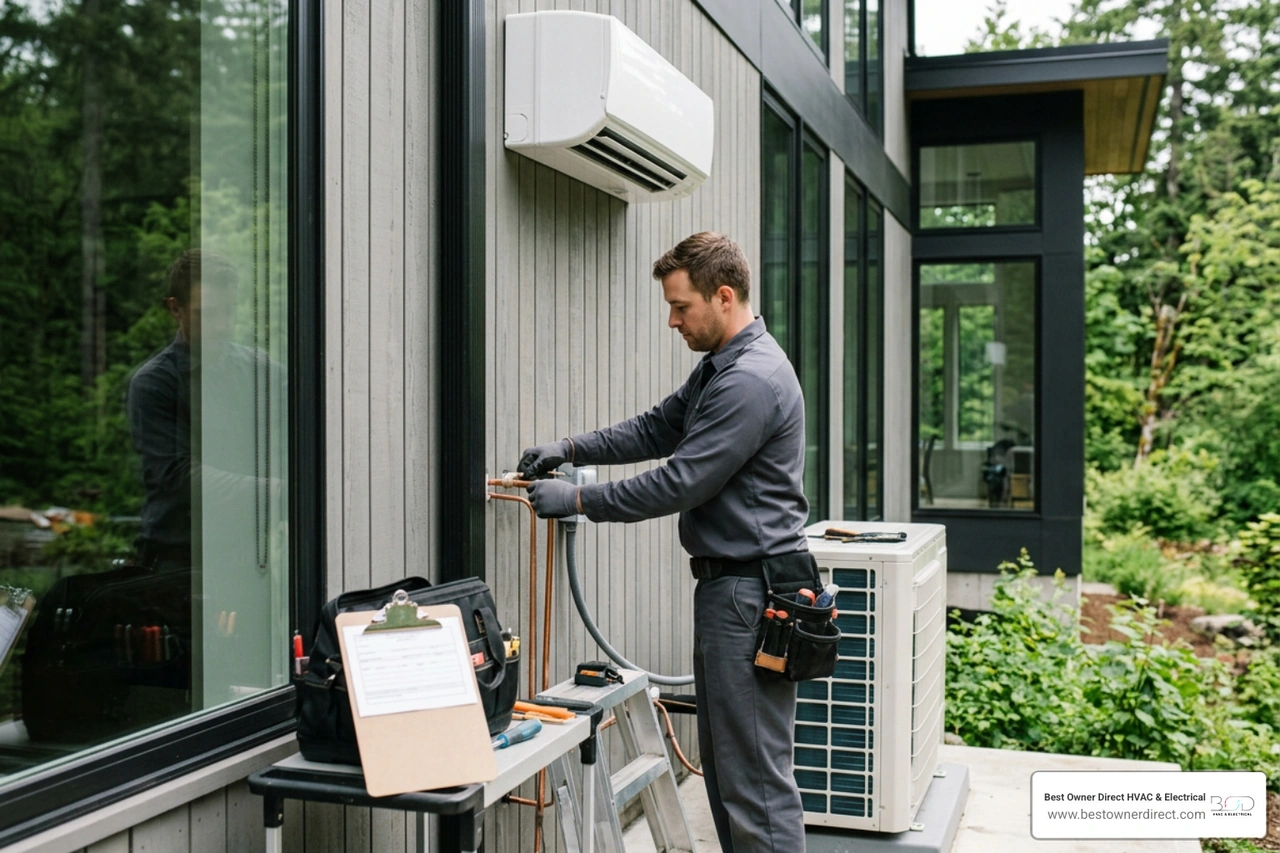
What Permits Are Needed for Mini Split Installation in Oregon?Learn what permits are needed for mini split installation in Oregon, including mechanical and electrical requirements, from Best Owner Direct HVAC & Electrical.
Read more
Sizing Hot Water Heaters for Large Families in CorneliusIf your morning routine is constantly ruined by cold showers, your tank might just be undersized. Find out how local groundwater temperatures impact your actual household demand.
Read more