Menu


The Late-Summer Cooling Trap: When Airflow Isn't the Problem
When your vents are blowing hard but your house still feels muggy, you might start searching for answers to a very specific question: what are the symptoms of a dirty evaporator coil besides weak airflow? At Best Owner Direct HVAC & Electrical, we hear this exact frustration from local homeowners all the time. It is incredibly frustrating when your equipment sounds like it is working perfectly, pushing out a strong breeze, yet the indoor environment remains sticky and uncomfortable. You check your air filter, find it relatively clean, and wonder why the living room still feels like a sauna.
This scenario is a common late-summer cooling trap. If you are experiencing this, you are dealing with an issue that goes beyond basic airflow restriction. To get to the root of the problem and restore your home's comfort, you need to rely on properly maintained air conditioning systems and expert professional HVAC services.
By the time August arrives in Cornelius, OR, and the back-to-school transition begins, our team knows your cooling equipment has been running hard for months. The demand for consistent, reliable end-of-season cooling makes any hidden system inefficiencies highly noticeable. A home that feels sticky and humid despite non-stop AC cycling is a massive red flag. Many homeowners suspect the worst—a failing compressor or a massive refrigerant leak—but in our experience, lingering indoor mugginess often points to a deeply fouled evaporator coil.
The critical decision point: You must determine if these subtle signs point to a dirty evaporator coil that requires professional intervention before the buildup leads to a complete system freeze-up. Waiting too long to address a coil that has lost its heat-transfer capabilities can turn a straightforward cleaning appointment into a costly emergency repair.
The Hidden Physics: Understanding Latent vs. Sensible Heat
To understand why an air conditioner might still blow air with strong force but fail to actually cool or dehumidify the room, you have to look at the hidden physics of the refrigeration cycle. Evaporator coils are responsible for removing two different types of heat from your indoor air: sensible heat and latent heat.
Sensible heat is the heat you can easily feel and measure with a thermometer—it is the actual temperature of the room. Latent heat, on the other hand, is the heat energy stored in moisture—it is the humidity levels in the air. When warm, humid indoor air blows across a clean, freezing-cold evaporator coil, the coil absorbs the sensible heat (lowering the temperature) and causes the moisture in the air to condense into water droplets (removing the latent heat).
When a thick layer of dust, pet hair, and biological grime coats the delicate aluminum fins of the coil, that grime acts as a highly effective insulator. It creates a physical barrier between the cold refrigerant inside the copper tubes and the warm air blowing across the outside.
• Sensible Heat — What It Controls: The actual temperature read by your wall thermostat. — How a Dirty Coil Impacts It: Takes longer to drop, causing extended cooling cycles and non-stop running.
• Latent Heat — What It Controls: The moisture and humidity levels in your indoor air. — How a Dirty Coil Impacts It: Fails completely, leaving the air feeling sticky, heavy, and extremely muggy.
Because latent heat removal relies heavily on the surface of the coil being cold enough to reach the dew point, a layer of insulating grime often causes latent heat removal to fail long before sensible heat removal fails entirely. This answers the specific search pattern: what are the symptoms of a dirty evaporator coil besides weak airflow? The system can still push air, but the physics of dehumidification are entirely broken.
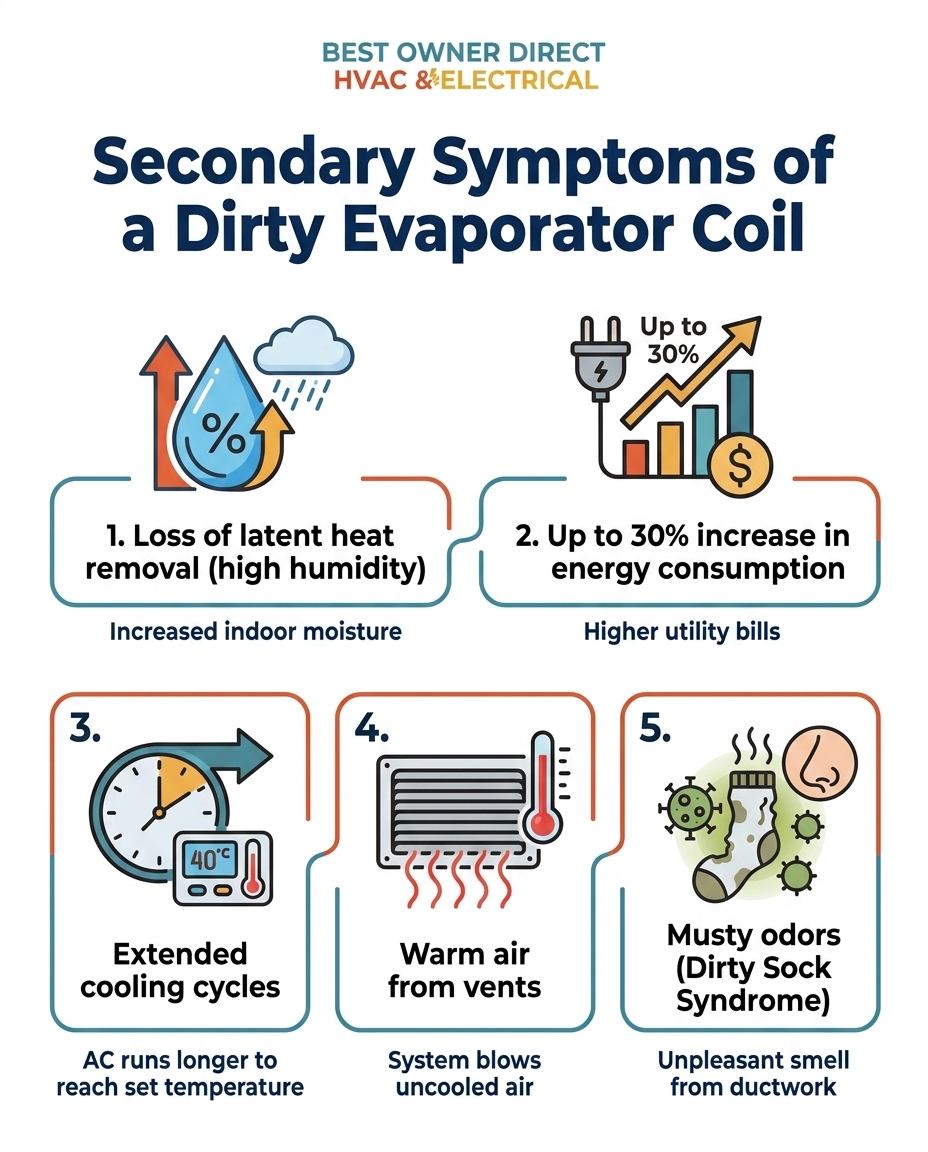
Symptom 1: Lingering Indoor Humidity and a Sticky Home
The most prominent secondary symptom of a fouled coil is a severe loss of dehumidification. A dirty coil fails to condense moisture out of the air effectively. Instead of the moisture dripping safely into the condensate drain pan and routing outside your home, the humidity simply recirculates right back through your ductwork and into your living spaces.
When this happens, your home will feel "sticky" or "muggy" rather than just warm. You might notice condensation forming on the inside of your windows, a clammy feeling on your skin, or hardwood floors that feel slightly tacky to the touch. The air feels heavy, making it difficult to get comfortable even if the thermostat reads a seemingly normal temperature.
Signs your home is losing latent heat removal:
• Clammy skin: You feel sweaty even when sitting still near an air vent.
• Musty textiles: Towels, curtains, and upholstery take on a damp, heavy feel.
• Thermostat wars: You find yourself constantly lowering the set temperature to try and achieve comfort.
• Window condensation: Moisture beads up on the interior glass of your home.
Our technicians find that this symptom often peaks in August and late summer. By this time of year, months of spring pollen, summer dust, and airborne particulates have accumulated on the coil. The late-summer heat demands peak dehumidification, making this hidden symptom severely impact your daily indoor comfort. When the coil is blanketed in grime, it simply cannot keep up with the latent heat load of a late-summer afternoon.
Symptom 2: Extended Cooling Cycles and Non-Stop Running
Another major indicator that your coil is heavily soiled is frequent or continuous cycling without the system ever reaching the set thermostat temperature. You might notice that the outdoor compressor and the indoor blower run for hours on end, yet the temperature on the wall never seems to drop.
The system runs longer because it is actively struggling to satisfy the thermostat. Due to the coil's insulating layer of dirt, the heat transfer process is severely slowed down. The equipment has to run twice as long to remove the same amount of heat that a clean coil could remove in a fraction of the time. This extended running places an immense burden on the mechanical components of your system.
Our team sees this exact pattern frequently in Cornelius, OR. For example, we recently visited a return customer who experienced a faulty fan in their HVAC system during a period of heavy end-of-season usage. One of our technicians discovered the issue, checked the electrical circuits, and replaced the failing fan with a stock part to resolve the problem. Extended run times are a primary driver of this exact type of component failure. When motors are forced to run continuously without a break, they overheat, wear out prematurely, and eventually fail entirely.
Investing in routine HVAC maintenance is the most effective way to restore efficiency and prevent these premature breakdowns. A professional cleaning removes the insulating barrier of grime, allowing the system to cycle normally, give its motors a rest, and significantly extend the lifespan of the equipment.
Symptom 3: Warm Air Blowing From Vents
As the buildup on your coil worsens, the symptoms progress from poor dehumidification to a total lack of cooling. Eventually, you will hold your hand up to a register and realize that the system is blowing completely warm, unconditioned air into the room.
This happens because the insulated coil eventually fails to remove sensible heat as well as latent heat. While the blower motor pushes air through the ductwork just fine, the air simply isn't being conditioned as it passes over the heavily soiled coil. The heat transfer process has completely stalled.
The progression of a failing coil:
1. Slight inefficiency: The system takes a few extra minutes to cool the house.
2. Humidity loss: The air feels cooler, but sticky and damp.
3. Constant running: The thermostat never reaches the target temperature.
4. Total failure: The vents blow warm air because the coil is either completely insulated by dirt or has frozen solid into a block of ice.
We always remind our customers that this symptom applies to both traditional central air conditioning units and heat pump systems operating in cooling mode. By late summer, if a heat pump's indoor coil is suffocated by dust, it will lose its ability to absorb heat from the indoor air, resulting in warm air circulating through your home right when you need relief the most.
Symptom 4: Unpleasant Odors and Dirty Sock Syndrome
Not all symptoms of a fouled coil are related to temperature and humidity; some are olfactory. If you notice a strange, unpleasant smell every time your system kicks on, your coil is likely the culprit.
This condition is commonly referred to in our industry as "Dirty Sock Syndrome." It is characterized by a musty, stale odor that smells exactly like a locker room or a pile of unwashed gym socks. This smell originates from biological growth thriving on a dirty, damp coil.
When dust and organic matter collect on the fins of the coil, they combine with the natural condensation produced during the cooling cycle. This creates a dark, wet, and nutrient-rich environment—the perfect breeding ground for biological growth. The smell is always most noticeable right when the system cycles on and the blower motor pushes that stagnant air into your living spaces.
• Electrical smells: Usually point to a failing motor or burnt wiring.
• Rotten egg smells: Indicate a dangerous natural gas leak.
• Musty, "dirty sock" smells: Directly point to biological growth on a fouled evaporator coil or a clogged condensate drain pan.
When our team encounters Dirty Sock Syndrome on a service call, we know standard filter changes will not solve the problem. These odors indicate a level of biological buildup deep within the air handler that requires specialized professional cleaning to eradicate safely.
Symptom 5: Spiking Energy Bills During the Cooling Season
There is a direct connection between the mechanical inefficiency of a dirty coil and the size of your monthly utility bills. When your equipment has to work harder and run longer to achieve the same level of comfort, it consumes significantly more electricity.
According to data from the US Department of Energy, a dirty evaporator coil can increase a system's overall energy consumption by up to 30%. That is a massive drop in efficiency. The extended run times directly correlate to higher electricity usage. Every extra minute the compressor and blower motor run is electricity being pulled from the grid.
The financial impact of a dirty coil:
• Higher baseline usage: Your system draws more power simply trying to force air through the restricted, dirty fins.
• Multiplied run times: Because the system runs constantly, your daily kilowatt-hour usage skyrockets.
• Component strain: The added stress on the compressor can lead to massive repair costs down the line.
By late summer, these extended run times can cause your energy bills to spike dramatically. While general energy rebates or federal tax credits may apply to qualifying heat pump installations if your old system fails completely, positioning professional maintenance as a priority is the smartest way to recover lost efficiency, lower your monthly operating costs, and protect your wallet from the hidden expenses of a neglected system.
Comprehensive FAQ: Dirty Evaporator Coils & AC Performance
Understanding the exact symptoms of a dirty evaporator coil besides weak airflow can help you catch minor issues before they become major headaches. If you want to learn more about the specific steps involved in cleaning your evaporator coil, professional intervention is always the safest route. Below are clear, concise answers to the most common questions homeowners ask about coil health.
Can a dirty AC coil cause high humidity?
Yes. Grime insulates the coil, preventing condensation and leaving moisture in the indoor air. When the warm air cannot make direct contact with the freezing-cold metal fins, the moisture never reaches its dew point, meaning the humidity simply blows right back into your living room.
Why is my AC running constantly but airflow is fine?
The system is failing to remove heat efficiently, forcing it to run longer cycles to reach the thermostat setting. Even if the blower motor is pushing air perfectly, the insulated coil cannot absorb the heat from that air, trapping your equipment in an endless cooling cycle.
What happens if an evaporator coil is dirty?
It leads to reduced cooling capacity, higher energy bills, potential system freezing, and premature component failure. Over time, the compressor will overheat from running constantly, and the lack of heat transfer can cause the refrigerant lines to ice over completely.
What does a dirty evaporator coil smell like?
It often smells musty or like dirty gym socks, a condition known as Dirty Sock Syndrome caused by biological growth. The combination of dust, darkness, and constant moisture creates a perfect environment for odor-causing buildup to thrive inside your air handler.
Can I clean my evaporator coil myself?
No. Evaporator coils are delicate and located deep inside the air handler. Improper cleaning can easily bend the fragile aluminum fins or damage the highly pressurized refrigerant lines, requiring a licensed professional with the right chemical cleaners and tools to do the job safely.
Restore Your Home's Comfort with Honest Diagnostics
Extended run times, high indoor humidity, warm air from the vents, and musty odors are all clear, secondary indicators of a deeply fouled coil. While weak airflow is a common symptom, it is far from the only sign that your equipment is crying out for help. Catching these hidden issues early is the key to preventing costly, premature system replacements.
If your Cornelius, OR home feels sticky and your system is running non-stop, it is time to schedule a professional diagnostic with our team. At Best Owner Direct HVAC & Electrical, leveraging our owner-direct business model means you receive honest, straightforward diagnostics that empower you with the facts. You get a clear explanation of exactly what is happening inside your air handler, allowing you to make informed decisions about cleaning and maintenance without ever being pushed into unnecessary replacements. Protect your comfort and your equipment by having a professional assess your coil today.


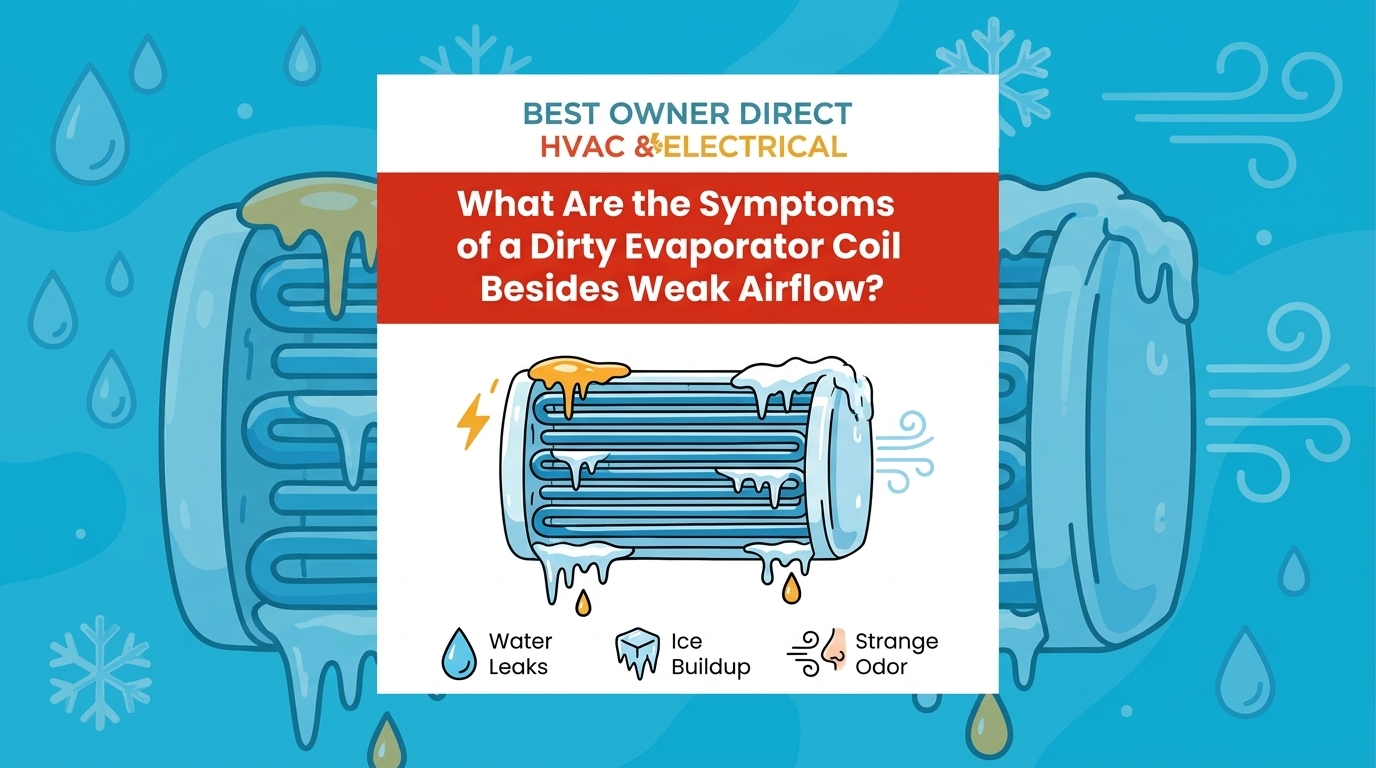
What Are the Symptoms of a Dirty Evaporator Coil Besides Weak Airflow?When your vents blow hard but your house still feels muggy, you might be dealing with a hidden AC issue. Discover why high humidity and non-stop cycling point to coil buildup.
Read more

What Permits Are Needed for Mini Split Installation in Oregon?Learn what permits are needed for mini split installation in Oregon, including mechanical and electrical requirements, from Best Owner Direct HVAC & Electrical.
Read more
Sizing Hot Water Heaters for Large Families in CorneliusIf your morning routine is constantly ruined by cold showers, your tank might just be undersized. Find out how local groundwater temperatures impact your actual household demand.
Read more