Menu


Tankless vs tank water heater for your home in Portland metro: which type fits your household?
When it comes to the tankless vs tank water heater for your home decision, here's the short answer:
| Factor | Tank Water Heater | Tankless Water Heater |
|---|---|---|
| Hot water supply | Limited by tank size (30–80 gal) | Unlimited, on demand |
| Energy efficiency | Lower — heats water 24/7 | Higher — heats only when needed |
| Lifespan | 10–15 years | 20+ years |
| Space needed | Large floor footprint | Small, wall-mounted |
| Best for | High simultaneous demand, emergency replacement | Long-term efficiency, smaller households, space-constrained homes |
Your water heater quietly works every single day — for showers, dishes, laundry, and more. Most homeowners never think about it until something goes wrong.
But when it's time to replace or upgrade, you face a real choice: stick with a traditional storage tank, or make the switch to a tankless system? Both work well, but they work very differently — and the right pick depends on your household size, daily hot water habits, available installation setup, and how long you plan to stay in your home.
Getting this decision right means fewer cold showers, better day-to-day comfort, and fewer surprise repairs down the road. This guide breaks it all down so you can choose with confidence.
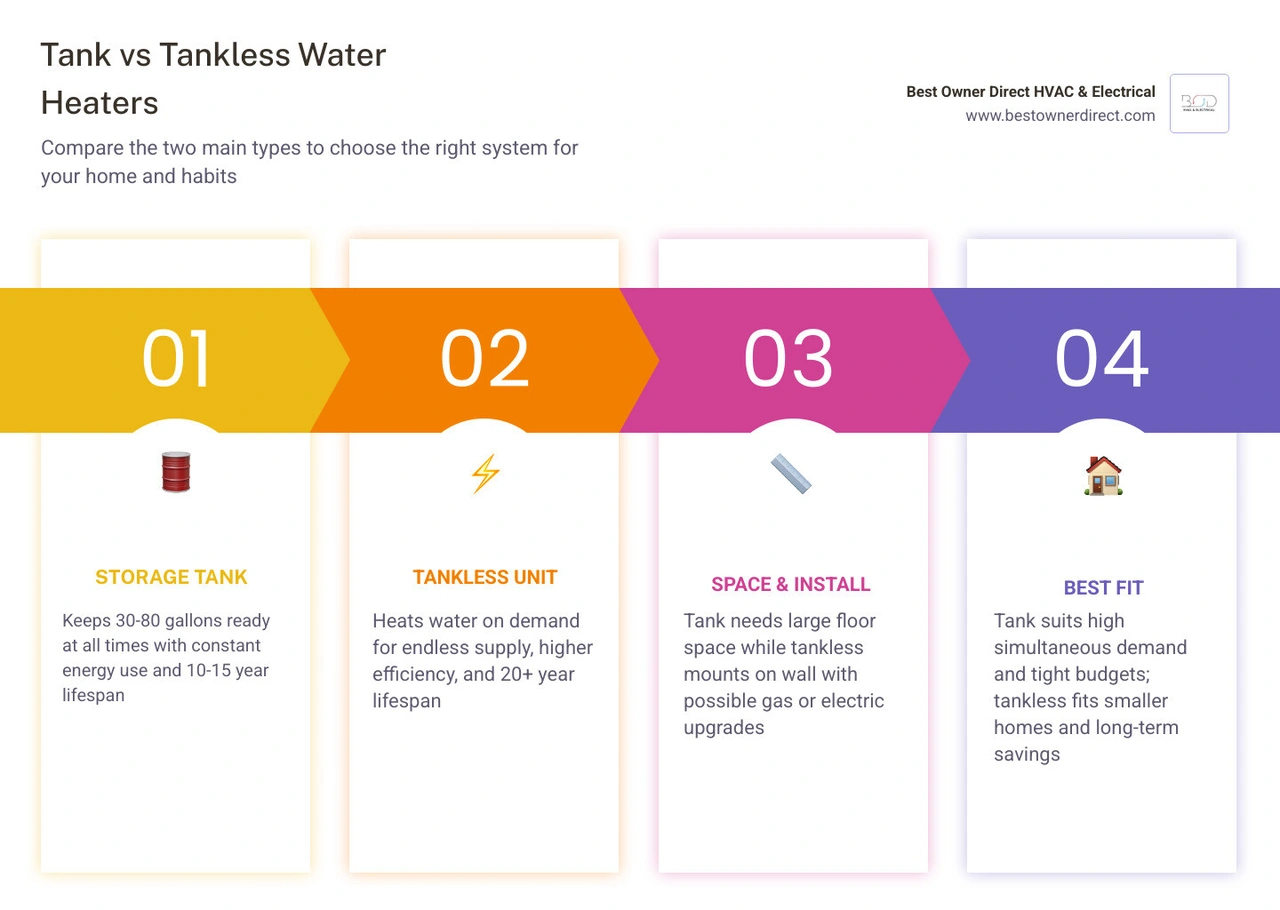
Know your tankless vs tank water heater for your home terms:
Tankless vs tank water heater for your home: the biggest differences
At the simplest level, a tank water heater stores hot water, while a tankless water heater makes hot water only when you ask for it.
A traditional tank heater keeps a reservoir of heated water ready to go. That is convenient, but it also creates standby heat loss, meaning energy is used all day to keep that water hot even when nobody is showering, washing dishes, or doing laundry.
A tankless unit is a demand heater. It turns on when hot water flows through it, heats that water through a heat exchanger, and shuts off when the demand stops. That is why tankless systems are generally more efficient and why they can deliver long showers without the dreaded "someone used all the hot water" moment.
Still, there is no universal winner. Tank models handle bursts of simultaneous demand well, and tankless models have flow limits that matter in larger households.
| Feature | Tank Water Heater | Tankless Water Heater |
|---|---|---|
| Water heating method | Stores and reheats water in a tank | Heats water on demand |
| Standby energy loss | Yes | Minimal |
| Hot water duration | Limited by stored volume | Continuous if sized correctly |
| Performance during heavy simultaneous use | Often strong if tank is sized right | Can struggle if demand exceeds GPM rating |
| Size | Larger floor footprint | Compact wall-mounted design |
| Leak risk | Higher due to stored volume | Lower stored-water risk |
| Key sizing metric | First-hour rating | Gallons per minute and temperature rise |
What is a tank water heater and how does it work?
A tank water heater is the familiar storage-style unit found in many garages, basements, utility closets, and laundry rooms. Most residential models store roughly 30 to 80 gallons of water.
Here is how it works:
- Cold water enters the tank through a dip tube.
- A gas burner or electric heating elements warm the stored water.
- A thermostat maintains the target temperature.
- Hot water exits from the top of the tank when you open a faucet.
- As hot water leaves, new cold water enters and begins heating.
This system is simple and proven. The tradeoff is recovery time. Once you use a large share of the hot water in the tank, you may need to wait while the unit reheats another batch.
What is a tankless water heater and how does it work?
A tankless water heater does not store hot water. Instead, it heats water as it moves through the unit.
Here is the basic process:
- You turn on a hot water tap.
- Water flow activates the heater once it reaches the minimum trigger rate.
- Gas burners or electric elements heat a heat exchanger.
- Water passing through the exchanger is heated to the set temperature.
- The unit shuts off when the tap closes.
Most whole-home tankless units are sized by gallons per minute, often in the 2 to 5 GPM range for smaller units and higher for larger gas models. Performance depends on both flow rate and temperature rise, which is the amount the system must raise incoming water temperature. In Oregon, colder incoming groundwater in winter can reduce how much hot water a single unit can deliver at once.
Tankless vs tank water heater for your home: convenience and performance differences
Convenience is where homeowners usually feel the difference first.
With a tank system, you can absolutely get plenty of hot water, but the supply is finite. If two showers, the dishwasher, and laundry all pile on at once, the tank can run low. That is when the last person into the shower starts negotiating with destiny.
With tankless, you do not run out of stored hot water because there is no tank to empty. But the system still has a limit: if household demand exceeds the unit's flow capacity, water temperature can drop.
Other real-world performance differences include:
- Long showers: tankless usually wins
- Simultaneous use in multiple bathrooms: depends heavily on sizing
- Dishwashers and laundry during shower time: tank models can do well if the first-hour rating is strong, while tankless may need a larger unit or multiple units
- Cold water sandwich: some tankless systems can briefly deliver a cool burst between hot water draws
- Recirculation: can improve wait times and comfort for either type
- Power outages: tankless systems generally need electricity for controls and ignition; a tank may still have some already-heated water available for a short time
Pros and cons of each water heater type
There is no magic water heater. Every system involves tradeoffs in efficiency, maintenance, installation, reliability, and daily performance.
Pros and cons of traditional tank water heaters
Traditional tank water heaters remain popular for good reason.
Pros:
- Simple, familiar technology
- Easier like-for-like replacement in many homes
- Lower barrier to replacement when a heater fails unexpectedly
- Strong peak delivery if tank size and first-hour rating match household demand
- Repairs and maintenance are usually straightforward
Cons:
- Limited hot water supply
- Standby heat loss from keeping water hot around the clock
- Larger footprint
- Shorter service life, typically around 10 to 15 years
- Greater leak and water-damage risk as tanks age
If your current tank is leaking, rusting, or pooling water, do not ignore it. A failing storage heater can become a major cleanup problem. We cover that in more detail here: Can a Leaking Hot Water Heater Be Repaired
Pros and cons of tankless water heaters
Tankless systems appeal to homeowners who want better efficiency, longer life, and more flexible installation options.
Pros:
- Heats water only when needed
- Can be 24% to 34% more energy efficient for homes using 41 gallons or less of hot water daily
- Still offers efficiency gains of 8% to 14% in higher-use homes around 86 gallons per day
- Longer lifespan, often more than 20 years
- Compact wall-mounted design
- Endless hot water when sized correctly
- Lower risk of catastrophic tank rupture from stored water
Cons:
- More demanding installation requirements
- Performance depends heavily on correct sizing
- Annual descaling is especially important in hard water areas
- A retrofit may require venting, electrical, or gas-line upgrades
- Some homes need more than one unit for heavy simultaneous use
If you want a more local look at tankless planning, see our Best Tankless Water Heater Beaverton Guide.
When a traditional tank water heater may be the better choice
A lot of articles try to declare tankless the winner every time. Real homes are messier than that.
A traditional tank may be the better fit when:
- You need an emergency replacement fast
- Your home is already set up for a direct tank swap
- You expect very high simultaneous demand
- You do not want to make gas, venting, or panel upgrades
- You plan to move in the near future
- You want the simplest replacement path
For a broader overview of water heater options, visit our Ultimate Water Heater Guide 2026.
Efficiency, lifespan, and long-term value
Which type is more energy efficient and how much can you save?
On efficiency, tankless usually has the edge because it avoids standby losses.
Research from the U.S. Department of Energy shows that demand water heaters can be:
- 24% to 34% more energy efficient in homes using 41 gallons or less of hot water daily
- 8% to 14% more efficient in homes using around 86 gallons per day
Why the bigger advantage in smaller-use homes? Because stored-water losses matter more when the heater spends lots of time waiting around. A tank heater keeps reheating water whether anyone needs it or not.
In practical terms, homeowners often report annual energy savings with tankless systems, and many see savings above $100 per year depending on fuel type, usage patterns, and the efficiency of the old unit being replaced. Some high-efficiency setups can reduce water-heating costs even more, especially when replacing older electric tanks.
Condensing gas tankless models can improve efficiency further by capturing additional heat from exhaust gases.
How long tank and tankless water heaters typically last
Typical service life looks like this:
- Tank water heater: about 10 to 15 years
- Tankless water heater: often 20 years or more
That is one of the strongest arguments for tankless. A well-maintained tankless system may outlast two lower-end tank replacements over the same span.
Tank systems usually fail from internal corrosion, sediment buildup, or tank leaks. Tankless units often have replaceable parts, but they depend more on maintenance and clean heat-exchanger performance.
For tank units, checking the anode rod and flushing sediment can help extend service life. For tankless, descaling is the big one.
How water quality and climate affect performance
Water quality matters more than many homeowners realize.
Hard water causes mineral scale buildup inside both tank and tankless systems, but tankless heaters are especially sensitive because scale can coat the heat exchanger and reduce efficiency, flow, and lifespan. If your home's water is hard, a softener or regular descaling schedule can make a major difference.
Climate matters too. Colder incoming groundwater means the heater must work harder to raise water to your set temperature. In cooler weather, a tankless unit's available GPM can drop because it is spending more energy per gallon. This does not make tankless bad in Oregon, but it does mean proper sizing is essential.
Tank heaters can also lose efficiency in cooler spaces. If you have a standard tank in an unconditioned area, insulation can help. Our article on Increase Your Water Heaters Efficiency with a Blanket explains when that makes sense.
Installation, space, and maintenance requirements
Installation needs for tank water heaters
Tank water heaters are often easier to replace when you are installing another similar unit in the same location.
Common installation considerations include:
- Adequate floor space
- Drain pan and drainage planning where required
- Proper venting for gas models
- Safe clearances and service access
- Expansion tank or other code-required components depending on the plumbing system
A same-location swap is often more straightforward than converting from tank to tankless. If you are planning installation in our service area, our Water Heater Installation Cornelius OR page is a helpful starting point.
Installation needs for tankless water heaters
Tankless installation is where the details really matter.
Depending on the home and fuel type, a tankless system may require:
- Gas line upsizing for higher BTU demand
- Dedicated electrical circuits
- Approved venting materials and vent routing
- Condensate drainage for condensing models
- Wall mounting with proper clearances
- Permit review and code-compliant setup
This is why not every tank-to-tankless swap is simple. Some homes are nearly ready for it. Others need meaningful infrastructure changes first. If you are exploring options locally, see our Tankless Water Heaters Beaverton OR service page.
Which type is better for small spaces and renovation constraints?
If space is tight, tankless is often the clear winner.
Because a tankless unit mounts on the wall and does not need a large storage cylinder, it can work well in:
- Small utility rooms
- Tight closets
- Condos
- ADUs
- Remodels where floor space matters
That said, the vent path, service clearances, and utility connections still matter. A compact heater is not the same thing as a no-planning heater.
For homes in our area considering this type of upgrade, our Tankless Water Heater Gladstone OR Guide may help.
Maintenance and safety considerations for both systems
Both types need maintenance. The myth that one can be installed and forgotten forever is how homeowners end up making emergency calls.
For tank water heaters:
- Flush sediment periodically
- Inspect the anode rod on schedule
- Test the temperature and pressure relief valve
- Watch for rust, rumbling, or moisture around the base
For tankless water heaters:
- Descale regularly, often annually in hard water conditions
- Clean filters
- Check venting and combustion components on gas units
- Inspect for error codes or reduced performance
Important safety considerations for both:
- Set safe temperatures to reduce scald risk
- Use licensed installation and service
- Monitor for leaks
- Ensure proper combustion safety and venting on gas units
- Never ignore unusual noises, error codes, or fluctuating water temperature
If you need urgent help, our Water Heaters 24 Hour Service in Portland OR page explains what to do next.
How to choose the right water heater for your household
The right choice usually comes down to a handful of practical questions, not marketing slogans.
Homeowner decision factors:
- How many people live in the home?
- How many bathrooms do you have?
- Do people shower one after another, or all at once?
- Do you often run laundry and dishes during peak morning or evening use?
- Are you replacing in an emergency or planning ahead?
- Is space limited?
- Is your water hard?
- Do you plan to stay in the home for many years?
- Is your house already equipped for gas or high electrical demand?
- Are rebates or incentives available for your upgrade?
Tankless vs tank water heater for your home based on household size and hot water demand
Household size matters, but usage pattern matters even more.
1 to 2 people:
- Tankless is often a great fit if usage is moderate and mostly sequential
- A smaller tank can also work well if simplicity is the priority
3 to 4 people:
- Either type can work
- The better choice depends on whether showers and appliances overlap often
5+ people:
- A properly sized large tank may be practical for high simultaneous demand
- A tankless system may still work very well, but sizing must be precise and sometimes multiple units are needed
The key is peak demand, not just daily demand. A family that showers one after another may love tankless. A household that runs two showers, the dishwasher, and laundry all at once needs careful design.
Gas vs electric considerations homeowners should check first
Before choosing a unit, check the basics:
- Is natural gas available?
- Can the existing gas line support a larger demand heater?
- Does the electrical panel have enough capacity for an electric model?
- Is there a practical vent route for gas equipment?
- What do you want the system to do during a power outage?
Gas tankless models often offer stronger whole-home performance than electric tankless models, especially for larger households. Electric tankless may work well in smaller applications, but whole-home electric models can require substantial electrical capacity.
Are rebates, tax credits, or financing options available?
In 2026, some high-efficiency water heaters may qualify for incentives, depending on the exact equipment and current program rules. Eligibility changes, so it is smart to check current federal, utility, and local offerings before installation.
If you are exploring broader efficiency incentives, our Heat Pump Water Heater Rebates and Incentives guide is a useful place to start.
Should you consider a heat pump water heater instead?
Possibly. If you are comparing options seriously, do not stop at tank vs tankless.
A heat pump water heater can be an excellent middle ground for some Oregon homeowners. It uses electricity very efficiently, can qualify for strong incentives, and may outperform a standard electric tank by a wide margin. The tradeoffs are slower recovery in some situations, space and airflow needs, and performance that depends on installation conditions.
To compare all three paths, read:
- Tankless vs Tank vs Heat Pump Water Heater Comparison
- Heat Pump Water Heater vs Traditional Tank Comparison
Frequently Asked Questions about tankless vs tank water heater for your home
Can a tankless water heater supply a whole house?
Yes, if it is properly sized for the home's peak hot water demand. That means matching the unit's GPM output to the fixtures likely to run at the same time. In larger homes, one unit may not always be enough.
Does tankless hot water arrive faster at the tap?
Not necessarily. Hot water speed mostly depends on the distance between the heater and the fixture, plus whether the home has a recirculation system. Tankless can also have a short activation delay. So while it gives continuous hot water, it does not automatically mean instant hot water.
Should you replace a failing tank with another tank or switch to tankless?
It depends on timing and infrastructure. If your current unit fails suddenly and you need hot water restored quickly, another tank may be the most practical choice. If you are renovating, planning ahead, or staying in the home long term, tankless may be worth serious consideration. The best answer comes from an on-site evaluation of your hot water habits, utility connections, and installation constraints.
Conclusion
The best answer to tankless vs tank water heater for your home is the one that fits how your household actually lives.
Tank water heaters still make sense for many homes, especially when straightforward replacement, strong peak delivery, and simplicity matter most. Tankless systems shine when efficiency, space savings, longer lifespan, and endless hot water are high priorities.
At Best Owner Direct HVAC & Electrical, we help homeowners across the Portland metro and surrounding Oregon communities make informed, practical choices based on comfort, safety, and long-term value. Proper sizing and licensed installation matter just as much as the equipment itself.
If you are ready to compare your options, learn more about our water heater services.


Why We Always Check the Evaporator Coil Before Switching to HeatThat harsh burning smell when you first turn on your furnace isn't always harmless dust. Learn how summer grime left on your AC coil becomes a hidden heating hazard.
Read more

Step-by-Step Guide to Mini Split Benefits for Garages & Bonus RoomsDiscover the mini split benefits for additions garages and bonus rooms with our step-by-step guide on zoned comfort, energy savings, and installation.
Read more
Gas Furnaces vs. Electric Heat Pumps for Pacific Northwest WintersBefore the cold sets in, deciding between a standard heat pump and a dual-fuel system is crucial. Explore how wet, near-freezing climates impact your heating choices.
Read more