Menu


The Quick-Fix Cooling Myth: Redirecting Airflow the Wrong Way
Closing vents in unused rooms doesn't save energy—it actually forces your equipment into overdrive. If you are unmasking the truth about magnetic vent covers on floor registers, the reality is far more complicated than a simple DIY hack. At Best Owner Direct HVAC & Electrical, our team frequently sees homeowners who think blocking off the guest room will push a blast of cold air into that sweltering master bedroom, but modern climate control simply does not work that way. Instead of solving the problem, you are quietly suffocating the very machinery designed to keep you comfortable.
To understand why this happens, we need to look at your HVAC system as a complete, precisely balanced ecosystem. If you are tired of battling hot upstairs rooms and need professional help, our HVAC services can provide safe, mechanical solutions that actually work.
The Garden Hose Fallacy
In our years of serving the area, our technicians consistently notice that many Cornelius OR homes with uneven cooling suffer from the same architectural challenges: long duct runs, second-story solar heat gain, and fundamental physics dictating that heat rises. When the upstairs feels like a sauna, the temptation is strong to head to the local hardware store and buy a pack of magnetic vent covers.
The logic seems sound at first glance. If you pinch a garden hose, the water sprays out faster and harder from the remaining opening. Homeowners assume ductwork operates on the same principle. They believe that by sealing off the downstairs floor registers, they are forcing all that precious, chilled air up to the second floor.
Here is the thing: your ductwork is not a garden hose, and air does not behave like water. Your home's cooling infrastructure is a closed-loop environment. The blower motor is calibrated to move a very specific volume of air—measured in cubic feet per minute (CFM)—across the indoor coil. When you seal off a register completely, you do not magically redirect that air. You simply create a roadblock. The air backs up, pressure builds inside the sheet metal, and the system begins to suffocate. This invisible damage compounds day after day, setting the stage for catastrophic failure just when you need the cooling the most.
What Happens If You Cover a Vent with a Magnetic Seal?
The Problem: During August late-summer heat, desperation sets in. The upstairs bedrooms are stifling, and the downstairs feels like a refrigerator. You place a magnetic seal over the downstairs vents, hoping to force the cold air upstairs.
The Cause: There is a massive mechanical difference between slightly adjusting the directional louvers on a standard vent and creating a near-perfect airtight seal with a piece of rubberized plastic. When you adjust a louver, air still escapes, albeit in a different direction. When you apply a magnetic cover, you completely dead-end that branch of the ductwork. The blower motor is still trying to push the same volume of air through a suddenly restricted network. Because the air has nowhere to go, the air velocity slows down across the entire system.
The Solution: The transparent truth we share with all our Best Owner Direct HVAC & Electrical customers is that hardware store gimmicks cannot override mechanical engineering. As an owner-direct company, we prioritize giving you the unfiltered facts about your equipment so you can avoid costly, self-inflicted repairs. Instead of closing vents in unused rooms, you must keep the airflow pathways open. Blocking vents actually reduces the total cooling capacity of your home. The cold air sits stagnant in the ducts, absorbing heat from the attic or crawlspace before it ever reaches your living areas, meaning your unit runs longer, works harder, and cools less.
The Domino Effect of Air Restriction
• Velocity drops: The speed of the air moving through the remaining open vents decreases, rather than increases.
• Temperature plummets at the coil: Because less warm return air is flowing over the indoor equipment, the internal temperatures drop to dangerous levels.
• Equipment strains: The blower motor works twice as hard to push air against a literal wall, drawing excess electricity and generating excess heat.
The Hidden Danger of Static Pressure Spikes
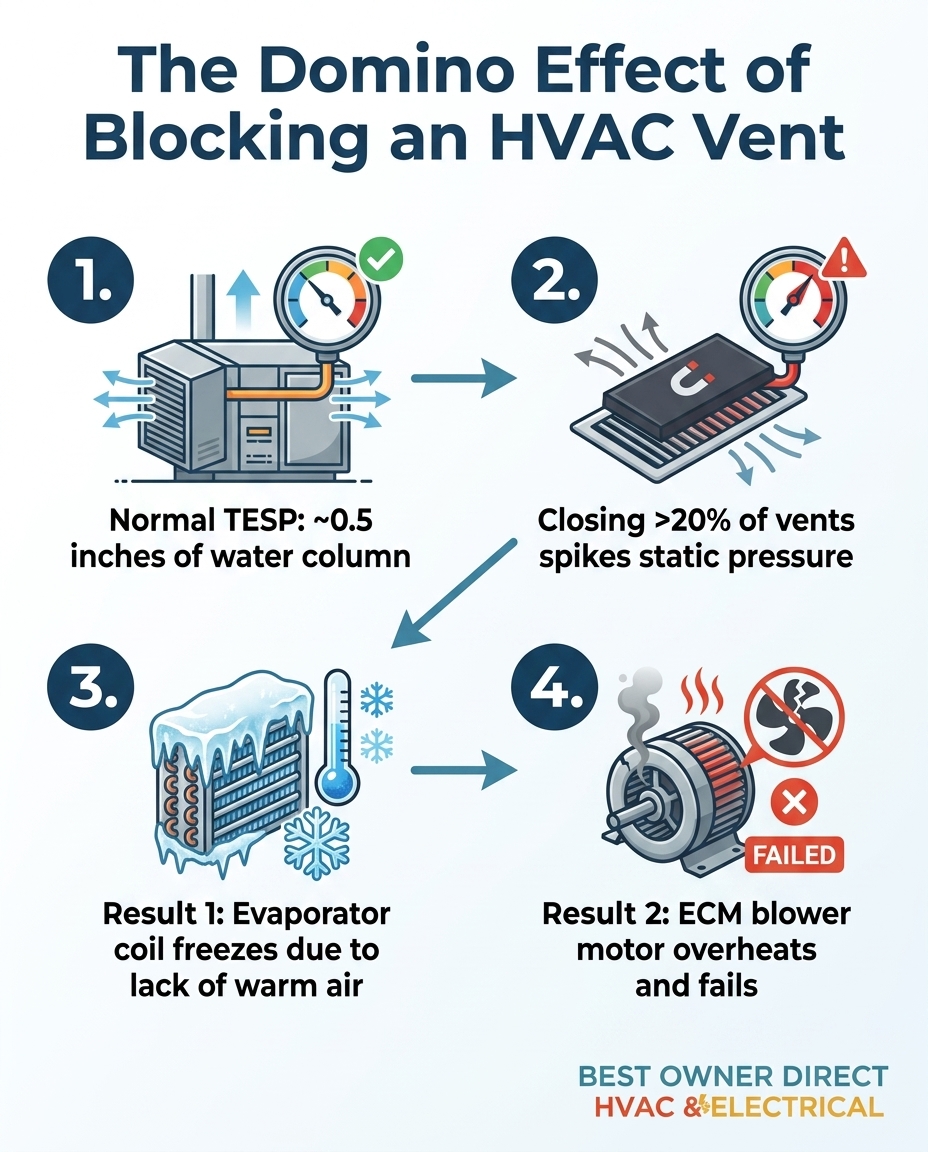
When our team measures airflow during a late-summer service call, we look closely at Total External Static Pressure (TESP). In the HVAC industry, static pressure is the resistance the blower motor must overcome to circulate air throughout your home. You can think of it exactly like human blood pressure. If your arteries are clear and wide, the heart pumps easily. If the arteries are clogged or restricted, blood pressure spikes, and the heart has to work dangerously hard to keep you alive.
Most residential systems are engineered to operate at a TESP of around 0.5 inches of water column. This is the sweet spot where the motor moves the perfect amount of air without overworking. When you seal off even 20 percent of your home's registers, you drastically alter this baseline. Static pressure spikes immediately.
Measuring the Invisible Threat
When static pressure spikes, the symptoms aren't always immediately obvious to the homeowner, but the internal components feel the stress instantly. The higher the pressure, the lower the airflow volume.
• All Vents Open (Normal) — Static Pressure Level: ~0.5 inches of water column — Blower Motor Strain: Normal / Efficient — Airflow Volume (CFM): Optimal (100%)
• 10% Vents Sealed — Static Pressure Level: Elevated (~0.6 - 0.7) — Blower Motor Strain: Moderate Strain — Airflow Volume (CFM): Reduced by ~15%
• 20%+ Vents Sealed — Static Pressure Level: Critical (0.8+) — Blower Motor Strain: Severe Overheating — Airflow Volume (CFM): Drastically Reduced
This spike in resistance forces your equipment to fight against itself. The motor is pushing, but the ductwork is pushing back. This tug-of-war is a pattern we see often, and it is the root cause of the most expensive summer breakdowns we encounter.
Choking the System: Frozen Evaporator Coils and AC Failure
The Problem: It is the middle of a Cornelius late August heatwave, right around the back-to-school transition. Your system has been running for hours to keep up with the soaring temperatures. Suddenly, the air coming from the remaining open vents feels lukewarm, and eventually, the airflow stops entirely. You check the indoor unit and find the copper lines encased in a thick block of solid ice.
The Cause: Your air conditioning does not actually "create" cold air; it removes heat from the existing air in your home. The evaporator coil, located inside your house, is filled with freezing cold liquid refrigerant. For the system to work, the blower motor must constantly push warm, unconditioned air over this coil. The refrigerant absorbs the heat, and the newly cooled air is pushed back into the house.
When you use magnetic vent covers, you drastically reduce the volume of warm air reaching that coil. Without enough heat to absorb, the temperature of the refrigerant drops below freezing. The natural humidity and condensation in the air immediately freeze to the metal fins. Within a few hours, the entire coil becomes a solid block of ice, choking off airflow completely.
The Solution: Never restrict the airflow. We see firsthand how quickly mechanical strain can take down a system. One local homeowner called us when an inducer motor failed within a month of replacement; our team returned immediately to replace the faulty unit free of charge. While that specific call involved a heating component, the principle we observe remains exactly the same for cooling: when parts are pushed past their engineered limits by restricted airflow, they fail prematurely. Keeping all vents open ensures the evaporator coil receives the steady stream of warm air it needs to function safely.
Blower Motor Burnout: Pushing Equipment Past Its Limits
While a frozen coil is a massive inconvenience, a burned-out blower motor is a major mechanical failure. Modern residential HVAC systems are frequently equipped with Electronically Commutated Motors (ECM). These are smart, variable-speed motors designed to ramp up or down based on the system's needs.
Why ECM Motors Suffer the Most
When an ECM motor senses an increase in static pressure—like the resistance caused by magnetic vent covers—its internal computer assumes the home needs more airflow to meet the thermostat's demand. To compensate for the blockage, the motor automatically increases its RPMs.
This creates a vicious, compounding cycle. The motor spins faster and faster, trying to force air through a closed duct network. As it spins faster, it draws significantly more electricity. This excess electrical draw generates immense heat inside the motor housing. Because the blower motor relies on the circulating air to keep itself cool, the restricted airflow means the motor is running hotter than ever before.
By the time late summer arrives, your blower motor has already endured months of heavy, continuous operation. Adding severe static pressure restriction at the end of the season dramatically increases the risk of a total burnout. During a recent late-summer heatwave, a customer reached out because their old AC system had been deemed unfixable previously. Our Best Owner Direct HVAC & Electrical technician tracked down a difficult-to-find part and repaired the system, restoring it to good working condition. We go the extra mile to save your equipment, which is why we strongly advise against using vent covers that force your motor into an early grave. Replacing a burned-out ECM motor is a major repair that far outweighs any perceived energy savings from closing a few vents.
Winter Warnings: Why House Vents Need Airflow Year-Round
As we approach the end of the cooling season, it is easy to assume that airflow restriction is only a summer problem, but the rules of static pressure do not change with the seasons. When the cold winters eventually arrive in Cornelius, your heating systems rely on the exact same ductwork and blower motor to keep your home warm.
Metal Fatigue and Furnace Safety
During the winter heating cycle, the blower motor pushes cold return air over a metal heat exchanger. The heat exchanger contains the extremely hot combustion gases from the furnace burners. As the air passes over the hot metal, it warms up and is distributed throughout the house.
If you leave those magnetic vent covers in place during December, you restrict the airflow over the heat exchanger. Without enough cold air passing over it to absorb the heat, the metal heat exchanger overheats rapidly. The metal expands far past its designed tolerances. When the cycle ends, it cools and contracts.
Repeated overheating and rapid expansion cause metal fatigue. Eventually, the heat exchanger will crack. A cracked heat exchanger is not just an expensive repair; it is a critical safety hazard that can allow carbon monoxide to leak into your living space. If a heat exchanger cracks, the entire component—and often the entire furnace—requires complete replacement. Magnetic vent covers for floor registers are just as dangerous in the dead of winter as they are during a summer heatwave.
Safe Alternatives for Balancing Your Home's Temperature
You do not have to settle for a sweltering upstairs bedroom, nor do you have to resort to dangerous DIY airflow restrictions. In our daily operations, we recommend several safe, professional methods for achieving even cooling throughout your multi-level home.
1. Invest in Professional Duct Balancing: A licensed technician can evaluate your ductwork and install mechanical dampers near the central plenum (not at the floor registers). This allows for the precise, safe redirection of air volume without spiking the total external static pressure.
2. Consider a Zoned HVAC System: True zoning involves multiple thermostats and motorized dampers integrated directly into the system's control board. The system intelligently communicates with the blower motor, adjusting output safely so that only the rooms that need cooling receive it, without straining the equipment. (Energy Trust of Oregon and local utility incentive programs may apply to qualifying high-efficiency upgrades; the federal Section 25C credit ended for installations completed after December 31, 2025, so check current details with your utility provider.)
3. Keep Interior Doors Open: Airflow requires a return path. If you close the bedroom doors upstairs, the air cannot easily flow back to the central return vent. Leaving doors cracked open promotes a healthy, balanced circulation of air throughout the house.
4. Run the Fan in 'ON' Mode: Instead of leaving your thermostat fan setting on 'AUTO', switch it to 'ON'. This keeps the blower motor running continuously at a low, energy-efficient speed, constantly mixing the air between the hot upstairs and the cooler downstairs, evening out the temperature differences.
5. Schedule Routine Maintenance: Before extreme weather hits, have your system evaluated. Recently, a homeowner contacted us in the spring because their AC system was not functioning correctly. Although we did not have the needed part initially, our technician quickly diagnosed the issue and got the system running perfectly before summer arrived. A clean, well-maintained system naturally pushes air more effectively than a neglected one.
Frequently Asked Questions About Airflow and Vent Covers
What happens if you cover a vent?
If you cover a vent, you immediately restrict the total airflow circulating through your HVAC system. This blockage causes a spike in static pressure inside the ductwork, forcing the blower motor to work significantly harder to move the same amount of air. Ultimately, this leads to overheating motors, frozen evaporator coils in the summer, and potential heat exchanger damage in the winter.
Is it safe to cover floor vents in unused rooms?
No, covering floor vents in unused rooms is never safe for your equipment. Modern heating and cooling systems are engineered as closed-loop environments that require a specific volume of air to operate correctly. Blocking off rooms alters the system's baseline pressure, causing mechanical strain that dramatically shortens the lifespan of your unit.
Do magnetic vent covers save energy?
Magnetic vent covers do not save energy; they actually decrease your system's overall efficiency. When airflow is blocked, the HVAC system has to run longer cycles to satisfy the thermostat's demands. Furthermore, variable-speed blower motors will consume more electricity as they ramp up their speed in a futile attempt to overcome the blocked registers.
Can covering vents damage my AC unit?
Yes, covering vents is one of the fastest ways to damage an AC unit. Restricted airflow prevents the indoor evaporator coil from absorbing enough ambient heat from the house. This causes the condensation on the coil to freeze solid, turning the equipment into a block of ice and potentially causing catastrophic compressor failure if liquid refrigerant flows backward into the outdoor unit.
What is the best way to push cold air upstairs?
The safest way to push cold air upstairs is to keep all interior doors open to allow return air to circulate freely back to the unit. Additionally, setting your thermostat fan to the 'ON' position helps constantly mix the air between floors. For a permanent solution, have a professional install a zoned damper system or perform a thorough duct balancing procedure.
How many vents can I safely close in my house?
HVAC professionals strongly recommend closing no more than 10 to 20 percent of your home's total registers. Closing anything beyond this threshold drastically alters the Total External Static Pressure, pushing the equipment into dangerous operating conditions. It is always safer to leave all vents fully open and address underlying insulation or duct design issues instead.
Protect Your Equipment and Improve Your Comfort
True comfort comes from a balanced, properly breathing HVAC system, not from blocking airflow with inexpensive plastic covers. Attempting to force air upstairs by suffocating your downstairs registers is a guaranteed path to frozen coils, burned-out motors, and expensive emergency repairs. It is time to ditch the magnetic covers and treat your equipment with the mechanical respect it requires.
If you are struggling with stubborn hot rooms and uneven cooling, seek professional guidance. A properly balanced system will keep every floor of your home comfortable without putting your machinery at risk. Reach out to explore safe, professional balancing and maintenance options that protect your investment for years to come.


How to Diagnose Electrical AC Problems in 3 Easy-to-Follow StepsLearn how electrical connection problems cause AC breakdowns with 3 easy steps. Diagnose warning signs, prevent failures, and protect your system.
Read more
Why Does the Furnace Smell Like Burning Dust on the First Start?That sharp odor on the first chilly September night is alarming, but it rarely means your house is in danger. Learn how to tell harmless burning dust from a serious hazard.
Read more

How Can Oregon Homeowners Keep Indoor Air Fresh When Wildfire Smoke Settles In?Learn how to keep your indoor air clean when outdoor air is smoky with expert tips on HVAC settings, filtration, and sealing for Oregon homeowners.
Read more