Menu


Understanding the Fundamental Differences in Water Heating Technology
Tankless vs tank vs heat pump water heater comparison is one of the most important decisions you’ll make for your home’s comfort and energy costs. Water heating accounts for roughly 18% of your household’s energy use — making it the second largest utility expense you pay every month.
Here’s a quick answer to help you compare all three types at a glance:
• How it works — Storage Tank: Heats and stores water continuously — Tankless: Heats water only when you need it — Heat Pump: Pulls heat from surrounding air into water
• Energy efficiency — Storage Tank: Lowest (UEF 0.63–0.95) — Tankless: Moderate (UEF 0.82–0.99) — Heat Pump: Highest (UEF 3.5–4.0+)
• Hot water supply — Storage Tank: Limited by tank size — Tankless: Continuous — Heat Pump: Continuous (with large storage tank)
• Upfront cost — Storage Tank: Lowest — Tankless: Moderate to high — Heat Pump: Moderate to high
• Lifespan — Storage Tank: 8–15 years — Tankless: Up to 20 years — Heat Pump: 10–15 years
• Best for — Storage Tank: Simple, low-budget installs — Tankless: Space-limited or high-demand homes — Heat Pump: Homeowners focused on long-term savings
• Key limitation — Storage Tank: Standby heat loss — Tankless: Flow rate limits under heavy use — Heat Pump: Needs 40°F+ ambient air and space for airflow
Not sure which one fits your Oregon home? The right choice depends on your household size, your utility setup, and where the unit will be installed — and the answer isn’t the same for everyone.
Water heaters haven’t always been this complicated. For decades, most homeowners simply swapped one storage tank for another without much thought. But today’s options — from on-demand tankless units to highly efficient heat pump models — can make a real difference in what you pay every month and how reliably your home gets hot water. In the Portland metro area and surrounding Oregon communities, where energy costs and climate conditions both play a role, choosing the right system matters more than ever.
In this guide, we’ll walk through how each type works, what the efficiency numbers actually mean, what installation looks like for Oregon homes, and which system makes the most sense for your situation.
As of May 2026, new Department of Energy standards have made energy efficiency a top priority. When we look at how these systems operate, the primary difference lies in whether they generate heat or simply move it.
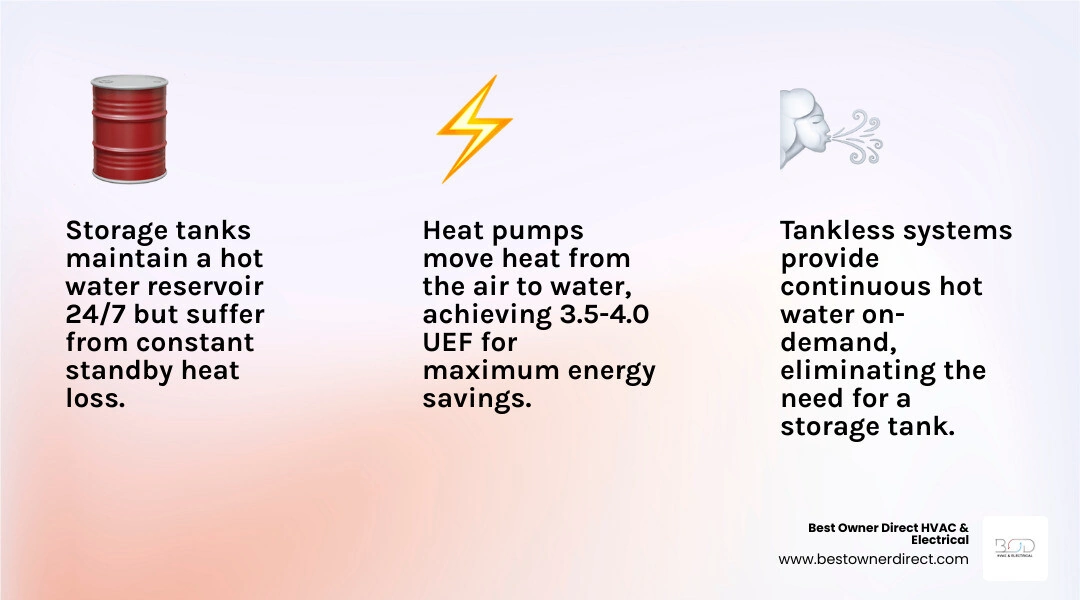
• Storage Tank Water Heaters: These are the traditional models most of us grew up with. They keep a large reservoir of water (usually 30 to 80 gallons) hot at all times. The main drawback is “standby heat loss,” which is the energy wasted keeping that water hot even when no one is using it.
• Tankless Water Heaters: Often called “on-demand” heaters, these units have no tank. When you turn on a hot water tap, cold water travels through a pipe into the unit, where either a gas burner or an electric element heats it instantly. This eliminates standby loss entirely. For more details on how these fit into local homes, check out our Tankless Water Heater Gladstone Or Guide.
• Heat Pump Water Heaters (HPWH): These are the innovators of the group. Instead of generating heat directly using a flame or an electric coil, they act like a “refrigerator in reverse.” They pull warmth from the surrounding air and transfer it into a storage tank. To learn more about the science behind this, read What Is A Heat Pump Water Heater.
Tankless vs Tank vs Heat Pump Water Heater Comparison: Efficiency and UEF Ratings
When you are shopping for a new unit, you will see a number called the Uniform Energy Factor (UEF). This is the industry-standard metric for measuring how much of the energy that goes into a water heater actually comes out as hot water. The higher the UEF, the more efficient the unit.
Under current May 2026 standards, the efficiency gap has widened significantly. While traditional tanks struggle to reach high ratings due to insulation limits, modern alternatives are pushing the boundaries of what is possible. For a deep dive into these metrics, see our Heat Pump Water Heater Vs Traditional Tank Comparison.
• Standard Electric Tank — Typical UEF Range: 0.90 – 0.95 — Energy Star Qualified?: Rarely
• Standard Gas Tank — Typical UEF Range: 0.60 – 0.70 — Energy Star Qualified?: No
• Gas Tankless — Typical UEF Range: 0.82 – 0.97 — Energy Star Qualified?: Yes (Condensing models)
• Electric Tankless — Typical UEF Range: 0.91 – 0.99 — Energy Star Qualified?: Yes
• Heat Pump (Hybrid) — Typical UEF Range: 3.50 – 4.20 — Energy Star Qualified?: Always
Why Heat Pumps Lead the Tankless vs tank vs heat pump water heater comparison
If your goal is the lowest possible monthly utility bill, the heat pump water heater is the clear champion. Because they move heat rather than creating it, they can be two to four times more energy-efficient than conventional electric heaters. In fact, some models can save a household up to 60% on their water heating bills compared to electric tankless or standard tank units.
This efficiency makes them a favorite for homeowners in Hillsboro and Beaverton who want to reduce their carbon footprint. You can explore the full range of perks in our guide on Heat Pump Water Heater Benefits For Homeowners.
Installation Requirements and Household Sizing for Oregon Homes
Choosing a water heater isn’t just about the unit itself; it’s about whether your home can support it. At Best Owner Direct HVAC & Electrical, we often find that the “best” unit is the one that fits your existing infrastructure without requiring a massive home remodel.
Electrical Panel Capacity:If you are switching from a gas tank to an electric tankless unit, you may need to upgrade your electrical panel. Electric tankless heaters require a massive amount of amperage to heat water instantly. Heat pump models, on the other hand, often run on a standard 240V circuit, and some newer 120V “plug-in” models are now available for easier retrofits.
Space and Ventilation:
• Heat Pumps: These units need room to breathe. They require at least 1,000 cubic feet of surrounding air space (roughly the size of a small bedroom) to extract enough heat to operate efficiently. They also exhaust cool, dry air, which can be a bonus for dehumidifying a damp Oregon basement.
• Tankless: These are the ultimate space-savers. They are roughly the size of a suitcase and mount on the wall, freeing up floor space in tight closets.
• Gas Models: Whether tank or tankless, gas units require specific venting to safely move carbon monoxide out of the home.
If you’re ready to upgrade, our team provides expert Water Heater Installation Cornelius Or to ensure everything is up to code and perfectly sized.
Sizing Your System for a Tankless vs tank vs heat pump water heater comparison
Sizing is where many homeowners get frustrated. If you buy a unit that is too small, you’ll be shivering mid-shower.
• For Tanks (including Heat Pumps): We look at the “First-Hour Rating” (FHR). This tells us how many gallons of hot water the unit can provide in its first hour of operation starting with a full tank. A family of four typically needs an FHR of at least 65 to 75 gallons.
• For Tankless: We look at Gallons Per Minute (GPM). This measures how many fixtures the unit can handle at once. In our cooler Oregon climate, incoming groundwater is colder, meaning the unit has to work harder. A unit that provides 5 GPM might handle two showers at once, but adding a dishwasher could cause a temperature drop.
For residents in the west metro area, we specialize in Tankless Water Heaters Beaverton Or to help you calculate the exact flow rate your family needs.
Lifespan, Maintenance, and Long-Term Reliability
A water heater is a long-term investment. How long it lasts depends heavily on the “Hard Water” common in some parts of the Willamette Valley.
1. Tankless Lifespan: These are the marathon runners. With proper maintenance, a tankless unit can last 20 years or more. However, they must be descaled every 1–2 years to prevent calcium buildup on the heat exchanger.
2. Heat Pump & Standard Tank Lifespan: These typically last 10 to 15 years. The “Achilles heel” of any tank is the tank itself. To extend its life, you should have the anode rod checked every few years and the tank flushed to remove sediment.
3. Routine Maintenance: All units benefit from an annual safety check. If you notice rusty water or strange popping sounds, it is time for a professional Water Heater Repair Hillsboro Or.
Frequently Asked Questions about Water Heater Comparisons
Which water heater is best for large families in Oregon?
For large families with high peak demand (everyone showering before school and work), a large-capacity heat pump water heater or a high-GPM tankless unit is best. If you have a massive soaking tub or teenagers who take 30-minute showers, a tankless unit provides “endless” hot water that a tank simply cannot match. If your current unit is struggling, consider a Water Heater Replacement Hillsboro Or to get a system that matches your actual usage.
How does ambient air temperature affect heat pump efficiency?
Heat pumps work best when the air around them is between 40°F and 90°F. If you install one in an unheated garage during a freezing Portland winter, its efficiency will drop, and it may switch to “backup electric mode,” which uses more energy. However, for most of the year in our region, they remain incredibly efficient. For more answers on climate impact, see our Heat Pump Water Heater Frequently Asked Questions.
What safety features should I look for in gas-powered models?
Safety is paramount with gas appliances. Look for units with Flammable Vapor Ignition Resistant (FVIR) technology, which prevents the burner from igniting vapors outside the unit. Additionally, ensure your home has working carbon monoxide detectors. Our comprehensive Water Heater Services include safety inspections for all gas connections and venting systems.
Conclusion
The tankless vs tank vs heat pump water heater comparison doesn’t have a single winner because every home in the Portland area is different. If you want the lowest upfront cost, a traditional tank is a reliable choice. If you have a small home and want “endless” hot water, tankless is a fantastic lifestyle upgrade. But if you are looking for the absolute best in energy efficiency and long-term savings, the heat pump water heater is the way of the future.
At Best Owner Direct HVAC & Electrical, we are here to help you navigate these choices. Our licensed technicians provide reliable, same-day service and professional consultations to ensure you get the perfect fit for your home and budget. Whether you are in Cornelius, Beaverton, or Oregon City, we are your local experts for all things hot water.
Ready to upgrade your home comfort? Visit our Water Heater page today to schedule your consultation!


Mini Split vs Central Ductwork: A Quick Start GuideLearn when a mini split is better than adding central ductwork for your Oregon home. Compare efficiency, zoning, and installation with Best Owner Direct.
Read more
The Real Reason Your Heat Pump Blows Cooler Air Than a Gas FurnaceThat lukewarm breeze coming from your vents on a chilly fall morning doesn't mean your system is failing. Here is why efficient heat pump air feels cool compared to traditional furnaces.
Read more
How to Fix Refrigerant Leaks: Causes and Repair Tips for Portland HomesLearn how refrigerant leaks happen and how they are repaired in Portland homes, from diagnosis to professional repair for lasting cooling comfort.
Read more