Menu


Why Knowing Which Water Heater Saves the Most Energy Can Cut Your Bills Year After Year
Which water heater saves the most energy is one of the smartest questions a homeowner can ask — and the answer has a direct impact on your monthly utility bills. Water heating accounts for roughly 18% of a home's total energy use, making it one of the biggest energy expenses you have — more than your refrigerator, dishwasher, clothes washer, and dryer combined.
Here's a quick answer before we dive deeper:
| Water Heater Type | Uniform Energy Factor (UEF) | Relative Efficiency |
|---|---|---|
| Heat Pump (Hybrid) Electric | 3.5 – 4.0 | Highest |
| Electric Tankless | 0.96 – 0.99 | High |
| Gas Tankless | 0.87 – 0.96 | Moderate-High |
| Standard Electric Tank | 0.92 – 0.95 | Moderate |
| Standard Gas Tank | 0.67 – 0.82 | Lower |
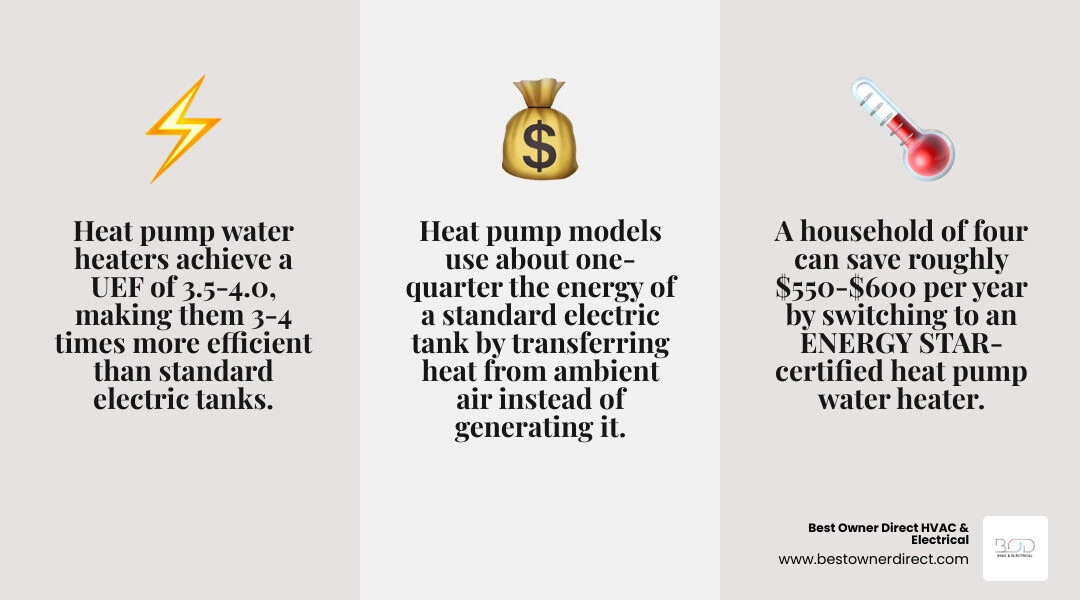
Bottom line: Heat pump water heaters are the most energy-efficient option available to most homeowners today. They use about one-quarter the energy of a standard electric tank model and are two to three times more efficient than conventional electric water heaters. A household of four can save roughly $550–$600 per year by switching to an ENERGY STAR-certified heat pump water heater.
Despite that, most homes still run older tank-style units that quietly drain energy around the clock — heating water even when nobody needs it. If your water heater is more than eight years old, there's a good chance you're paying significantly more than you need to.
In this guide, we break down every major water heater type, compare their real-world efficiency, and help you figure out which system makes the most sense for your home in the Portland metro area and surrounding Oregon communities.
Which Water Heater Saves the Most Energy? Comparing Your Options
When evaluating water heaters, the industry standard for measuring efficiency is the Uniform Energy Factor (UEF). The higher the UEF, the more efficiently the appliance converts electricity or gas into hot water.
Conventional storage tanks have historically suffered from low UEF ratings due to standby heat loss. This happens because a standard tank must constantly heat and reheat dozens of gallons of water to keep it ready for use, even when your household is fast asleep or away at work.
To help you sort through your choices, we have put together a detailed breakdown in our Energy Efficient Water Heater Options Compared guide. The major shift in modern water heating is moving away from energy generation (burning fuel or using electric resistance coils) and moving toward smart heat transfer and on-demand heating.
Standard Storage Tanks vs. Tankless Systems
Standard tank water heaters maintain a ready reservoir of hot water, typically holding between 40 and 80 gallons. While they are reliable and have a lower upfront purchase price, they are constantly running to combat standby loss.
Tankless systems, also known as demand water heaters, eliminate standby loss entirely. They do not store any water. Instead, when you turn on a hot water tap, cold water travels through a pipe and into the unit, where either a high-powered gas burner or an electric element heats the water instantly.
Because they only heat water on demand, tankless systems can achieve energy savings of 30% to 50% compared to a conventional tank. However, they do have flow rate limitations. If you try to run the dishwasher, washing machine, and two showers simultaneously, a tankless unit may struggle to keep up. If you live in the Beaverton area, you can learn more about choosing the right system in our Best Tankless Water Heater Beaverton Guide.
How Heat Pump Technology Answers Which Water Heater Saves the Most Energy
If your primary goal is finding which water heater saves the most energy, the undisputed champion is the heat pump water heater (HPWH), often called a hybrid water heater.
While a standard electric water heater uses electric resistance elements to generate heat directly, a heat pump water heater works like a refrigerator in reverse. Instead of pumping heat out of a box to keep food cold, it pulls heat from the surrounding ambient air and transfers it into the water tank.
Because it moves heat rather than generating it, a heat pump water heater is incredibly efficient. It can deliver 3.5 to 4 units of heat energy for every single unit of electricity it consumes. This translates to an outstanding UEF of 3.5 to 4.0. To see how these units perform side-by-side against standard options, take a look at our Heat Pump Water Heater vs Traditional Tank Comparison.
The Efficiency and Environmental Benefits of Heat Pump Water Heaters

Beyond saving money on your monthly utility bills, switching to a heat pump water heater offers incredible safety and environmental benefits.
For homeowners looking to reduce their carbon footprint, hybrid electric models are a massive win. A typical gas tank water heater produces between 1,200 and 1,500 pounds of carbon dioxide annually through fuel combustion. Because heat pump units run entirely on electricity and operate at such high efficiency, they drastically reduce greenhouse gas emissions — especially when paired with a clean local electrical grid.
Safety is another major advantage. Because heat pump units are 100% electric, they require zero indoor fuel combustion. This completely eliminates the risk of natural gas leaks, carbon monoxide poisoning, and nitrogen dioxide buildup inside your home. If you are interested in exploring these advantages further, check out our article on Heat Pump Water Heater Benefits for Homeowners.
Cold Climate Performance and Reliability
A common concern among homeowners in Oregon is how a heat pump water heater performs when the weather turns cold. Because these units rely on drawing heat from the surrounding air, do they stop working in the winter?
Fortunately, modern hybrid water heaters are designed with smart controls and auxiliary electric resistance elements. If the ambient air temperature drops below the unit's operating threshold (usually around 38°F to 40°F), or if there is a sudden, high demand for hot water, the system automatically switches to hybrid or standard electric resistance mode.
To maximize efficiency in cooler climates, we often recommend installing these units in unconditioned basements, crawlspaces, or garages. A basement is an ideal location because it stays relatively temperate year-round and often benefits from the ambient heat generated by nearby appliances like furnaces or boilers. For a complete look at how these systems handle different climates, read our Ultimate Heat Pump Water Heater Guide.
Sizing and Installation Requirements for Maximum Efficiency
To ensure your energy-efficient water heater operates at peak performance, proper installation is absolutely critical. Heat pump and tankless water heaters have unique physical and mechanical requirements that differ from standard tank models.
When installing a heat pump water heater, you must consider the following:
- Air Volume: Because they pull heat from the air, hybrid models require a certain volume of surrounding air space to breathe. Most manufacturers specify a minimum of 450 to 750 cubic feet of clear air space (roughly the size of a small 10' x 10' room), unless the space is louvered or ducted.
- Condensate Drainage: As the heat pump cools and dehumidifies the surrounding air, it produces condensation — up to a couple of gallons of water per day. This condensate must be safely routed to a nearby floor drain, laundry tub, or directed outside using a small condensate pump.
- Electrical Panel Capacity: If you are switching from a gas water heater to an electric heat pump model (fuel switching), you may need to run a new 240-volt circuit to your utility area. This requires checking your home's electrical panel capacity to ensure it can handle the load.
- Clearance and Ventilation: Proper clearance around the air intake and exhaust vents is essential to prevent the unit from recirculating its own cold exhaust air, which would lower its efficiency.
If you are planning an upgrade in the Beaverton area, our Water Heater Replacement Beaverton OR Guide walks you through the local permitting and installation process.
Sizing Your System to Determine Which Water Heater Saves the Most Energy for Your Family
Sizing a water heater is not just about choosing a tank capacity; it is about matching the system's performance to your household's peak water usage.
For tank-style and hybrid water heaters, the key metric to look at is the First-Hour Rating (FHR). The FHR is the number of gallons of hot water the heater can deliver in a single hour of fully charged operation. Sizing your tank correctly prevents the system from having to work in its less efficient electric resistance mode to keep up with demand.
For tankless systems, sizing is calculated by flow rate measured in Gallons Per Minute (GPM). You must calculate the temperature rise (the difference between the cold groundwater coming into your home and your desired hot water temperature) and the maximum number of fixtures you plan to run at the same time.
If your current system is showing signs of age or active leaking, it is important to address it before a catastrophic failure occurs. Review our Leaking Water Heater Replacement Guide to help determine your next steps.
Maintenance and Smart Features to Maximize Lifespan
To keep your water heater running at peak efficiency for its entire 10- to 15-year lifespan, regular maintenance is essential.
- Annual Flushing: Hard water is a major efficiency killer. Over time, calcium and magnesium scale builds up at the bottom of storage tanks or inside the delicate heat exchangers of tankless units. Flushing your system once a year removes this sediment and prevents scale from insulating the heating elements.
- Anode Rod Inspection: Standard and hybrid tanks contain a sacrificial anode rod that attracts corrosive elements in the water, rusting so your tank doesn't. We recommend checking this rod every three to five years and replacing it when it is worn down to protect the tank from corrosion.
- Air Filter Cleaning: Heat pump water heaters have an air filter designed to keep dust and debris out of the evaporator coils. Cleaning this filter every three to six months keeps air flowing freely and maintains maximum efficiency.
- Mixing Valves: Installing a thermostatic mixing valve allows you to keep your water heater tank at a higher, safer temperature (around 130°F to 140°F) to prevent bacterial growth like Legionella, while safely mixing in cold water at the outlet to deliver a comfortable 120°F to your taps.
- Smart Controls and Vacation Mode: Many modern hybrid units feature Wi-Fi connectivity and smart controls. You can set schedules to heat water during off-peak utility hours or put the unit into "Vacation Mode" when you go away, preventing the system from heating water unnecessarily.
While some homeowners ask about adding insulation to their systems, you should note that you must never wrap a hybrid heat pump water heater with an insulation blanket, as this can block the air vents and damage the heat pump compressor. However, standard tanks can benefit from external insulation. Read more in our guide on how to Increase Your Water Heater's Efficiency with a Blanket.
Frequently Asked Questions About Energy-Efficient Water Heaters
What federal tax credits and rebates are available in 2026?
Under current federal incentives, homeowners who install an ENERGY STAR-certified heat pump water heater may qualify for significant federal tax credits. Additionally, local Oregon utility companies and state programs often offer generous rebates that can significantly offset the initial cost of upgrading to a high-efficiency hybrid electric system.
How do I verify if a water heater is ENERGY STAR certified?
You can easily verify a model's certification by using the online ENERGY STAR Product Finder tool or by checking the physical yellow EnergyGuide label attached to the appliance. Look for the ENERGY STAR logo and confirm that the Uniform Energy Factor (UEF) matches the high-efficiency standards required for rebates.
Does a leaking water heater mean I need a repair or a replacement?
It depends entirely on where the leak is originating. If water is dripping from a loose pipe connection, a faulty temperature and pressure (T&P) relief valve, or a worn-out heating element gasket, these can usually be repaired. However, if the steel storage tank itself has corroded and is weeping water, the tank cannot be patched and must be replaced immediately.
For a detailed diagnostic checklist, check out our guide on Does a Leaking Water Heater Mean You Need a Repair or a Replacement.
Conclusion
Investing in a high-efficiency water heater is one of the most effective ways to lower your household's energy footprint and enjoy reliable, long-term utility savings. While standard electric and gas tanks are common, heat pump hybrid systems and tankless models represent the future of home comfort.
Choosing the right system requires balancing your household's daily hot water demands, your existing electrical or gas infrastructure, and your physical space constraints. Because correct sizing and professional installation are vital to achieving the maximum advertised energy savings, working with a licensed professional is always the best path forward.
At Best Owner Direct HVAC & Electrical, we are dedicated to helping homeowners in Cornelius, OR, and throughout the surrounding Portland metro area find the perfect comfort solutions for their homes. Whether you need a simple repair, a routine maintenance flush, or a complete upgrade to a hybrid heat pump system, our experienced, licensed technicians are here to help.
Schedule your professional water heater consultation with Best Owner Direct HVAC & Electrical today, and let us help you maximize your home's energy savings!


Does Furniture Placement Over House Vents Really Ruin Compressors?Rearranging furniture over floor vents might seem harmless, but it severely chokes AC airflow. Understand the mechanical reality of this mistake before it triggers a catastrophic compressor failure.
Read more

The First Furnace Test of Fall: What to Listen ForThat initial September startup can bring a wave of anxiety when your heater emits strange noises. We explain which expansion pops are harmless and which grinds require an immediate shutdown.
Read more
How to Diagnose and Fix Heat Pump Ice Buildup: Simple StepsLearn how to diagnose heat pump ice buildup causes and what to do with simple DIY steps, from normal frost to heavy ice, plus when to call a pro.
Read more