Menu


What Homeowners in Cornelius, OR Need to Know About How a Heat Pump Cools Your Home in Summer
How a heat pump cools your home in summer is simpler than most people expect — and understanding it can help you get more comfort out of your system while keeping energy bills in check.
Here is the quick answer:
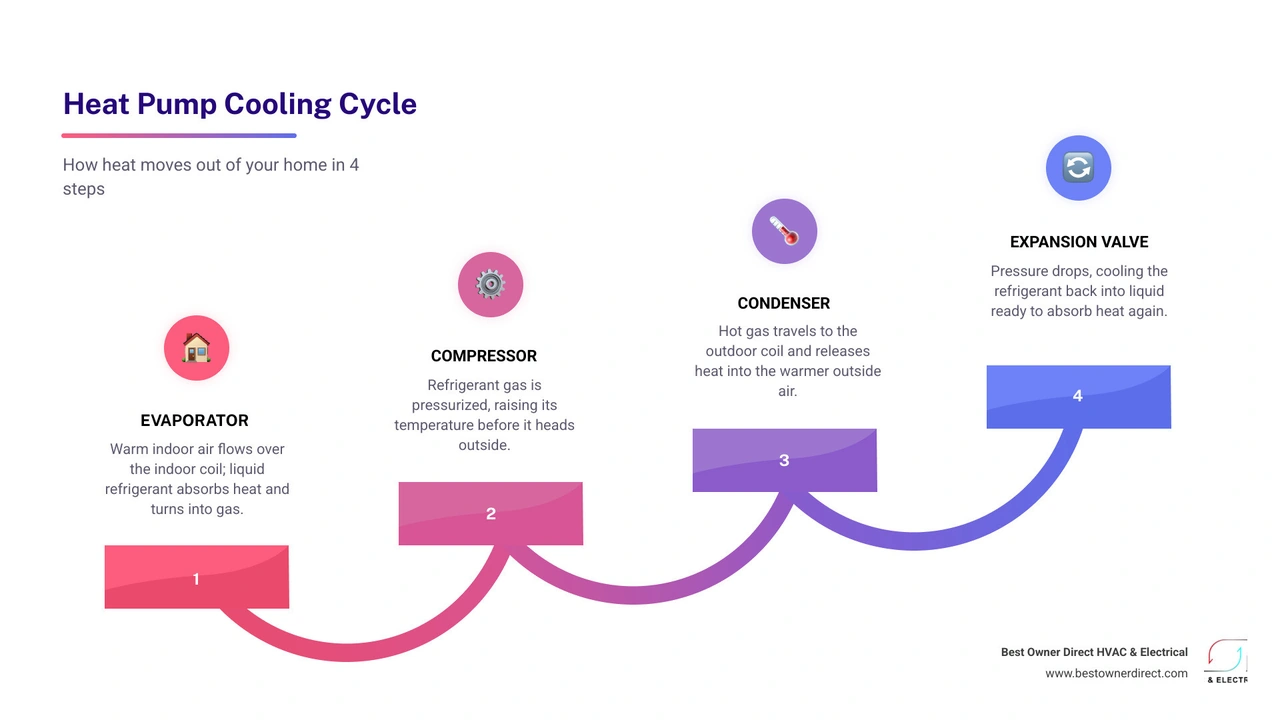
- Warm indoor air passes over the evaporator coil inside your home, where liquid refrigerant absorbs the heat and evaporates into a gas.
- The compressor pressurizes the refrigerant gas, raising its temperature significantly.
- The hot refrigerant travels to the outdoor condenser coil, where it releases that heat into the outside air.
- The expansion valve drops the refrigerant's pressure and temperature, turning it back into a cool liquid ready to absorb heat again.
- The cycle repeats continuously until your home reaches the set temperature.
In short, your heat pump does not generate cold air — it moves heat out of your home. That single difference is why heat pumps are 2 to 3 times more energy efficient than traditional cooling systems.
For Portland metro homeowners in communities like Cornelius, Hillsboro, and surrounding areas, this means reliable, efficient summer cooling without the energy waste of older systems. Whether you already have a heat pump or are thinking about one, knowing how the cooling cycle works helps you maintain it better and catch problems early.
The Science of Summer Cooling: How a Heat Pump Cools Your Home in Summer
To understand how a heat pump keeps your home comfortable during our increasingly warm Pacific Northwest summers, we have to look at the basic laws of thermodynamics. In nature, heat naturally flows from areas of high temperature to areas of low temperature. A heat pump essentially tricks nature by manipulating the pressure and state of a chemical refrigerant, allowing it to absorb heat from a cooler space (your living room) and dump it into a warmer space (the hot outdoors).
Think of refrigerant as a thermal sponge. When you place a dry sponge in water, it eagerly absorbs the moisture. When you squeeze that sponge, the water is forced out. A heat pump does the exact same thing with heat energy. By circulating this "heat sponge" between your indoor air handler and your outdoor unit, the system can continuously extract thermal energy from your home and reject it outside.
This process is fundamentally different from traditional heating systems like furnaces, which must burn fossil fuels or use electric resistance to create heat from scratch. Because heat pumps are simply moving existing heat rather than generating it, they can achieve incredible efficiencies. In fact, a heat pump can be up to 300% efficient, whereas even the most efficient fossil fuel furnaces top out at about 98% efficiency.
To learn more about how this versatile system handles both seasons seamlessly, take a look at our detailed guide on How a Heat Pump Works for Heating and Cooling.
Step-by-Step: How a Heat Pump Cools Your Home in Summer using the Refrigeration Cycle
The magic of heat pump cooling relies on a continuous four-stage vapor-compression refrigeration cycle. Here is exactly what happens behind the scenes when your thermostat calls for cooling:
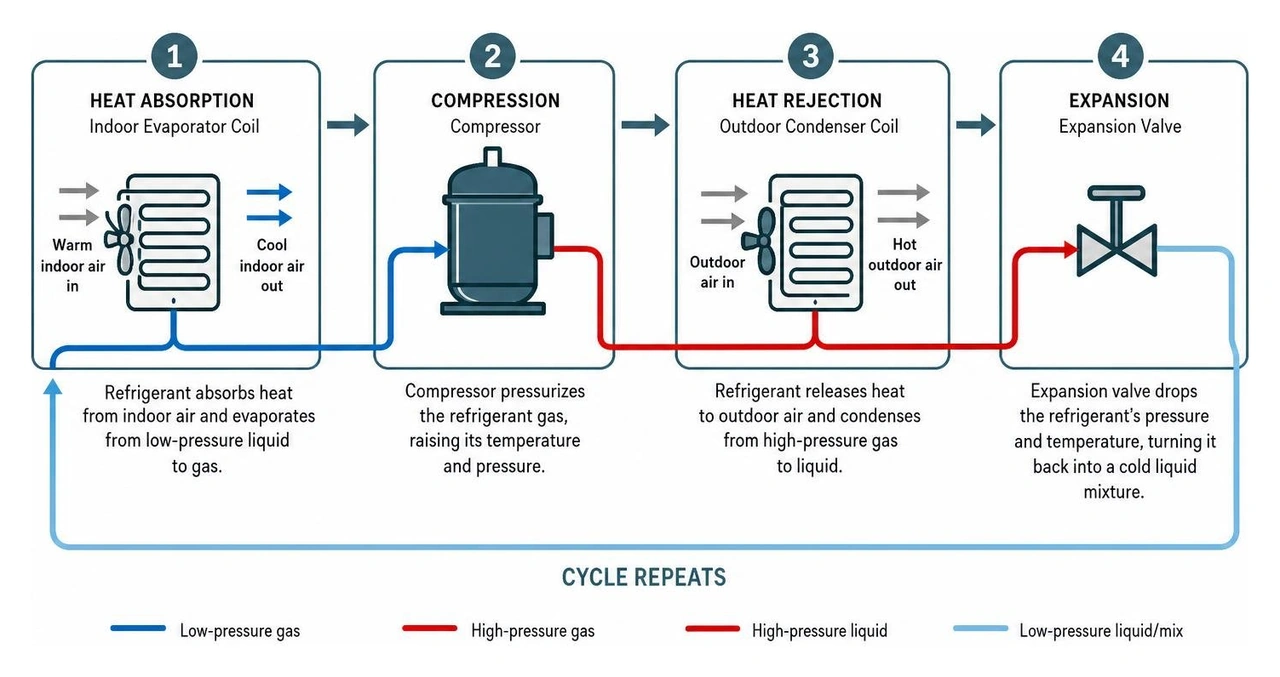
- Stage 1: Heat Absorption (The Indoor Evaporator Coil): The cycle begins indoors. Your home's warm indoor air is pulled across the indoor coil (acting as the evaporator in summer). Inside this coil is cold, low-pressure liquid refrigerant. Because the indoor air is warmer than the refrigerant, heat naturally transfers from your air to the refrigerant. As the refrigerant absorbs this heat, it reaches its boiling point and evaporates into a low-pressure gas. The air blowing back into your home is now beautifully cooled and dehumidified.
- Stage 2: Compression (The Compressor): The low-pressure refrigerant gas travels through copper lines to the outdoor unit, where it enters the compressor. Often called the heart of the system, the compressor squeezes the gas, rapidly packing the molecules together. This dramatic increase in pressure causes the refrigerant's temperature to skyrocket, turning it into a superheated, high-pressure gas.
- Stage 3: Heat Rejection (The Outdoor Condenser Coil): The superheated gas flows into the outdoor coil (acting as the condenser in summer). A large fan blows hot outdoor air across the coil. Because the compressed refrigerant is even hotter than the outdoor air, the heat naturally transfers from the coil to the outside environment. As the refrigerant sheds its heat, it condenses back into a high-pressure liquid.
- Stage 4: Expansion (The Expansion Valve): Finally, the high-pressure liquid refrigerant passes through the expansion valve (or metering device). This valve acts like a narrow nozzle, restricting flow and suddenly dropping the refrigerant's pressure. This sudden drop in pressure causes the temperature to plummet instantly. The refrigerant is now a freezing-cold, low-pressure liquid-and-gas mixture, ready to return indoors and begin the cycle all over again.
The Reversing Valve: Switching from Heating to Cooling
You might be wondering: if a heat pump uses the same refrigeration cycle as a standard central air conditioner, how does it also keep us warm during chilly Willamette Valley winters? The answer lies in a single, highly specialized component called the reversing valve.
The reversing valve is an electromechanical valve located in the outdoor unit. It features a sliding mechanism controlled by an electrical solenoid. When you switch your thermostat from heating to cooling mode, an electrical signal is sent to the solenoid, which slides the valve into the cooling position. This physical slide alters the path of the refrigerant gas as it leaves the compressor.
In heating mode, the reversing valve directs the hot, compressed refrigerant gas straight to your indoor coil first, allowing it to release heat inside your home. In cooling mode, the valve flips the flow, sending that hot gas to the outdoor coil first so the heat is dumped outside instead.
This simple yet brilliant mechanism is what makes the heat pump an all-in-one comfort solution. To explore how this dual-capability can simplify your home comfort setup and lower your utility bills, check out our article on Heat Pump Advantages Over Traditional HVAC.
Dehumidification: How Heat Pumps Manage Summer Moisture
In places like Cornelius, Hillsboro, and Portland, summer isn't always just hot—it can get surprisingly muggy, too. High humidity makes the air feel warmer than it actually is because it prevents our sweat from evaporating efficiently. Fortunately, how a heat pump cools your home in summer also includes a built-in dehumidification process.
As warm, humid air from your home is pulled across the freezing-cold indoor evaporator coil, the air temperature drops rapidly. When air cools, it loses its capacity to hold moisture. Once the air temperature drops below its dew point, the water vapor suspended in the air condenses into liquid water droplets on the cold surface of the coil—much like condensation forming on a cold glass of iced tea on a July afternoon.
This moisture trickles down the fins of the evaporator coil into a drain pan and is safely funneled outside your home through a condensate drain line. By removing this "latent heat" (the heat stored in water vapor), the heat pump significantly lowers the relative humidity of your indoor air.

Dehumidification: How a Heat Pump Cools Your Home in Summer While Controlling Humidity
By lowering the relative humidity inside your home, a heat pump allows you to feel perfectly comfortable at a slightly higher thermostat setting. Dry air at 75°F feels noticeably cooler and more refreshing than humid air at the same temperature.
Modern heat pumps—especially those equipped with variable-speed inverter compressors—are exceptionally good at managing humidity. Because they can run at lower speeds for longer, continuous cycles rather than constantly turning on and off, they keep air moving over the cold evaporator coil steadily. This continuous contact allows the system to extract maximum moisture from the air, preventing that clammy, sticky feeling that often plagues older, single-speed air conditioners.
Comparing Heat Pumps to Traditional Air Conditioners
Many homeowners ask us if a heat pump is less effective at cooling than a dedicated central air conditioner. The simple answer is no. In cooling mode, a heat pump operates exactly like a central air conditioner, utilizing the same refrigeration cycle, compressor, and coils.
However, when we look at year-round performance, energy efficiency, and environmental impact, heat pumps offer several clear advantages. To put this into perspective, air conditioners are responsible for over 100 million metric tons of carbon dioxide emissions each year. Switching to an electric heat pump helps lower this carbon footprint, especially when connected to a cleaner electric grid like we have here in the Pacific Northwest.
| Feature | Heat Pump | Traditional Central AC |
|---|---|---|
| Cooling Method | Vapor-compression refrigeration | Vapor-compression refrigeration |
| Heating Method | Reverses cooling cycle to extract outdoor heat | Requires separate furnace (gas/electric) |
| Energy Efficiency | Up to 300%+ year-round efficiency | Limited to cooling-only efficiency |
| Compressor Technology | Often features advanced variable-speed inverters | Often standard single- or two-stage |
| Environmental Impact | Zero direct emissions; lowers overall carbon footprint | High carbon footprint when paired with gas furnace |
| Typical Lifespan | 15 years (with regular semi-annual maintenance) | 15–20 years (runs only half the year) |
Why Heat Pumps Outperform Standard AC Units in the Pacific Northwest
Our climate in the Portland metro area is uniquely suited for heat pumps. We experience relatively mild summers compared to the desert Southwest, alongside moderate winters. This makes the extreme efficiency of a heat pump highly practical.
Because our summer cooling loads fluctuate, standard single-stage air conditioners often "short-cycle"—turning on at 100% capacity, rapidly cooling the home, and shutting off. This wastes energy and leaves behind pockets of humid, stagnant air.
Modern heat pumps utilize variable-speed inverter compressors. Instead of running at either 0% or 100%, these systems adjust their output in tiny increments (sometimes as precise as 1%) to match the exact cooling needs of your home. They run at lower, whisper-quiet speeds for up to 80% of the day, maintaining a perfectly steady indoor temperature while slashing electricity consumption.
To see why so many of your neighbors in Washington and Clackamas counties are making the switch, read our guide on Heat Pump Benefits for Pacific Northwest Homeowners.
Types of Heat Pumps and Their Summer Performance
Not all homes in our service area are built the same way. Some historic homes in Forest Grove or Yamhill lack the ductwork required for central systems, while newer builds in Hillsboro or Beaverton are fully ducted. Fortunately, heat pumps come in several configurations to match any home layout.
- Ducted Heat Pumps: These systems connect directly to your home’s existing ductwork. They look and function just like a traditional central furnace and air conditioner setup, distributing cooled air evenly to every room through floor or ceiling registers.
- Ductless Mini-Splits: If your home doesn't have ducts, ductless mini-splits are an incredible alternative. They feature an outdoor condenser connected by small refrigerant lines to one or more indoor air handlers mounted on your walls or ceilings. This design allows you to control the temperature of individual rooms or "zones" independently.
- Geothermal (Ground-Source) Heat Pumps: Instead of exchanging heat with the outdoor air, geothermal systems use buried underground pipe loops to exchange heat with the earth. Because the ground temperature a few feet down remains a stable 55°F to 65°F year-round, geothermal systems are incredibly efficient. However, they require significant yard space and a higher initial installation effort.
Ductless Mini-Splits vs. Ducted Heat Pumps in Hot Weather
When it comes to summer cooling performance, ductless mini-splits have a major aerodynamic advantage. In traditional ducted systems, cool air must travel through yards of metal or flexible ductwork, which is often routed through hot spaces like attics or crawlspaces. According to industry data, duct leaks and thermal conduction through ducts can cause a 20% to 30% loss in cooling efficiency.
Ductless systems completely eliminate these duct losses because the cooled refrigerant is delivered directly to the indoor wall unit, cooling the room instantly. Furthermore, ductless zoning means you don't have to waste energy cooling empty guest rooms or basement spaces. You can keep your bedroom icy cold at night while leaving the rest of the house warmer.
To learn more about how these flexible systems can transform your home's comfort, take a look at our comparison guide on Understanding Ductless Mini Split Systems and Heat Pumps.
Troubleshooting and Maintaining Your Heat Pump for Summer Efficiency
A heat pump is a hard-working machine. Because it provides both heating in the winter and cooling in the summer, it runs year-round. This constant operation means regular maintenance is absolutely essential to keep it running efficiently and prevent unexpected breakdowns on the hottest days of the year.
To ensure your system is ready for the summer heat, we highly recommend scheduling a professional tune-up. You can learn about what our certified technicians inspect during a visit by reading about our Heat Pump Maintenance Tune Up services.
Why Does a Heat Pump Freeze Up in the Summer?
One of the most common summer service calls we receive is for a "frozen" heat pump. It might seem bizarre for an air conditioner to cover itself in ice when it's 90°F outside, but it happens quite often. This freezing is typically caused by one of three issues:
- Restricted Airflow: Your heat pump needs a steady, heavy stream of warm indoor air flowing over the indoor evaporator coil to keep the refrigerant inside warm enough to stay above freezing. If airflow is restricted—usually due to a heavily clogged, dirty air filter or blocked supply vents—the coil temperature will drop below 32°F. Any humidity in the air will instantly freeze onto the coil, starting a chain reaction that completely encases the unit in ice.
- Dirty Evaporator Coil: Over time, household dust, pet dander, and pollen can bypass your air filter and accumulate on the wet fins of your indoor coil. This layer of dirt acts as an insulator, preventing the refrigerant inside the coil from efficiently absorbing heat from your indoor air. As a result, the coil gets colder and colder until it freezes over.
- Low Refrigerant Levels: If your heat pump has a small refrigerant leak, the drop in pressure inside the system will cause the remaining refrigerant to expand too much, dropping its temperature far below normal operating levels. This causes the moisture on the evaporator coil to freeze rapidly.
If you notice ice forming on your indoor or outdoor unit, turn the system off immediately at your thermostat and switch it to "Fan Only" mode to help it melt. Do not attempt to scrape the ice off, as this can easily puncture the delicate copper refrigerant lines. Give us a call so a licensed technician can safely locate and repair the root cause.
Best Practices for Operating Your Heat Pump in July 2026
To maximize your system's efficiency and longevity during the peak summer months, keep these practical tips in mind:
- Set the Thermostat to 78°F: The U.S. Department of Energy recommends setting your thermostat to 78°F (25.5°C) when you are home in the summer.
- Avoid Constant Adjustments: Heat pumps work best when they can run at a steady, continuous pace. Constantly raising and lowering the temperature forces the system to ramp up to maximum capacity, wasting energy. Find a comfortable temperature and "set it and forget it."
- Change Air Filters Regularly: Check your air filter monthly and replace it at least every six weeks during peak cooling and heating seasons.
- Keep the Outdoor Unit Clear: Maintain at least two feet of clear space around your outdoor condenser unit. Keep grass clipped, trim back shrubs, and clear away any leaves or debris that could restrict airflow through the outdoor coil.
If you're still weighing your options on whether a heat pump is the right upgrade for your property, read our article on Why Should I Install a Heat Pump for My Home.
Frequently Asked Questions About Heat Pump Cooling
We love helping our customers understand their home comfort systems. Here are answers to some of the most common questions we hear about summer heat pump operation.
Do heat pumps bring in fresh air from the outside?
No. A common myth is that heat pumps pull fresh air from the outdoors and blow it inside. In reality, a heat pump uses a completely closed-loop refrigerant system. It only transfers heat energy between the indoors and outdoors. The air blowing out of your vents is simply your own indoor air being recirculated, filtered, and cooled.
What is the ideal thermostat setting for a heat pump in summer?
For the best balance of comfort and energy savings, we recommend setting your thermostat to 78°F. If that feels too warm at first, try lowering it to 75°F and raising it by one degree each day to allow your body to adapt. Because the heat pump dehumidifies the air so effectively, 78°F inside a well-maintained home will feel much cooler and drier than the air outside.
What is the typical lifespan of a heat pump used year-round?
With proper care and professional maintenance twice a year (once in spring before cooling season, and once in fall before heating season), a high-quality air-source heat pump will typically last about 15 years. Because these systems run during both hot and cold seasons, they experience more wear and tear than a dedicated air conditioner that sits idle all winter.
To learn more about maximizing your system's operating life, check out our Heat Pump Lifespan Complete Guide.
Conclusion
Understanding how a heat pump cools your home in summer shows just how brilliant and efficient these systems really are. By simply moving heat from inside your home to the outdoors, a heat pump provides whisper-quiet cooling, exceptional dehumidification, and unmatched energy savings throughout our beautiful Pacific Northwest summers.
At Best Owner Direct HVAC & Electrical, we are proud to be a family-owned company based right here in Cornelius, OR. Our licensed, factory-trained technicians serve homeowners and businesses across the entire Portland metro area—including Banks, Beaverton, Hillsboro, Forest Grove, Lake Oswego, and Oregon City. We are dedicated to providing honest, transparent, and high-quality service to keep your home comfortable and safe year-round.
If you are ready to upgrade your home comfort, lower your energy bills, or schedule a summer system tune-up, we are here to help. Explore our Heat Pump Installation Hillsboro OR services or visit our main heat pump services page to schedule your consultation with our friendly team today!


Why August Is the Best Time to Plan a Furnace ReplacementAvoid the September supply chain bottleneck by upgrading your aging heating system now. Booking early secures the best equipment and an installation date that fits your busy schedule.
Read more
A Practical Guide to Ductless Mini Split Value in OregonIs a ductless mini split worth the investment in Oregon? Discover zoned comfort, energy savings, and incentives for older homes.
Read more

Direct-to-Owner HVAC Services vs. Large Franchises for AccountabilityWhen an AC breaks down in late summer, the technician's accountability is critical. See how an owner-operated business compares to a massive corporate dispatch fleet.
Read more