Menu


Is a Ductless Mini Split Worth the Investment in Oregon?
Is a ductless mini split worth the investment in Oregon? For most homeowners in the Portland metro area and surrounding communities, the answer is yes — and often by a wide margin.
Here's a quick summary:
Yes, a ductless mini split is worth it in Oregon if:
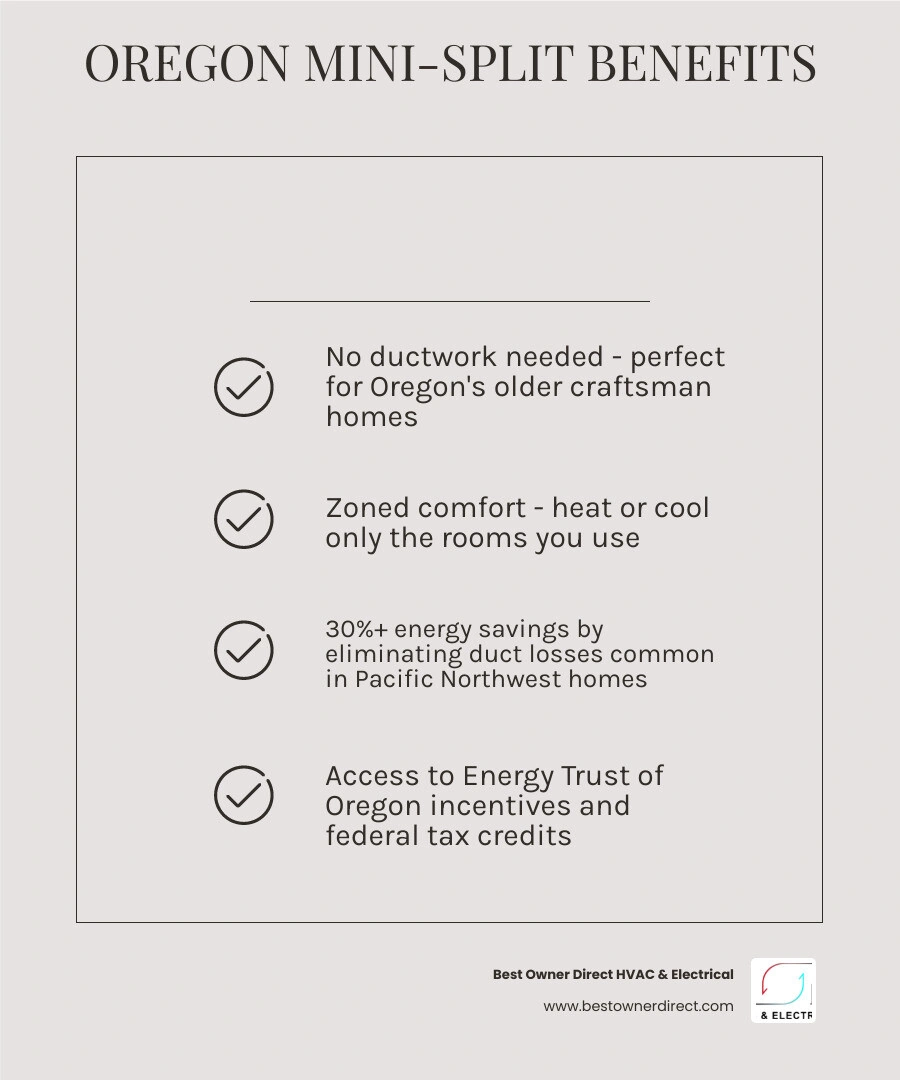
- Your home has no existing ductwork (common in older craftsman and ranch-style homes)
- You want room-by-room temperature control
- You're adding a room, garage, or accessory dwelling unit
- You want to reduce energy waste from leaky ducts
- You're looking to lower monthly heating and cooling bills long-term
It may be less ideal if:
- You already have well-maintained ductwork and a newer central system
- You need to condition a very large home and prefer uniform whole-home airflow
Oregon's climate is a strong match for ductless systems. The Willamette Valley's mild winters and increasingly hot summers are exactly the conditions where these systems shine. And with duct losses accounting for more than 30% of energy consumption in a typical home, according to the U.S. Department of Energy, going ductless can make a real difference on your utility bill.
Whether you live in Hillsboro, Forest Grove, Portland, or anywhere across the region, understanding how these systems work — and what they'll cost and save — helps you make a confident decision.
Understanding Ductless Mini-Splits and How They Work
To understand why these systems are such a popular option in our neck of the woods, it helps to understand how they work. Traditional heating and cooling systems rely on a single, centralized unit that blows conditioned air through a massive network of metal ducts hidden in your crawlspace, attic, or walls.
A ductless mini-split system, on the other hand, bypasses the ductwork entirely. Instead, it places individual, compact air-handling units directly into the rooms you want to heat or cool.
The system consists of two primary parts:
- An Outdoor Compressor/Condenser: This unit sits quietly outside your home, anchored to a concrete pad or mounted to an exterior wall. Its job is to release or collect heat from the outdoor air.
- One or More Indoor Air Handlers: These are the sleek, wall-mounted or ceiling-recessed units installed inside your living spaces. They deliver conditioned air directly into the room.
These indoor and outdoor components are connected by a small conduit housing a power cable, communication wires, and copper refrigerant lines. The lines pass through a small, non-invasive hole in your exterior wall—usually only about three inches in diameter.
What makes modern mini-splits so highly efficient is inverter technology. Traditional heating and cooling systems operate like a standard light switch: they are either 100% on or 100% off. When your home drops below the set temperature, the furnace kicks on at full blast, runs until the target is reached, and then shuts off. This constant cycling consumes a massive amount of energy.
In contrast, inverter-driven compressors work more like cruise control on your car. They can adjust their motor speed dynamically. If your living room needs just a tiny bit of warmth to stay comfortable, the compressor runs at a low, whisper-quiet speed. It maintains a perfectly steady temperature without the energy spikes associated with cycling on and off.
To dive deeper into the mechanics of these systems, check out our guide on Ductless Mini-Split Systems Explained.
Why a Ductless Mini Split Is Worth the Investment in Oregon for Older Homes
If you live in one of Oregon's historic neighborhoods, you are likely well-acquainted with the charm—and the climate control challenges—of older architecture. From the classic craftsman bungalows of Portland and Forest Grove to the mid-century ranch homes in Beaverton and Hillsboro, many of these homes were built long before central air conditioning was standard.
In these older properties, retrofitting a traditional ducted system is often a homeowner's worst nightmare. It requires:
- Cutting into plaster walls or historic wood paneling.
- Sacrificing precious closet space or ceiling height to build bulkheads for ductwork.
- Enduring days or weeks of invasive construction dust and disruption.
- Paying significant remodeling expenses just to cover up the newly installed ducts.
This is where a ductless heat pump becomes a game-changer. Because they require nothing more than a small hole in the wall, we can install a mini-split system with virtually zero impact on your home's historic charm. You get to keep your beautiful original ceilings, built-in shelving, and architectural details while enjoying modern, whisper-quiet cooling in July and cozy heating in January.
Furthermore, many older homes in regions like Yamhill, Carlton, and Lafayette rely on inefficient zonal electric baseboard heaters or oil boilers. These systems are notoriously expensive to operate during damp Oregon winters. Replacing or supplementing these outdated systems with a mini-split can dramatically cut down your winter utility bills while providing a massive upgrade in comfort.
If you are wondering whether your specific property is a good candidate, take a look at our detailed breakdown: Should You Get a Ductless Heat Pump?.
Is a Ductless Mini Split Worth the Investment in Oregon?

When evaluating if is a ductless mini split worth the investment in oregon, you have to look at the long-term balance of upfront investment versus year-round energy savings. While the initial installation of a multi-zone mini-split can represent a significant project, the operational savings over time are substantial.
The primary driver of these savings is the elimination of duct losses. According to the U.S. Department of Energy (DOE), duct losses can account for more than 30% of energy consumption for heating and cooling. Think about that: in a traditional ducted home, nearly a third of the air you pay to heat or cool escapes through tiny cracks, loose joints, or uninsulated ductwork in your attic, basement, or crawlspace before it ever reaches your living room.
Because ductless systems deliver air directly into your living spaces, their duct loss is exactly 0%.
This efficiency is reflected in the systems' performance ratings. Modern cooling systems are rated using SEER2 (Seasonal Energy Efficiency Ratio 2).
- Traditional ducted heat pumps generally feature SEER2 ratings ranging from 15.2 to 25.
- High-efficiency ductless mini-splits can achieve SEER2 ratings from 15.2 all the way up to 35.
By choosing a system with a high SEER2 rating, you are opting for one of the most environmentally friendly HVAC solutions on the market. In environmentally conscious states like Oregon, where communities from Lake Oswego to West Linn prioritize reducing their carbon footprint, mini-splits align perfectly with green living goals. They require less electricity to move heat, use advanced eco-friendly refrigerants, and integrate seamlessly with home solar panel setups.
Comparing Efficiency: Ductless vs. Central Systems
To help visualize how these two options stack up against each other, let's look at the core differences in how they distribute air, manage energy, and perform over time.
| Feature | Ductless Mini-Split Systems | Traditional Central AC & Heat Pumps |
|---|---|---|
| Air Distribution | Direct delivery into designated zones via indoor air handlers | Pushed through extensive ductwork throughout the entire home |
| Energy Loss | 0% duct loss (no ducts to leak) | Up to 30%+ energy loss through duct leaks and uninsulated runs |
| Efficiency Ratings | Exceptional (SEER2 ratings up to 35) | Standard to High (SEER2 ratings up to 25) |
| Zoning Capability | Built-in; turn off units in unused rooms | Typically single-zone (heats/cools empty rooms automatically) |
| Compressor Tech | Variable-speed inverter (runs continuously at low speeds) | Often single or two-stage (cycles on and off) |
| Noise Levels | Extremely quiet (indoor units operate as low as 19 dB) | Moderate (louder indoor blower and outdoor condenser) |
| Lifespan | Typically 15 to 20 years | Typically 12 to 15 years |
By utilizing a variable-speed inverter compressor, a mini-split avoids the massive power draws required to start up a traditional single-stage central compressor. Instead of blasting cold air for ten minutes and then shutting off, the mini-split hums along at a fraction of its capacity, maintaining a rock-solid indoor climate.
This zoning capability also means you can customize your comfort. If you have guest bedrooms in your Beaverton home or a home office in Hillsboro that is only used during the day, you don't have to waste money heating or cooling those empty spaces. You simply adjust or turn off the individual indoor units in those rooms while keeping your main living areas perfectly conditioned.
For a deeper dive into how these systems compare, read our comprehensive analysis on Central AC vs. Ductless Mini-Split Comparison.
Performance in Oregon’s Diverse Climate
Oregon's climate is unique. In the Willamette Valley—including Portland, Tualatin, Tigard, and Oregon City—we experience relatively mild, damp winters and increasingly hot, dry summers. It is not uncommon to have chilly, foggy mornings that transition into warm, sunny afternoons.
This daily temperature swing requires an HVAC system that is highly flexible. A mini-split handles these transitions effortlessly. Because it is a heat pump, it can reverse its operation in a fraction of a second. In the morning, it extracts heat from the outdoor air to warm your kitchen. In the afternoon, it reverses the process, extracting heat from your living room and dumping it outside to keep things cool.
In the past, some homeowners worried that ductless heat pumps couldn't handle freezing winter temperatures. However, modern systems equipped with hyper-heating technology can operate at high efficiency even when outdoor temperatures drop well below freezing. They are designed to extract warmth from sub-zero outdoor air, making them an excellent fit for cold snaps in North Plains, Banks, or Gaston.
At the same time, Oregon summers have grown hotter over the last decade. High-efficiency mini-splits provide exceptional dehumidification and cooling during our summer heatwaves. Because they run continuously on low speeds, they do a fantastic job of pulling moisture out of the air, ensuring your home feels crisp and comfortable rather than muggy.
Determining If a Ductless Mini Split Is Worth the Investment in Oregon for Whole-Home Comfort
One of the most common questions we hear from homeowners in Cornelius, Sherwood, and Newberg is: Can a ductless mini-split system heat and cool my entire house, or is it only good for single rooms?
The honest answer is: it depends on your home's layout.
Excellent for Whole-Home Comfort in:
- Open-Concept Homes: If your kitchen, dining room, and living room flow together without many dividing walls, a single high-capacity indoor unit can easily condition the entire space.
- Smaller Homes or ADUs: For accessory dwelling units, cottages, or smaller single-story homes, a multi-zone mini-split system is often the most efficient and practical whole-home solution.
- Zoned Multi-Level Homes: By placing one indoor unit upstairs and one downstairs, you can solve the classic "too hot upstairs, too cold downstairs" dilemma.
Best as Supplemental Comfort in:
- Highly Compartmentalized Homes: If your home has many small, closed-off rooms with heavy doors, a single mini-split unit will struggle to distribute air evenly. In this case, you would need multiple indoor units (a multi-zone system), which can increase the complexity of the installation.
- Home Additions and Problem Rooms: If you've converted your garage in Tualatin, finished an attic in a Portland craftsman, or added a sunroom in West Linn, a single-zone mini-split is the perfect way to bring comfort to that specific space without overloading your existing central system.
To see how the installation and operational dynamics compare when looking at whole-home solutions, check out our guide on the Mini-Split vs. Central AC Cost Comparison.
Maximizing Your Investment: Incentives and Maintenance
One of the factors that makes a ductless mini-split highly attractive in 2026 is the wide array of financial incentives available to Oregon homeowners. Because Oregon has committed to ambitious clean energy and electrification goals, local utilities and government programs are actively helping homeowners transition away from fossil fuels and inefficient electric resistance heating.
If you are upgrading your home's heating and cooling system, you may qualify for:
- Energy Trust of Oregon Rebates: Cash-back incentives are frequently available for homeowners who install qualifying high-efficiency ductless heat pumps.
- Federal Tax Credits: Under current energy efficiency programs, you can claim significant tax credits for installing certified qualifying heat pumps.
- Local Utility Incentives: Utilities throughout Multnomah, Washington, Clackamas, and Yamhill counties offer additional programs to help offset your initial investment.
These incentives can significantly lower the net investment of your upgrade, accelerating your return on investment. When combined with monthly utility savings of 20% to 30%, many of our customers find that the system pays for itself over time.
Long-Term Lifespan and Return on Investment
A properly installed ductless mini-split system is built to last. While a standard central air conditioner typically has a lifespan of 12 to 15 years, a high-quality ductless system can easily last 15 to 20 years with proper care.
To maximize this lifespan and protect your investment, regular maintenance is essential. Fortunately, mini-split maintenance is incredibly straightforward:
- Clean the Washable Filters: Every 2 to 4 weeks, simply pop open the front panel of your indoor unit, slide out the plastic mesh filters, rinse them under a tap, let them dry, and slide them back in. This keeps airflow strong and indoor air quality high.
- Keep the Outdoor Unit Clear: Ensure that leaves, weeds, and debris don't pile up around your outdoor compressor. It needs at least two to three feet of clear space around it to breathe properly.
- Schedule Professional Tune-Ups: Once a year, have a professional technician inspect your electrical connections, flush the condensate drain lines, check the refrigerant charge, and deep-clean the coils and blower wheels.
By taking these simple steps, you ensure your system runs at peak efficiency, protecting your home comfort for decades to come.
Frequently Asked Questions about Oregon Ductless Systems
Do mini-splits work well in cold Oregon winters?
Yes, absolutely. Modern ductless mini-splits are highly efficient heat pumps. While older models struggled when temperatures dropped, modern systems are engineered to extract heat from outdoor air even in freezing conditions. For areas in Oregon that experience colder winter dips, we can install systems specifically rated for low-temperature operation to ensure your home stays perfectly warm without needing backup electric baseboards.
How long does it take to install a ductless system?
For a straightforward, single-zone system (such as conditioning a home addition, garage, or primary living space), we can typically complete the installation in just four to eight hours. The process is minimally invasive, requiring only a small three-inch hole through an exterior wall for the refrigerant line set. Multi-zone systems with three or four indoor units may take two to three days depending on the complexity of the routing and your home's electrical panel capacity.
Do ductless mini-splits require a lot of maintenance?
Not at all, but they do require consistent maintenance. The most important task is cleaning the indoor unit's washable filters every few weeks, which takes less than five minutes. Beyond that, keeping the outdoor compressor free of debris and scheduling an annual professional inspection is all it takes to keep your system running beautifully for up to 20 years.
Conclusion
When you weigh the exceptional energy efficiency, the elimination of duct losses, the quiet zoned comfort, and the available Oregon utility incentives, a ductless mini-split is undoubtedly a smart, high-value investment for homes in our region.
Whether you are looking to bring reliable cooling to a historic home in Forest Grove, finish a basement in Beaverton, or completely upgrade your heating and cooling efficiency in Hillsboro, we are here to help. At Best Owner Direct HVAC & Electrical, based right here in Cornelius, OR, we specialize in helping our neighbors find the perfect comfort solutions for their homes.
Our team of licensed, experienced technicians is dedicated to providing quality workmanship, transparent service, and customized comfort systems that fit your lifestyle.
Ready to discover how a ductless system can transform your home comfort? Explore our Ductless Mini-Splits services or contact us today to schedule your personalized, in-home assessment!



Direct-to-Owner HVAC Services vs. Large Franchises for AccountabilityWhen an AC breaks down in late summer, the technician's accountability is critical. See how an owner-operated business compares to a massive corporate dispatch fleet.
Read more
Why Capacitor Failure Is the Most Common AC Repair: Terms DemystifiedLearn why capacitor failure is the most common AC repair, how it happens, and how to prevent costly damage to your HVAC system.
Read more
Evaluating HVAC Companies Near Me: What Cornelius Residents Should AskA late-summer AC breakdown often forces rushed decisions. Asking the right questions over the phone ensures you hire an accountable, licensed professional instead of a sales-driven corporation.
Read more