Menu


Why a Clogged Filter Is One of the Biggest Threats to Your AC System
How a clogged filter makes your AC work harder is something most homeowners don't think about until their home stops cooling properly — and by then, the system has already been straining for weeks or months.
Here's the short answer:
- A dirty filter blocks the airflow your AC depends on to move heat out of your home
- With less air moving through the system, your AC runs longer to reach the temperature you set
- Longer run times mean higher energy bills — the U.S. Department of Energy estimates a clean filter can reduce energy use by 5 to 15 percent
- Restricted airflow causes the evaporator coil to get too cold, which leads to ice buildup and can halt cooling entirely
- Over time, the added strain wears down the blower motor and other components faster than normal
Think of it this way: running your AC with a clogged filter is like trying to breathe through a cloth that keeps getting thicker. Your lungs work harder, but you get less air. Your AC does the same thing — it works harder, uses more electricity, and delivers less comfort.
Most homeowners are surprised to learn that something as simple as a $10 filter can quietly push up their energy bill, cause ice to form on their equipment, and shorten the life of a system that costs thousands to replace.
I'm Chandrine Stepisnik, and in this guide I'll walk you through exactly what's happening inside your system when a filter clogs — and what you can do about it before the damage adds up.
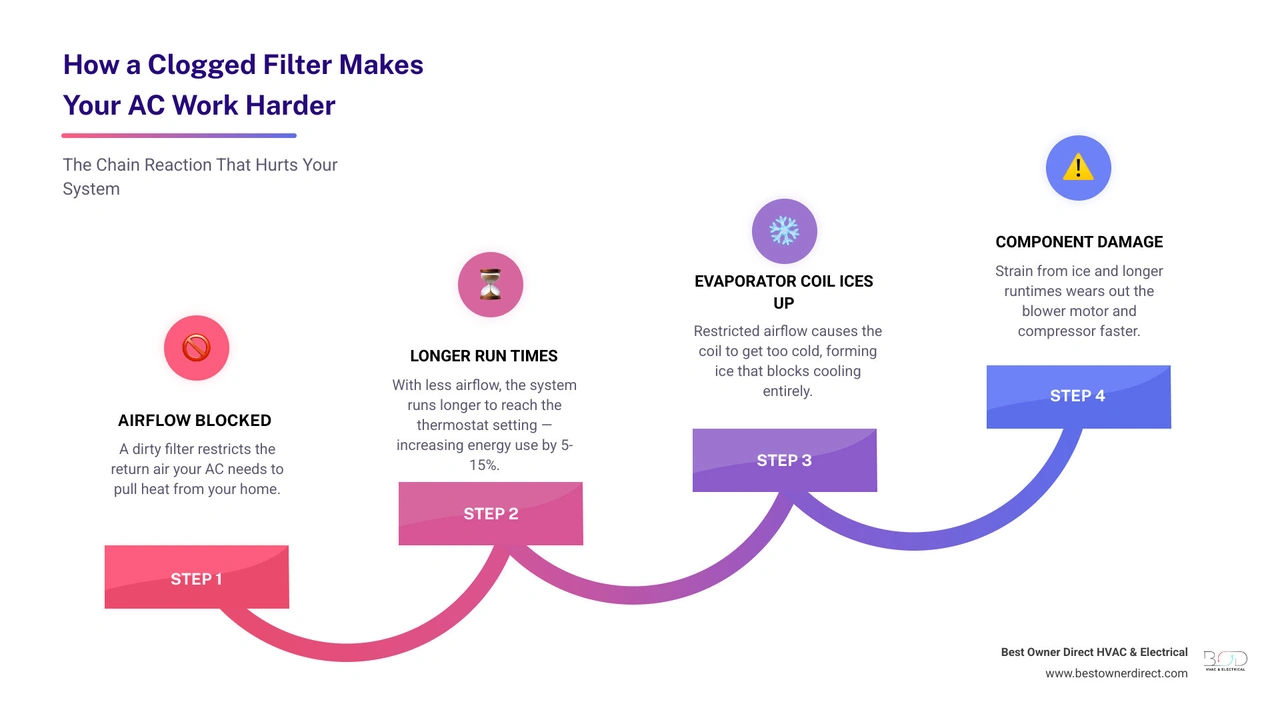
How a clogged filter makes your ac work harder further reading:
Why Airflow is Critical to Your Air Conditioning System
To understand how a dirty filter disrupts your home comfort, it helps to understand how an air conditioner actually works. Many people believe that an AC creates cold air out of nothing and pumps it into the house. In reality, your air conditioner is a heat-moving machine. It doesn't create cold; it removes heat.
Your air conditioning system relies on a continuous loop of air circulation to keep your home cool. The process looks like this:
- Warm indoor air is pulled into the system through return vents.
- The air passes through the air filter to trap dust, pet dander, and other airborne particles.
- The clean air flows over the cold indoor evaporator coil, where refrigerant absorbs the heat and moisture.
- The cooled, dehumidified air is pushed by the blower fan back into your living spaces through the supply registers.
- The absorbed heat is transferred to the outdoor condenser unit and released outside.
For this cycle of heat transfer to work, your system requires a steady, unrestricted volume of air moving across the evaporator coil. If the blower fan cannot pull enough air through the return registers because of a physical barrier, the entire cooling process breaks down. This is why keeping up with a routine AC Maintenance Tune-Up is so vital for your system's health.
How a Clogged Filter Makes Your AC Work Harder
When an air filter becomes packed with airborne debris, it creates a high level of resistance against the air trying to pass through. In technical terms, this increases the "static pressure" within your ductwork. Static pressure is the resistance to airflow within your heating and cooling system.
When static pressure rises, your blower fan has to fight much harder to pull and push air. This restriction triggers a domino effect of system strain, reduced performance, and spiked energy consumption. To see how these issues compound over a single cooling season, check out our guide on How a Tune-Up Improves Efficiency and Lowers Bills.
The Mechanics of How a Clogged Filter Makes Your AC Work Harder
When you set your thermostat to a cool 72 degrees on a hot July afternoon in Hillsboro or Beaverton, your thermostat expects the AC to run for a standard cycle—usually 15 to 20 minutes—to reach that goal.
However, when a clogged filter restricts the airflow, only a fraction of the cooled air actually makes it back into your living spaces. Because the cool air is trickling out of your vents instead of blowing in a strong, steady stream, your home cools down at a snail's pace.
Your thermostat doesn't measure how hard your AC is struggling; it only measures the temperature of the room. Since the room is taking much longer to cool down, the thermostat keeps the system running. These extended runtimes directly translate to higher electricity bills. The U.S. Department of Energy reports that replacing a dirty, clogged filter with a clean one can lower your air conditioner's energy consumption by 5 to 15 percent.
Frozen Evaporator Coils and Blower Motor Strain
The consequences of restricted airflow go far beyond a high electric bill. Inside your indoor unit sits the evaporator coil, which is filled with cold refrigerant. Under normal conditions, the warm air blowing over the coil transfers its heat to the refrigerant, keeping the coil just above freezing.
When a clogged filter blocks that warm air, the temperature of the evaporator coil drops rapidly. Without enough heat to absorb, any moisture condensing on the cold coil from your home's humid air will quickly freeze. This creates a layer of ice over the coil.
Once ice forms, it acts as an insulator, blocking whatever little airflow was left. This is a primary cause of system failure. If you suspect your system is suffering from this issue, you can read about the Common Symptoms of a Dirty Evaporator Coil.
Additionally, the blower motor must work under extreme stress to move air through the blocked filter. This continuous struggle causes the motor to overheat, which can lead to burnt-out electrical components, mechanical failure, and eventually, severe compressor damage.
Signs of Restricted Airflow and System Strain
Because your air filter is usually tucked away inside a utility closet, basement, or ceiling return grate, it's easy to forget about it. However, your air conditioner will drop several hints when its airflow is being choked off. Recognizing these AC Repair Signs early can save you from a major breakdown during a summer heatwave.
Signs That Show How a Clogged Filter Makes Your AC Work Harder
If your system is working overtime due to a dirty filter, watch out for these common warning signs:
- Lukewarm air from vents: The air coming out of your supply registers feels weak and barely cool rather than crisp and cold.
- Uneven temperatures: Some rooms in your home feel like iceboxes while others remain uncomfortably warm.
- Short cycling: Your AC turns on and off rapidly without ever completing a full cooling cycle. This happens when the system overheats and shuts down as a safety precaution.
- Excessive indoor dust: A dirty filter can no longer trap particles, allowing dust, pet hair, and pollen to bypass the filter and settle all over your furniture.
- Musty odors: Moisture trapped on a frozen or damp evaporator coil can lead to mold and mildew growth, creating a "dirty sock" smell when the system runs.
- Constant running: Your AC runs continuously for hours on end without ever meeting your thermostat settings.
When to Check Your Filter vs. Calling a Professional
Before you pick up the phone to call for service, there are a few simple troubleshooting steps you can perform safely at home. If you notice weak airflow or warm air:
- Perform a visual inspection: Turn off your thermostat and slide the air filter out. If it is covered in a thick, gray blanket of dust and pet hair, it needs to be replaced.
- Try the light test: Hold your filter up to a bright light bulb or look through it toward a window. If you cannot see any light passing through the fibers, the filter is completely plugged and must be discarded.
- Check for ice: Look at the copper refrigerant lines going into your indoor unit. If you see ice forming on the pipes or the evaporator coil cabinet, shut the system off immediately at the thermostat.
- Allow the system to thaw: Leave the system off for at least an hour or two to let the ice melt completely. Running the system with frozen coils can destroy your compressor. Once thawed, replace the filter with a fresh one and turn the system back on.
If you have replaced the filter, cleared your vents, and your system still blows lukewarm air or continues to freeze up, it's time to call in a professional. For more self-checks, read through our AC Troubleshooting Tips Before Calling a Professional.
Choosing the Right Filter and Maintenance Schedule
When it comes to air filters, more expensive is not always better. Many homeowners make the mistake of buying the thickest, highest-rated filter on the shelf, thinking it will give them the cleanest air. However, if your system isn't designed to handle that level of filtration, a brand-new high-efficiency filter can restrict airflow just as badly as a clogged dirty filter.
Finding the right balance between filtration and airflow is a key part of your seasonal preventative care, as highlighted in our AC Tune-Up Checklist: What Your Technician Should Check.
Understanding MERV Ratings and Airflow Balance
Air filters are rated using the Minimum Efficiency Reporting Value (MERV) scale. This scale ranges from 1 to 16 for residential systems, measuring how effectively a filter traps particles of various sizes.
| Filter Type | MERV Rating | What It Traps | Airflow Impact | Best Use Case |
|---|---|---|---|---|
| Basic Fiberglass | MERV 1–4 | Large dust particles, lint | Extremely low resistance | Minimal protection; mostly protects system components rather than air quality. |
| Standard Pleated | MERV 5–8 | Dust mites, pollen, mold spores, pet dander | Low to moderate resistance | The residential sweet spot. Excellent balance of filtration and healthy airflow. |
| High-Efficiency Pleated | MERV 9–12 | Fine dust, pet dander, smog, auto emissions | Moderate resistance | Great for allergy sufferers; ensure your HVAC system can handle the static pressure. |
| HEPA / Maximum Filtration | MERV 13–16 | Bacteria, tobacco smoke, microscopic allergens | High resistance | Often too restrictive for standard residential blowers without modifications. |
For most standard homes in the Portland metro area, a MERV 8 or MERV 11 pleated filter offers the perfect balance. It keeps your indoor air clean while allowing your AC blower fan to breathe easily.
Recommended Filter Replacement Intervals
There is no single rule for how often you should change your filter, as it depends heavily on your household's lifestyle and environment. However, here are some general guidelines:
- Standard homes without pets: Replace your filter every 60 to 90 days.
- Homes with one or more pets: Replace your filter every 30 to 60 days to keep up with shedding fur and dander.
- Allergy or asthma sufferers: Replace your filter every 30 days to minimize airborne triggers.
- Peak summer and winter seasons: Check your filter monthly. When your system is running constantly during hot July stretches, it accumulates dust much faster than during mild spring months.
Frequently Asked Questions About AC Air Filters
Can I run my AC without a filter for a short time?
No, you should never run your air conditioner without a filter, even for a few hours. The filter's primary job is to protect the sensitive internal components of your HVAC system. Running your system without a filter allows airborne dust, hair, and debris to settle directly onto your cold, wet evaporator coil and the blower wheel. This can quickly clog the coil, reduce heat transfer, damage the blower motor, and lead to poor indoor air quality.
Will a new filter fix weak AC airflow?
If your old filter was heavily clogged, replacing it with a fresh one will often restore your system's airflow immediately. However, if you install a clean filter and the air coming out of your vents still feels weak, you may be dealing with other underlying issues. Common culprits include disconnected or leaky ductwork, a failing blower motor capacitor, dirty evaporator coils, or a system that has low refrigerant. If a filter swap doesn't resolve the issue, a professional diagnostic is highly recommended.
Why does my air filter get dirty so fast?
If you find yourself replacing your filter every couple of weeks because it is completely gray and dusty, several factors could be at play:
- Shedding pets: Multiple dogs or cats will rapidly fill a filter with fur and dander.
- Leaky return ducts: If your return ductwork has cracks or gaps, it can pull in dusty, dirty air from unconditioned spaces like your attic, crawlspace, or basement, clogging your filter ahead of schedule.
- Recent home renovations: Drywall dust, sawing debris, and floor sanding can overload a filter in a matter of days.
- High outdoor pollen or smoke: During peak pollen seasons or wildfire events in Oregon, your indoor air filter has to work much harder to capture incoming particles.
Conclusion
At Best Owner Direct HVAC & Electrical, we want to help you keep your home comfortable, safe, and energy-efficient. Operating out of Cornelius, OR, and serving homeowners across the entire Portland metro area—including Hillsboro, Beaverton, Tualatin, and West Linn—we know exactly how local weather patterns and indoor air quality factors impact your heating and cooling equipment.
Taking care of your air filter is one of the simplest, most cost-effective ways to protect your comfort and prevent expensive breakdowns. If you are experiencing weak airflow, uneven cooling, or want to make sure your system is ready to tackle the summer heat of July 2026, we are here to help.
For professional assistance, check out our Indoor Air Quality Services in Beaverton or schedule a seasonal check-up with our team for AC Maintenance Hillsboro OR. Contact us today to keep your home comfort running smoothly!


How Cornelius Homes Handle Peak Summer AC Loads on Older Electrical PanelsModern AC units often overwhelm aging 1970s electrical panels during intense summer heat. Review the warning signs and specific upgrades needed to keep your home safely cooled.
Read more

The Electrical Toll of a Struggling HVAC System on Your Home's BreakersAn aging air conditioner does not just lose cooling power; it actively stresses your electrical panel. A tripping breaker during late summer heat is a warning sign requiring professional diagnosis.
Read more
End-of-Summer Electrical Inspections: Checking Outdoor Disconnect BoxesAfter months of intense Pacific Northwest sun, your outdoor AC disconnect box can become brittle and unsafe. Learn the visual warning signs of UV degradation.
Read more