Menu


Which Water Heater Type Qualifies for the Best Rebates Right Now?
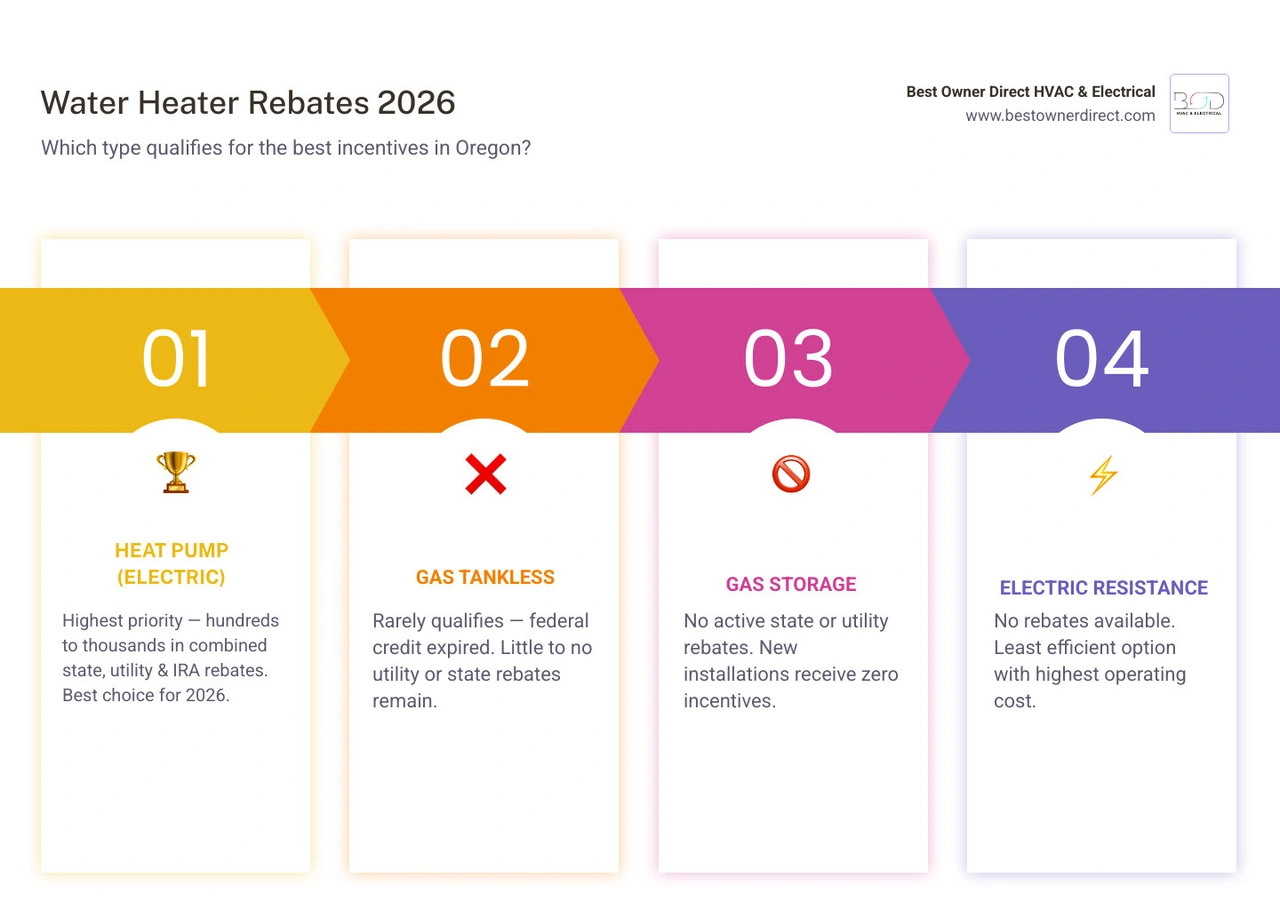
Which water heater type qualifies for the best rebates in 2026 has a clear answer: electric heat pump water heaters. They dominate every major rebate program available to Oregon homeowners this year. Here is a quick breakdown:
| Water Heater Type | Qualifies for Best Rebates? | Typical Incentive Range |
|---|---|---|
| Electric Heat Pump | Yes — highest priority | Hundreds to thousands of dollars combined |
| Gas Tankless | Rarely | Little to no rebates in 2026 |
| Gas Storage | No | No active state or utility rebates |
| Standard Electric Resistance | No | No rebates |
Water heating accounts for roughly 20% of the average home's energy use — making it the second-largest energy expense most households carry. That is a significant cost center, and it is exactly why utilities, states, and federal programs have poured incentives into pushing homeowners toward more efficient technology.
But here is the problem most homeowners run into: the rebate landscape shifted dramatically heading into 2026. The federal Section 25C energy efficiency tax credit — which previously covered 30% of a heat pump water heater's cost up to $2,000 — expired for any equipment placed in service after December 31, 2025. It was repealed by the One Big Beautiful Bill Act signed in July 2025, and industry analysts do not expect it to return anytime soon.
That does not mean the savings are gone. State programs, utility rebates, and IRA-funded HEEHRA rebates are still very much active in Oregon and across the country — but they almost exclusively favor heat pump water heaters. Gas tankless systems, which once qualified for a modest $600 federal tax credit, now qualify for almost nothing.
If you are a homeowner in the Portland metro area — whether you are in Hillsboro, Beaverton, Forest Grove, or Cornelius — understanding which programs are still open, which have expired, and exactly what documentation you need is the difference between saving hundreds of dollars and losing the rebate entirely.
I'm Chandrine Stepisnik, and in this guide I will walk you through the complete eligibility checklist so you can claim every dollar available to you.
Basic which water heater type qualifies for the best rebates vocab:
- Gas vs Electric vs Heat Pump Water Heater Comparison
- How Heat Pump Water Heaters are the Most Efficient Option
- Operating Cost Comparison Gas vs Electric vs Heat Pump
Which Water Heater Type Qualifies for the Best Rebates in 2026?
When we look closely at the various types of water heating systems available today, we see a massive divergence in how programs treat them. The clear winner is the electric heat pump water heater (HPWH), often called a hybrid water heater. Because these units pull heat from the surrounding air and transfer it into the water tank rather than generating heat directly, they are incredibly efficient.
In fact, heat pump water heaters are two to three times more energy efficient than conventional electric resistance models. This unmatched level of efficiency is the primary reason why local utilities and state programs focus their funding almost entirely on this technology.
By choosing a hybrid system, homeowners can access substantial local utility rebates and state-level environmental program incentives. You can read more about these mechanisms in our guide on Heat Pump Water Heater Benefits for Homeowners.
Conversely, gas tankless systems have faced a steady decline in rebate support. While they are far more efficient than old-school gas tanks, the policy shift toward electrification has left gas-powered appliances with very few financial incentives. In 2026, gas tankless systems qualify for almost no state-level rebate programs in Oregon, as the focus has turned entirely to zero-emission and electric options.
Standard gas storage tanks and traditional electric resistance tanks do not qualify for any modern rebate programs. If you want to compare how these systems match up beyond just their financial incentives, check out our resource on Energy Efficient Water Heater Options Compared.
To qualify for the most valuable rebates, the water heater must meet strict efficiency standards. This is measured by the Uniform Energy Factor (UEF). For a heat pump water heater to qualify for top-tier incentives, it generally must be ENERGY STAR certified and achieve a high UEF rating. Checking these ratings before making a purchase is a vital step in securing your savings.

Understanding the 2026 Rebate Landscape: Federal, State, and Utility Programs
Navigating home efficiency incentives can feel like learning a new language. To maximize your savings, it is important to understand the three distinct layers of incentives: federal tax credits, state-administered programs, and utility-backed rebates.
First, let's address the federal level. With the expiration of the 25C tax credit at the end of 2025, there are no longer broad federal tax credits available for new 2026 water heater installations. If you completed an installation in 2025, you might still claim it on your tax return, but for new projects initiated this year, we must look to state and local utility programs. You can read a detailed history of these changes in our article on Federal Tax Credits for Heat Pump and Water Heater Upgrades.
Second, we have state-level programs funded by the federal Inflation Reduction Act (IRA), specifically the High-Efficiency Electric Home Rebate Act (HEEHRA). These programs are designed to provide direct, point-of-sale discounts for electric appliances, including heat pump water heaters. Because HEEHRA is administered at the state level, the rollout timeline and exact guidelines depend heavily on where you live. In Oregon, these programs are closely aligned with regional energy goals.
Third, and often the most reliable source of immediate savings, are utility-backed incentives. In our region, organizations like the Energy Trust of Oregon work alongside major utility providers to deliver cash incentives directly to homeowners. These incentives can often be applied as instant discounts by a certified contractor, meaning you do not have to wait months for a check in the mail. For a step-by-step breakdown of how these local programs operate, refer to our guide on How to Apply for Energy Rebates in Oregon.
How Heat Pumps Answer Which Water Heater Type Qualifies for the Best Rebates
To understand why heat pump water heaters receive such favorable treatment from rebate programs, we have to look at how they operate. Rather than using raw electrical energy to heat a metal element inside a tank, a heat pump water heater works like a refrigerator in reverse. It uses a compressor and a small amount of refrigerant to absorb ambient heat from the surrounding air and transfer it directly into the water.
This heat transfer technology allows the unit to deliver the same amount of hot water while using up to 75% less electricity than a standard model. It is a massive leap in efficiency that translates to significant utility bill savings. For example, a family of four switching from a standard electric resistance tank to a heat pump water heater can save approximately $600 per year on their electric bills.
Because of this superior performance, organizations like the Consortium for Energy Efficiency (CEE) place these units into advanced tiers, such as CEE Tier 2 or higher. Rebate programs use these tiers to determine incentive levels. The higher the tier and the more efficient the unit, the larger the rebate you can secure. If you are wondering whether this technology is a good fit for our local climate, we discuss the details in Is a Heat Pump Water Heater Worth It in Oregon.
Why Gas Tankless Systems Fall Short of Which Water Heater Type Qualifies for the Best Rebates
For many years, gas tankless water heaters were considered the gold standard for energy-efficient upgrades. They provide hot water on demand, have a long lifespan, and eliminate the standby energy loss associated with keeping a large tank of water hot all day.
However, the policy landscape has shifted. State and local governments across the Pacific Northwest are actively pursuing electrification goals to reduce residential fossil fuel consumption. As a result, gas-powered appliances — even highly efficient tankless models — are being systematically phased out of incentive structures.
While some natural gas utilities still offer modest rebates for upgrading an old gas tank to a high-efficiency gas tankless unit with a UEF of 0.95 or higher, these incentives pale in comparison to those available for heat pumps. If your goal is to maximize the amount of rebate money you receive to offset your upfront installation costs, gas tankless systems simply cannot compete in the current regulatory environment.
Ultimate Checklist for Water Heater Rebate Eligibility in Oregon
To ensure you do not leave any money on the table, we have compiled the ultimate checklist for securing your water heater rebates. Meeting these criteria is essential, as even a minor oversight can lead to a rejected application.
- Verify Your Utility Provider: Your home must be served by a participating utility. In Oregon, the Energy Trust of Oregon partners with Portland General Electric (PGE), Pacific Power, NW Natural, Cascade Natural Gas, and Avista.
- Choose an ENERGY STAR Certified Model: The unit you purchase must be actively listed on the ENERGY STAR certified products list at the exact time of installation and meet the minimum UEF requirements.
- Hire a Licensed Trade Ally Contractor: To qualify for the best rebates, the system must be installed by a licensed professional. Using an approved Trade Ally contractor ensures the work meets all local building codes and program guidelines.
- Keep All Documentation: You will need your detailed, itemized installation invoice, the manufacturer's specification sheet showing the model number and UEF, and a copy of the approved building permit.
- Submit Within the 60-Day Window: For mail-in or online utility rebates, your completed application and supporting documents must be received within 60 days of the installation date.
If you are planning an upgrade in the Portland metro area, we can help you navigate this process seamlessly. Our teams are highly experienced with local installations, whether you need a Water Heater Replacement Hillsboro OR or are exploring high-efficiency Tankless Water Heaters Beaverton OR.
Income Limits and HEEHRA Guidelines
The Inflation Reduction Act's HEEHRA program is designed to make energy-efficient upgrades accessible to everyone, with a specific focus on low-to-moderate-income households. Eligibility for these direct state-administered rebates is based on your household's Adjusted Gross Income (AGI) compared to the Area Median Income (AMI) of your county.
Under these guidelines:
- Low-Income Households (Under 80% AMI): Qualify for the maximum rebate amount, which can cover up to 100% of the purchase and installation costs for a qualifying heat pump water heater, up to a designated program cap.
- Moderate-Income Households (80% to 150% AMI): Qualify for a partial rebate, typically covering up to 50% of the project costs up to the program cap.
- Higher-Income Households (Above 150% AMI): Do not qualify for the income-restricted HEEHRA rebates but remain fully eligible for local utility incentives and promotions.
Understanding where your household falls on this spectrum allows you to plan your project budget accurately. We break down these income tiers and local stacking strategies further in our guide to Heat Pump Water Heater Rebates and Incentives.
Common Mistakes That Void Your Rebate Eligibility
Every year, homeowners miss out on hundreds of dollars in savings due to simple, avoidable errors. One of the most common mistakes is attempting a DIY installation. While doing the work yourself might seem like a way to save on labor, almost all utility and state rebate programs strictly require professional installation by a licensed contractor to ensure safety and performance.
Another frequent pitfall is choosing non-certified equipment. Just because a water heater is modern or labeled "efficient" by a retailer does not mean it meets the precise UEF standards required by local programs. Always double-check the qualifying products list before buying.
Finally, timing is everything. Many homeowners forget to submit their paperwork or wait until after the program's strict deadline has passed. For example, the Energy Trust of Oregon requires all applications to be submitted within 60 days of installation. Waiting too long means forfeiting your rebate. To make sure you select a system that is perfectly suited for our climate and fully eligible for local programs, consult our guide on the Best Water Heater Type for the Pacific Northwest.
Frequently Asked Questions About Water Heater Rebates
Do DIY installations qualify for any water heater rebates?
In almost all cases, no. DIY installations do not qualify for utility or state-administered rebates. Program administrators require professional installation to guarantee that the system is installed safely, complies with local plumbing and electrical codes, and operates at its rated efficiency.
Furthermore, attempting a DIY installation often voids the manufacturer's warranty. If a component fails prematurely due to an installation error, you could be left responsible for the full cost of repairs. Hiring a licensed professional protects your investment, ensures permit compliance, and secures your rebate eligibility.
How long does it take to receive rebate payments after installation?
The timeline for receiving your rebate depends on the application path you choose. If you work with a certified Trade Ally contractor who can apply the rebate as an instant, point-of-sale discount, you receive the savings immediately on your installation invoice. This is the fastest and most convenient method.
If you must submit a mail-in or online application after the installation is complete, standard processing times typically range from six to eight weeks. During peak times of the year, or if your application is missing required documentation like an itemized invoice or UEF certification, the review process can take up to twelve weeks.
Can I stack multiple rebates to maximize my savings?
Yes, in many cases you can stack different incentives to maximize your overall savings. For example, you can often combine local utility cash incentives with state-level clean energy programs.
However, there are specific rules you must follow. When stacking programs, the total incentive amount cannot exceed the total cost of the project. Additionally, some state programs require your contractor to calculate a reduced cost basis so that you do not claim double incentives on the exact same portion of the installation cost. Working with an experienced contractor who understands these stacking rules is the best way to ensure you get the maximum legal savings.
Conclusion
Upgrading your home's water heater is one of the smartest ways to lower your monthly energy bills and improve your home's overall efficiency. By choosing a high-efficiency electric heat pump water heater, you align your home with the technology that qualifies for the absolute best rebates available today.
At Best Owner Direct HVAC & Electrical, we are proud to serve families throughout Cornelius, Hillsboro, Beaverton, Portland, and the surrounding communities. Our experienced, licensed technicians are here to help you select the perfect system for your household, handle the professional installation safely, and ensure you maximize every available local utility rebate.
If you are ready to upgrade to a highly efficient system and want to learn more about how we can help you save, visit our dedicated Water Heater service page or contact us today to schedule your consultation!


How Cornelius Homes Handle Peak Summer AC Loads on Older Electrical PanelsModern AC units often overwhelm aging 1970s electrical panels during intense summer heat. Review the warning signs and specific upgrades needed to keep your home safely cooled.
Read more
The Electrical Toll of a Struggling HVAC System on Your Home's BreakersAn aging air conditioner does not just lose cooling power; it actively stresses your electrical panel. A tripping breaker during late summer heat is a warning sign requiring professional diagnosis.
Read more
End-of-Summer Electrical Inspections: Checking Outdoor Disconnect BoxesAfter months of intense Pacific Northwest sun, your outdoor AC disconnect box can become brittle and unsafe. Learn the visual warning signs of UV degradation.
Read more